There are seven ways to put money into real estate: rent out a flat, buy a new-build off plan to resell, take an apartment or a hotel room, buy commercial premises, join a closed-end real estate fund (ZPIF) or an investment platform, buy resort property abroad, or take a share in a hotel company.
On one sum, 15.5 million rubles ($190,000 at the Bank of Russia rate on 4 November 2026), a year after costs and tax leaves from 3.8% (a Moscow flat) to 15.9% (a share in a hotel, by the model). A deposit leaves 11.5%. Data as of 4 November 2026.
How much real estate investment returns in 2026: one sum, seven ways
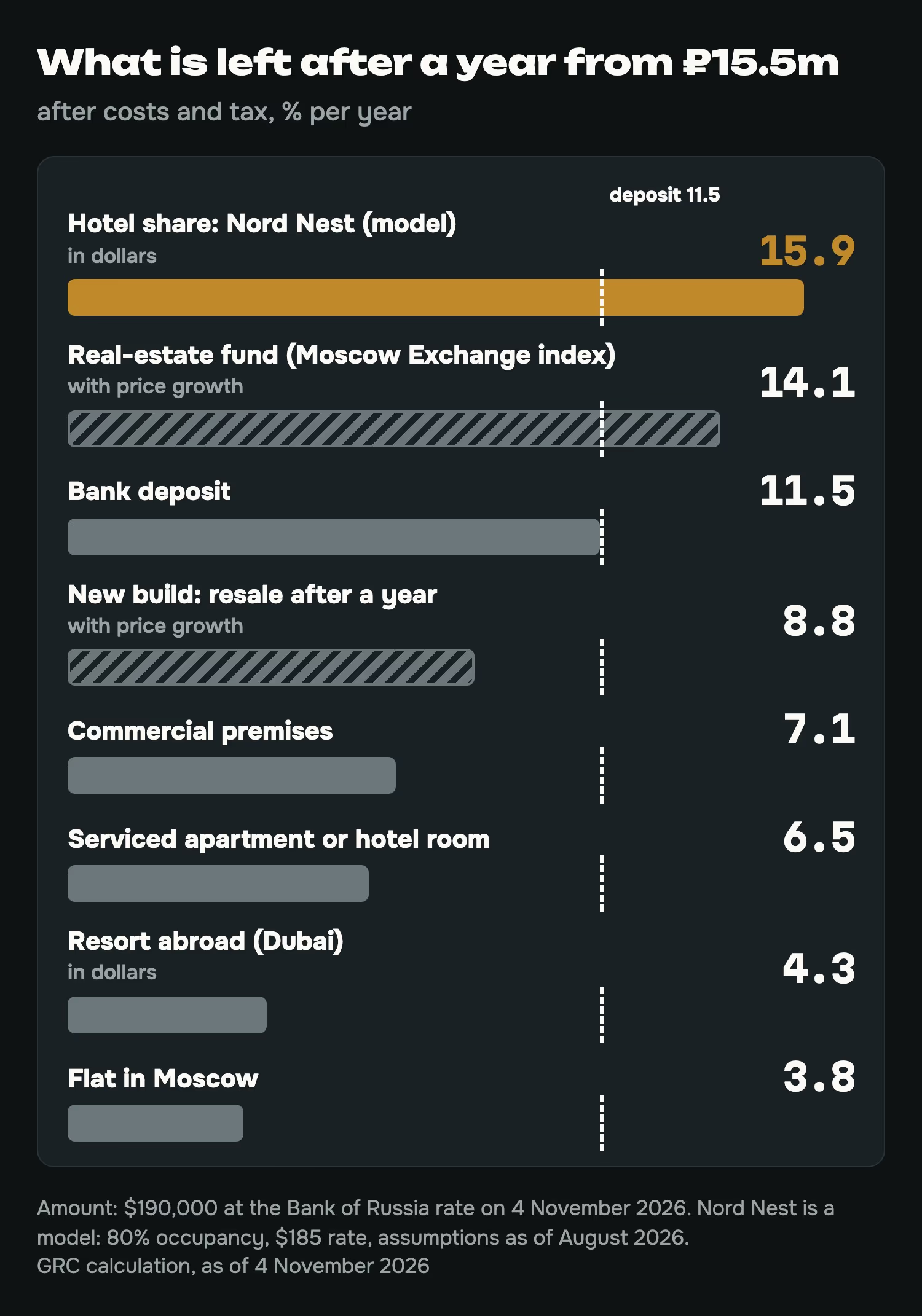
We took one sum and looked at what is left in your pocket after a year. The sum equals the entry into a Nord Nest share: $190,000, or 15.5 million rubles at the Bank of Russia rate on 4 November 2026.
How we counted: income minus costs minus tax for a Russian tax resident, on the income-tax scale: 13% up to 2.4 million rubles a year, 15% up to 5 million, 18% up to 20 million. The person has no other income in the calculation.
Growth in the property’s price is not counted as income. There are two exceptions. The fund: its index does not separate share growth from payouts. And the new-build: it has no other income, so we count a resale after one year.
Vacancy, repairs and agent fees are not deducted for the flat, because there is no primary source for them. Real results for the flat and the apartment will be lower.
The full calculation is available as a file.
By result, the order is: Nord Nest 15.9% (model), fund 14.1%, deposit 11.5%, new-build 8.8%, commercial premises 7.1%, apartments 6.5%, Dubai 4.3%, Moscow flat 3.8%. Now one by one.
Seven ways side by side: what you need to enter and how you get out
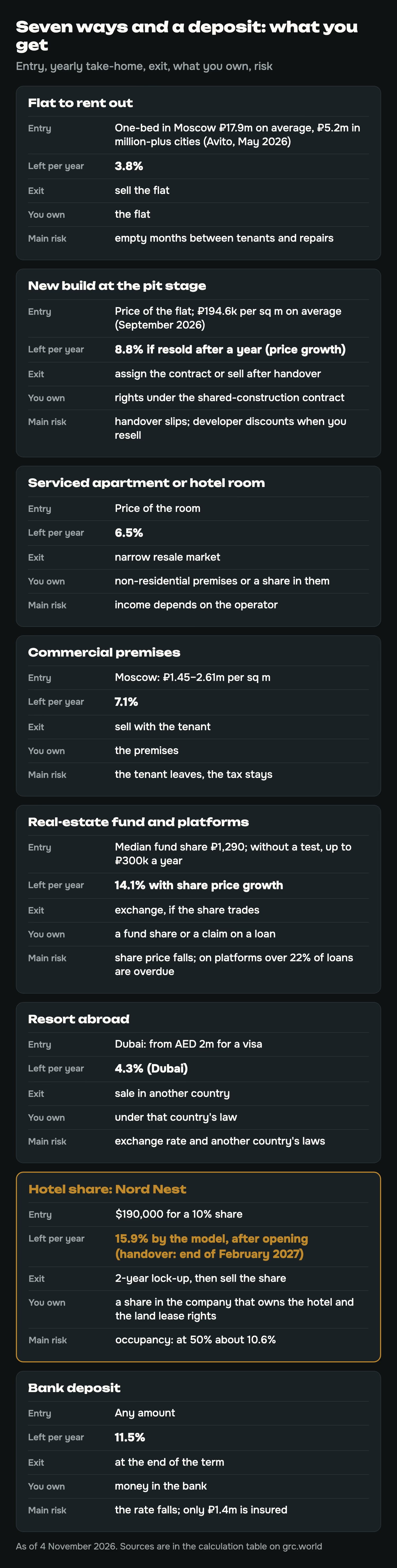
The ways differ in more than income: in the entry sum, the exit and what is registered in your name.
A flat or commercial premises is property outright, and you enter with a large sum. Funds and platforms let you in with a small amount, but you own a fund share or a claim on a loan, not walls. A hotel share is a share in a company that owns the hotel and the land lease.
Exits differ too. A flat sells over months, a closed-end fund share can be sold on the exchange if the issue is admitted to trading, and a hotel share goes by the rules of the deal. We did not measure days to sell for flats and apartments, so we give no figure.
1. A flat to rent out
This is the most familiar way and the most modest in income. The gross yield of a one-bedroom flat in Moscow is 4.1%: rent of 60,500 rubles a month on an average price of 17.9 million rubles (Avito, RBC calculation, early May 2026).
Note that 15.5 million rubles does not buy a one-bedroom in Moscow outright. In million-plus cities the yield is higher: 4.1–6.6%, at an average one-bedroom price of 5.2 million rubles.
After property tax and tax on rent, 3.8% is left. The professional income tax (for the self-employed) on letting a flat to an individual is 4%, with an income cap of 2.4 million rubles a year (Federal Tax Service, 18 February 2026). Anyone renting without it pays income tax on the scale.
The price of one-bedrooms in Moscow rose 23.4% in a year (May 2026 vs May 2025, Avito asking prices), but that growth is not counted: you get it only on sale. Vacancy between tenants and repairs are also yours.
Ownership is the most direct here: the flat is registered in your name.
2. A new-build off plan to resell

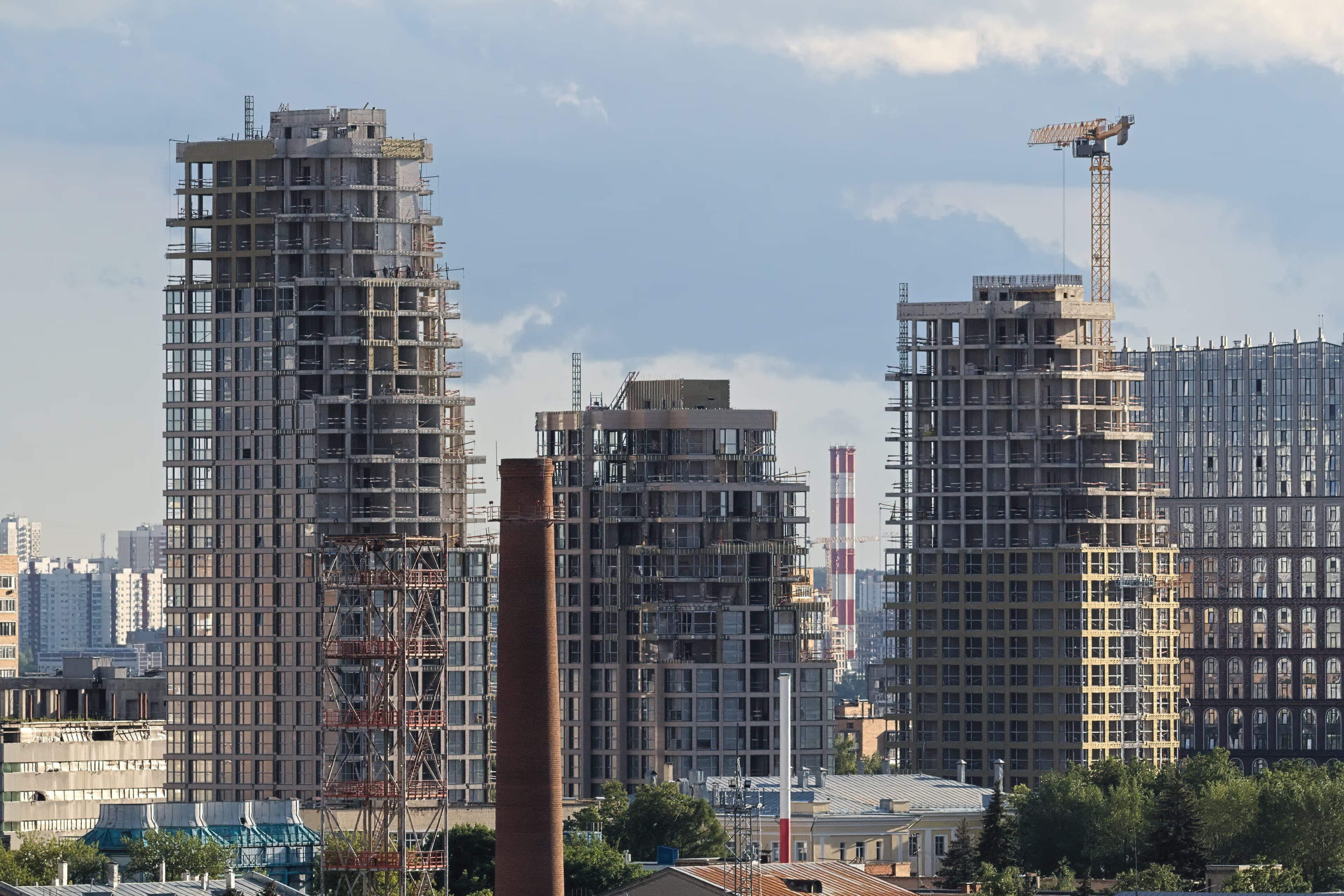
While the building goes up, there is no income at all. You pay and wait.
The gain comes with the price.
The average price per square metre of new-builds in Russia is 194,600 rubles, up 10.1% in a year (September 2026 against September 2025, Domclick and Sber’s Centre for Financial Analytics, RBC Real Estate, 13 October 2026). In Moscow a metre costs 425,300 rubles.
Resale flats rose 12.1% over the same year.
If you resell after a year at the average price, after 13% tax on the gain you get 8.8%. That is a price rise, not income, and you receive it only on the day of sale.
The gap between asking price and deal price on new-builds is 15.2% across Russia and 32.2% in Moscow. When you resell, you compete with the developer’s own discounts.
Before the building is commissioned, you hold rights under a shared-construction contract. Liquidity depends on the market on the day you sell.
3. Apartments and a hotel room
Apartments and hotel rooms are sold as income property, but the income depends on the operator.
A consultant’s estimate puts operating yield at 7–9% before tax (Macon via RBC Krasnodar, 18 September 2025). Developers quote 12–20%. Those are their words, not a report.
Moscow, first half of 2026: occupancy 69.7%, room rate 11,100 rubles, income per available room 7,700 rubles, down 8% in a year (NF Group via Rossiyskaya Gazeta, 11 August 2026).
The management company takes 20–30% of revenue (an estimate by Delovoy Peterburg, 2 October 2025). Property tax is 0.5%, or 2% if the building is on the list, and apartments get no area deduction. On 15.5 million rubles, 6.5% is left.
Ownership is a non-residential premises, often a share or a right of use. One operator runs the hotel. Such rooms sell slowly on the secondary market, and payback in estimates is 8–10 years.
More in owning a hotel room.
4. Investing in commercial real estate
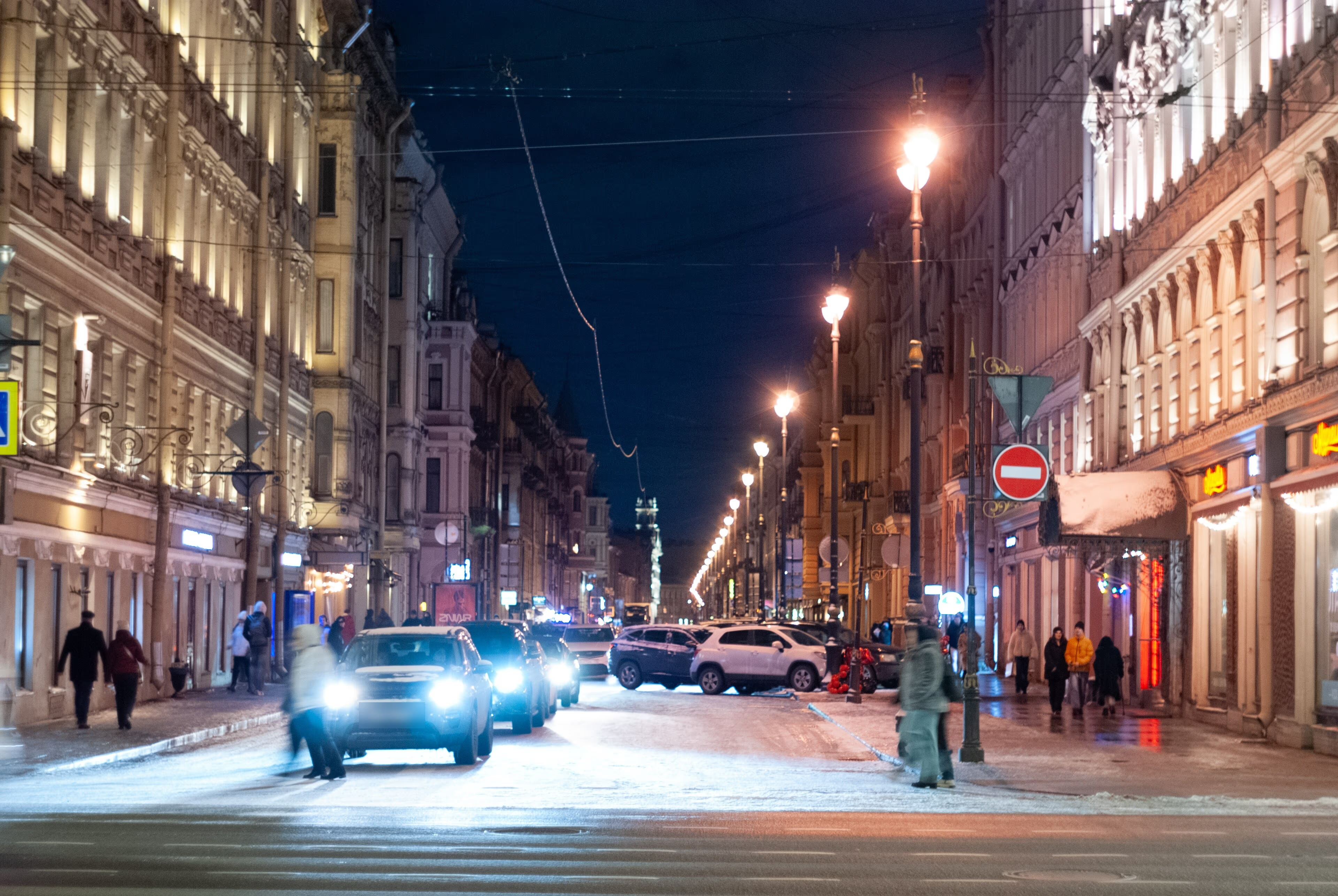
Commercial premises for a tenant is a shop, cafe or office on the ground floor. Its yield is measured by the capitalisation rate: annual rent divided by the price of the premises.
For Moscow street retail over 2025 and the first quarter of 2026 (NF Group via ShopAndMall, 20 April 2026): 6–8% in the centre, 8–10% on Tverskaya and Myasnitskaya, and 9–12% outside the centre. Five years ago the centre was 7–9%.
The average price of premises up to 100 sq m is 2.61 million rubles per sq m. On 15.5 million rubles that is about 6 sq m, so in the centre premises do not fit our sum.
We took the middle outside the centre, 10.5%. With property tax at the upper estimate (2%) and income tax of 13%, 7.1% is left. At 9% it comes to 5.8%, at 12% to 8.4%.
The main risk is a tenant who leaves. While the premises stand empty there is no income, and the tax is still due. Ownership is direct: the premises are registered in your name.
5. Real estate funds (ZPIF) and investment platforms
In a closed-end fund (ZPIF) you buy a share: a stake in the common property of a fund run by a management company. There is no entry threshold for non-qualified investors; the median share price in a sample of 50 issues is 1,290 rubles (23 October 2026).
The Moscow Exchange real estate fund index (with payouts) rose 16.19% in the year from 27 October 2025 to 3 November 2026. After 13–15% tax, 14.1% is left in our calculation.
The index is not any given fund: these are exchange-traded shares. It includes the rise in share prices, not only payouts. The management company’s fees, up to 10% of average annual asset value, are already in the share price.
Without passing a test, a non-qualified investor may put no more than 300,000 rubles a year into closed-end fund shares. After a passed test this limit does not apply.
Investment platforms allow no more than 600,000 rubles a year. Qualified status needs property of 24 million rubles or income of 12 million. So without the test or the status, 15.5 million rubles will not go into funds within a year.
Platforms have their own problem. Overdue debt is 7.2 billion rubles, more than 22% of all loans outstanding (Bank of Russia, 31 December 2025). You hold a claim on a loan or a security, not real estate.
A closed-end fund lives 3–15 years. Shares can be sold on the exchange if the issue is admitted, but we did not measure how fast. More in collective real estate investment.
6. Resort property abroad
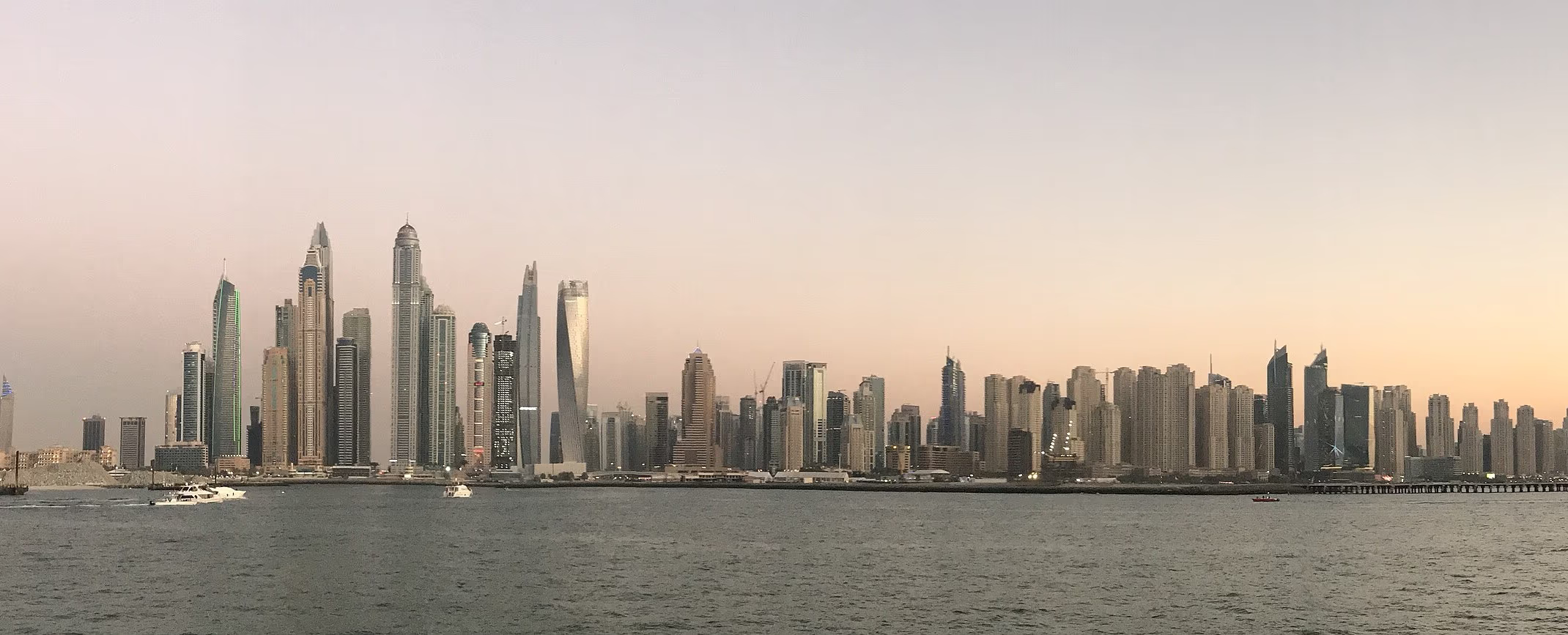
Income here is modest. For Dubai we took a gross yield of 4.94% for the UAE as a whole (Global Property Guide, second quarter 2026).
After Russian tax, 4.3% is left, and the owner’s costs are not included. Agency reviews give higher figures, 6.7–6.8%, but that is second-hand.
The entry threshold differs by country. Dubai: from AED 2 million for the Golden Visa.
Turkey: $400,000 for citizenship. Bali: the median villa price is $376,000 across 46 listings (27 October 2026).
Ownership differs too. Dubai has freehold in designated zones.
Bali has a land lease, Hak Pakai or a share in a company. In Thailand you can buy a condo flat but not land.
Purchase tax: Turkey 4%, Dubai 4%, Thailand 2%, Bali up to 5%. In Turkey the lira fell 16% against the dollar in a year, and inflation in September 2026 was 29.73%.
A comparison of four resorts is in investing in resort property.
7. A share in a hotel company
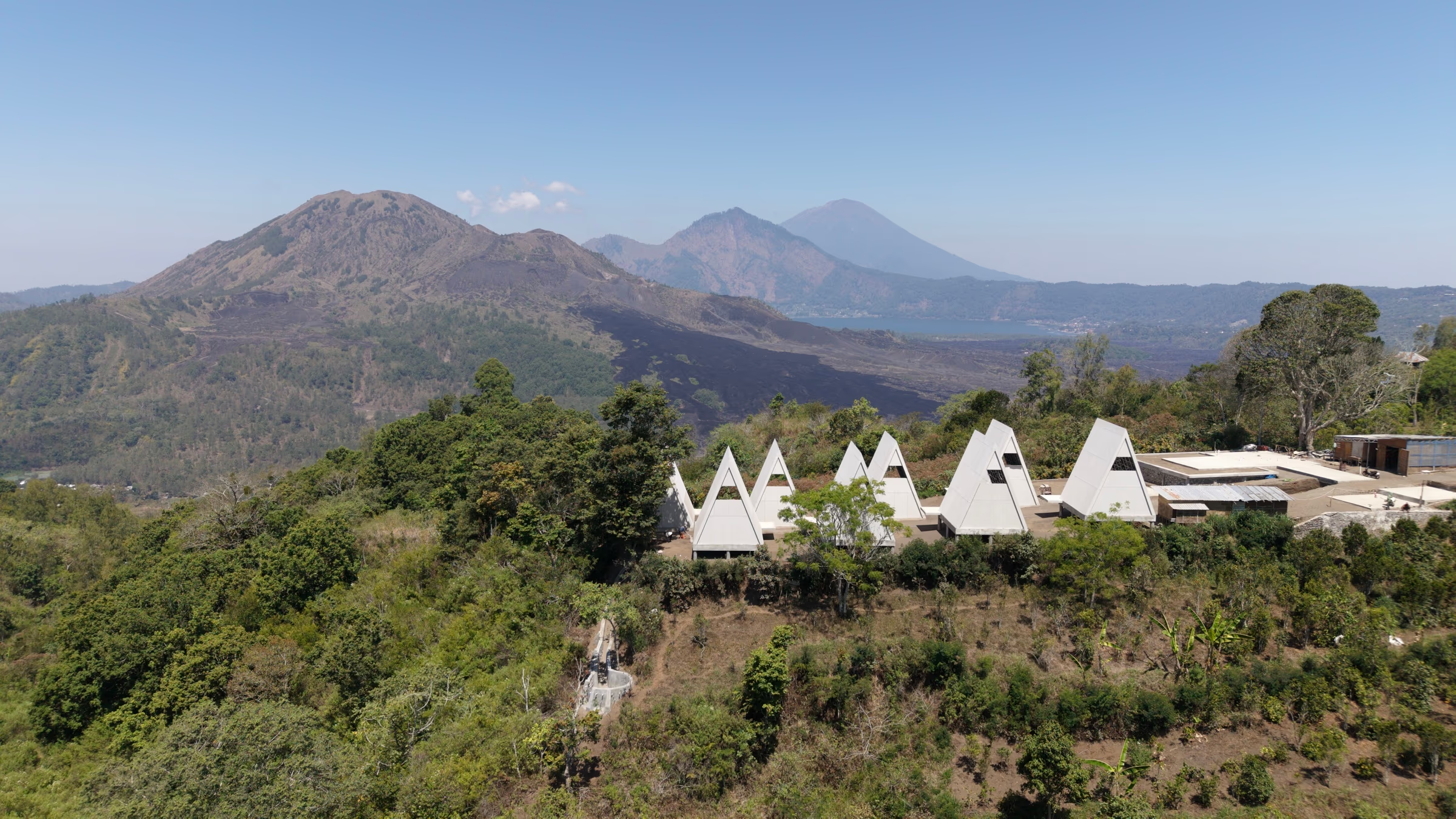
A share in a hotel company is a part of the company that owns the hotel and the land lease, not a villa in your name. Income comes from the hotel’s work: you receive a part of the distributable profit.
Here we describe our own project. Nord Nest: $190,000 for a 10% share. The model shows 18.7% a year at 80% villa occupancy and an average rate of $185 a night (assumptions as of August 2026).
The model counts a year of the open hotel’s operation; handover is planned for the end of February 2027.
Repairs and management are already deducted in the model. Payback by the model is 5.3 years.
At 50% occupancy the downside scenario gives about 12.5%. This is a model, not a promise: the actual result depends on occupancy and the nightly rate.
For the comparison we took a cautious tax: Indonesia withholds 15% on dividends, Russian tax is credited, and nothing more is due. That gives 15.9% after tax, and about 10.6% in the downside scenario. The tax in the calculation is an assumption.
Terms of the deal: lock-up of two years. After that the share can be sold with a right of first refusal: the other co-owners, including GRC, have 30 days to respond.
The land lease is 25 + 1 years. Handover is planned for the end of February 2027.
Details of the deal are on the Nord Nest page, the model is in finance, and who gets paid from a booking before the owner is in the queue for money. For other hotel investments, see investing in hotel real estate.
Real estate returns versus a deposit
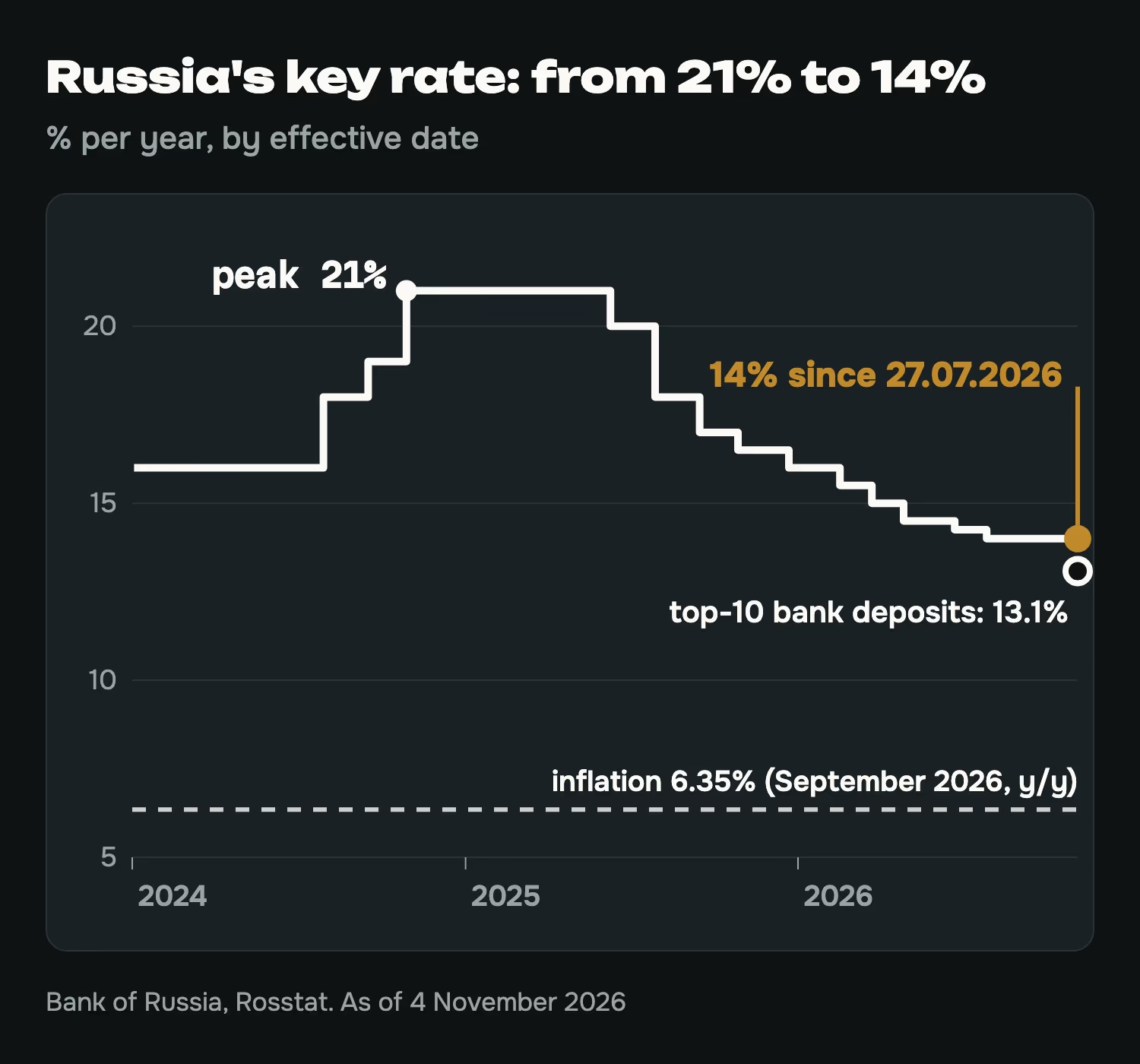
A deposit is the main rival of any property. The Bank of Russia key rate is 14% since 27 July 2026.
The average maximum rate at the ten largest deposit banks is 13.085% (last ten days of October 2026). After tax, a deposit of 15.5 million rubles gives 11.5%.
The rate is falling. It reached 21% on 28 October 2024 and has fallen 7 points since. At the end of December 2025 deposits paid 15.28%.
A one-year deposit locks in today’s rate, and later it will be different. The Bank of Russia forecasts an average key rate of 12.5–13.5% in 2027.
But the two cannot be compared head-on. Returns in rubles include ruble inflation: it was 6.35% in September 2026 (Rosstat, Bank of Russia database), and the Bank of Russia expects 7.1–7.6% for the year. The real return on a deposit before tax is about 6.7%.
For dollar income you do not subtract ruble inflation, but the ruble result depends on the exchange rate: over the year the dollar rose 1% (80.89 on 4 November 2025, 81.67 on 4 November 2026).
A deposit is insured up to 1.4 million rubles per bank. Out of 15.5 million, that is a small part.
We will cover the risks of each way in a separate article. Here it is only a comparison of income.
Questions and answers
Which real estate investments pay best in 2026?
In our calculation on 15.5 million rubles, a hotel share by the model (15.9%) and a fund (14.1%) lead. A deposit gives 11.5%. A Moscow flat gives 3.8%.
But each way has its own terms: a fund is capped at 300,000 rubles a year unless you pass the test, and a hotel share is a model, not a fact.
How much money do you need to start investing in real estate?
A ZPIF takes the price of one share, a median of 1,290 rubles, but without the test no more than 300,000 rubles a year. A flat or commercial premises take several million rubles. Entry into Nord Nest is $190,000 for a 10% share.
What is more liquid: a flat, a fund or a hotel share?
Easiest to exit is a fund share, if the issue is admitted to trading. A flat or premises sell more slowly, depending on the market. A hotel share can be sold after the two-year lock-up, with a right of first refusal for co-owners.
What tax is paid on real estate income?
A Russian resident pays income tax on the scale: 13% up to 2.4 million rubles of income a year, 15% up to 5 million, 18% up to 20 million. For letting a flat to an individual there is the self-employed tax of 4%. Property tax depends on the region and the type of property.
Income from property abroad is also taxed in Russia, and foreign tax can be credited under a treaty.
Is real estate better than a deposit?
A deposit gives 11.5% after tax now, but the rate is falling: at the end of December 2025 deposits paid 15.28%. Of the property options, only a fund and a hotel share beat a deposit in our calculation, and the rest return less. Price growth of the property is not part of this calculation, except for funds and new-builds.
What should you check before a deal?
Check who is selling and what exactly you get rights to. If you are looking at Bali, we have a checklist on how to check a developer in Bali. Compare the calculation’s assumptions with your own: the sum, your tax status and how long you can lock the money up.