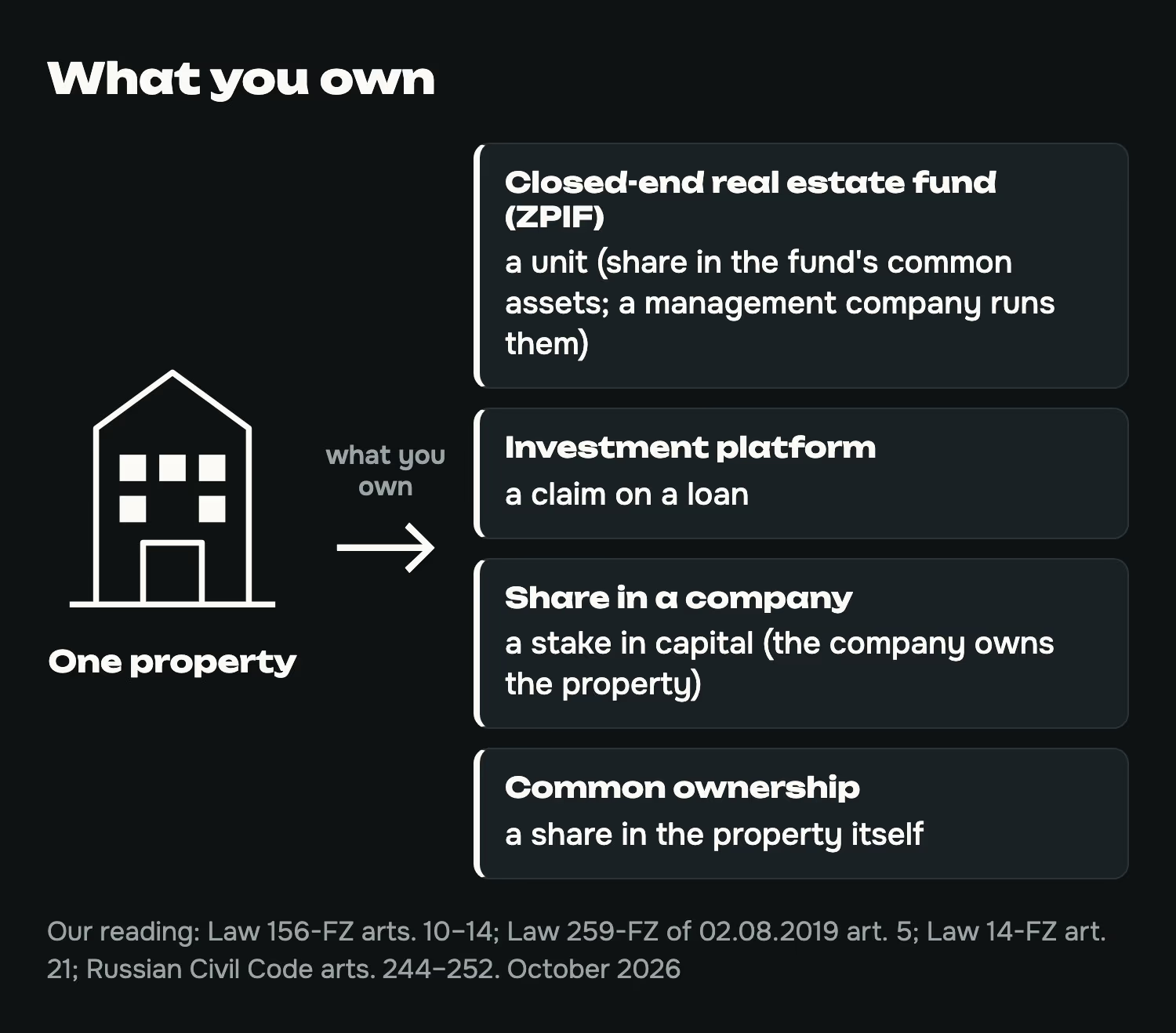
Collective real estate investment means several people putting money into one property or portfolio and sharing the income. There are four main formats: a unit of a closed-end real estate fund (a ZPIF, the Russian mutual fund structure), a loan through an investment platform, a share in the company that owns the property, and co-ownership of the property itself.
The key difference is what you own: a unit, a claim on a loan, a stake in a company or a share of the thing. That decides the limits, the tax, the exit and the main risk.
Data as of October 2026. The laws are Russian except where Indonesia is named. Where we interpret the law, it is our reading, and a lawyer should check it before any deal.
What collective real estate investment is
One person rarely buys a whole hotel, so people pool money. The legal form of that pooling decides whose property it is, who takes decisions and who stands in the line for the money.
The same villa can be bought jointly in four ways, and in law these are four different purchases.
Closed-end real estate fund (ZPIF): a unit in a fund
A unit is a security that certifies a share in the common ownership of the fund’s assets (Federal Law 156-FZ on investment funds, arts. 10 and 14). A management company runs the assets, not you. The law does not let you carve out your share in kind.
A closed fund lasts 3 to 15 years, and units are redeemed when it ends. Before that you can exit by selling the unit on the exchange, if the issue is admitted to trading. Liquidity differs between issues, and we did not measure it.
Limits for someone without qualified-investor status:
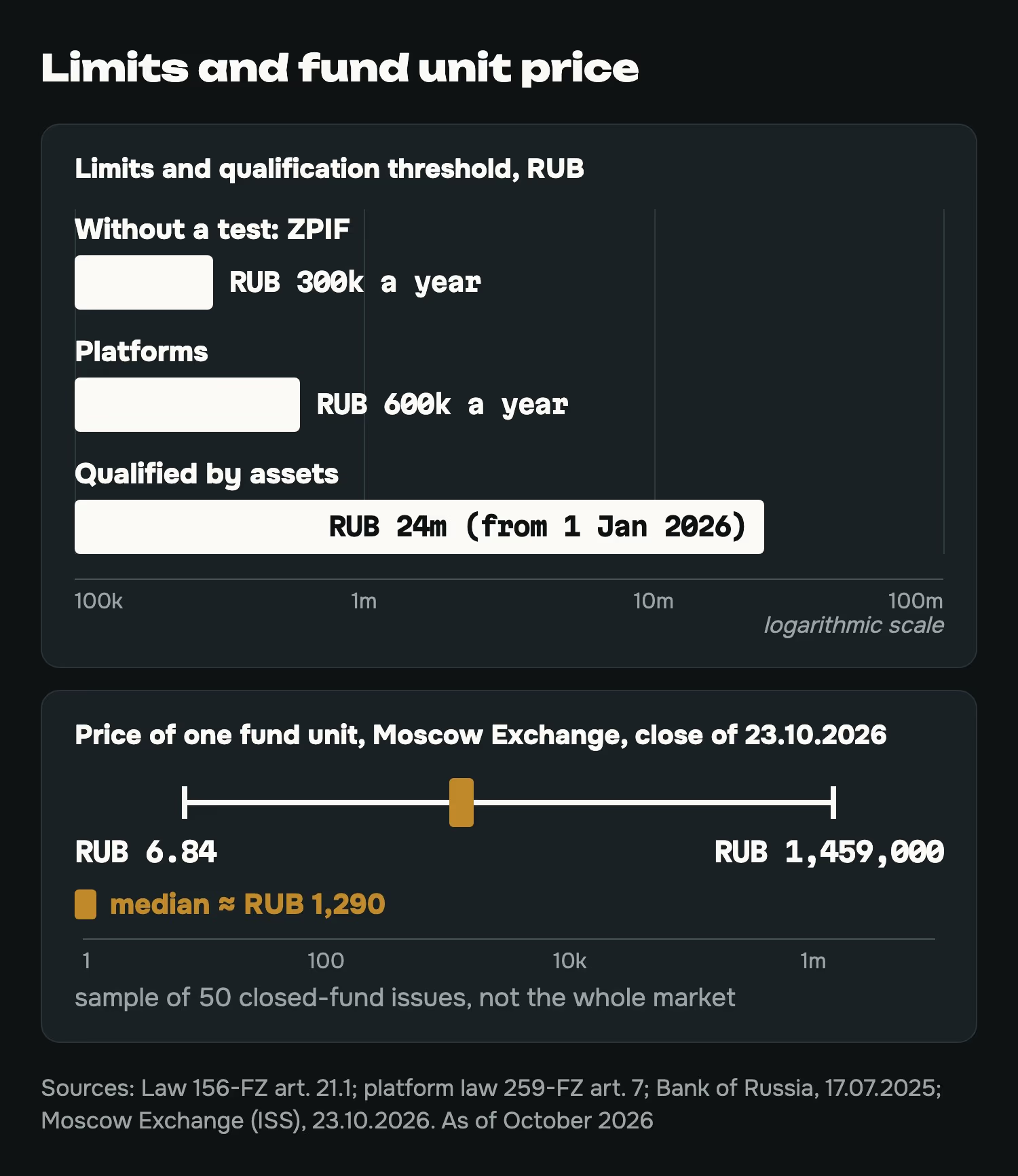
- without a passed test you can buy units of closed funds for no more than RUB 300,000 per calendar year (art. 21.1). That is a ceiling, not a minimum: since 1 October 2023 the Central Bank’s instruction No. 4129-U sets no minimum entry amount for real estate funds. No test is needed for units on the exchange’s quotation list or units that meet Bank of Russia requirements (our reading);
- an individual qualifies with assets of RUB 24 million from 1 January 2026, or income of RUB 12 million a year over two years. With education, a qualification or a test the thresholds are lower: RUB 12 million in assets and RUB 6 million in income (Bank of Russia, 17.07.2025).
The practical entry threshold is the price of one unit. We took 50 issues of closed-fund units on the Moscow Exchange, closing prices of 23.10.2026: from RUB 6.84 to RUB 1,459,000, with a median of about RUB 1,290.
We built the sample from words in fund names, so it does not cover the whole market, and some issues in it are not real estate or are open to qualified investors only.
Personal income tax on fund income is 13% up to RUB 2.4 million a year and 15% above that (Federal Tax Service table for 2025). The Bank of Russia reports that a law passed in July 2026 extends the long-term holding relief to fund units: from 3 years of ownership, relief up to RUB 3 million for each full year. We have not read the text of the law itself, so check the conditions.
In funds open to non-qualified investors, fees of the management company and other parties are capped at 10% of average net assets a year. Units restricted to qualified investors have no such cap (art. 41).
Fund units are not covered by Russian deposit insurance, which protects bank deposits up to RUB 1.4 million (Law 177-FZ, our reading). Two more risks are the term of up to 15 years and an exchange price that can sit below the valuation.
At 30.06.2026 Russia had 129 mass-market ZPIFs and 424,000 individual unit holders, and real estate accounted for 42% of their assets (Bank of Russia; “real estate” there means the word in the fund’s name).
Investment platforms: crowdfunding is a loan

Platforms work under Law 259-FZ of 02.08.2019. Since 1 September 2026 there are two ways to invest: loans and issued securities. Utility digital rights were removed from that list.
For property this is usually a loan to a developer or an owner. Collateral is a term of a particular deal; we found no such requirement in the platform law. What you hold is a claim on a loan, not a share of the building (our reading).
For a non-qualified investor the limit is RUB 600,000 a year across all platforms together. The operator checks it on your own statement and does not ask for documents.
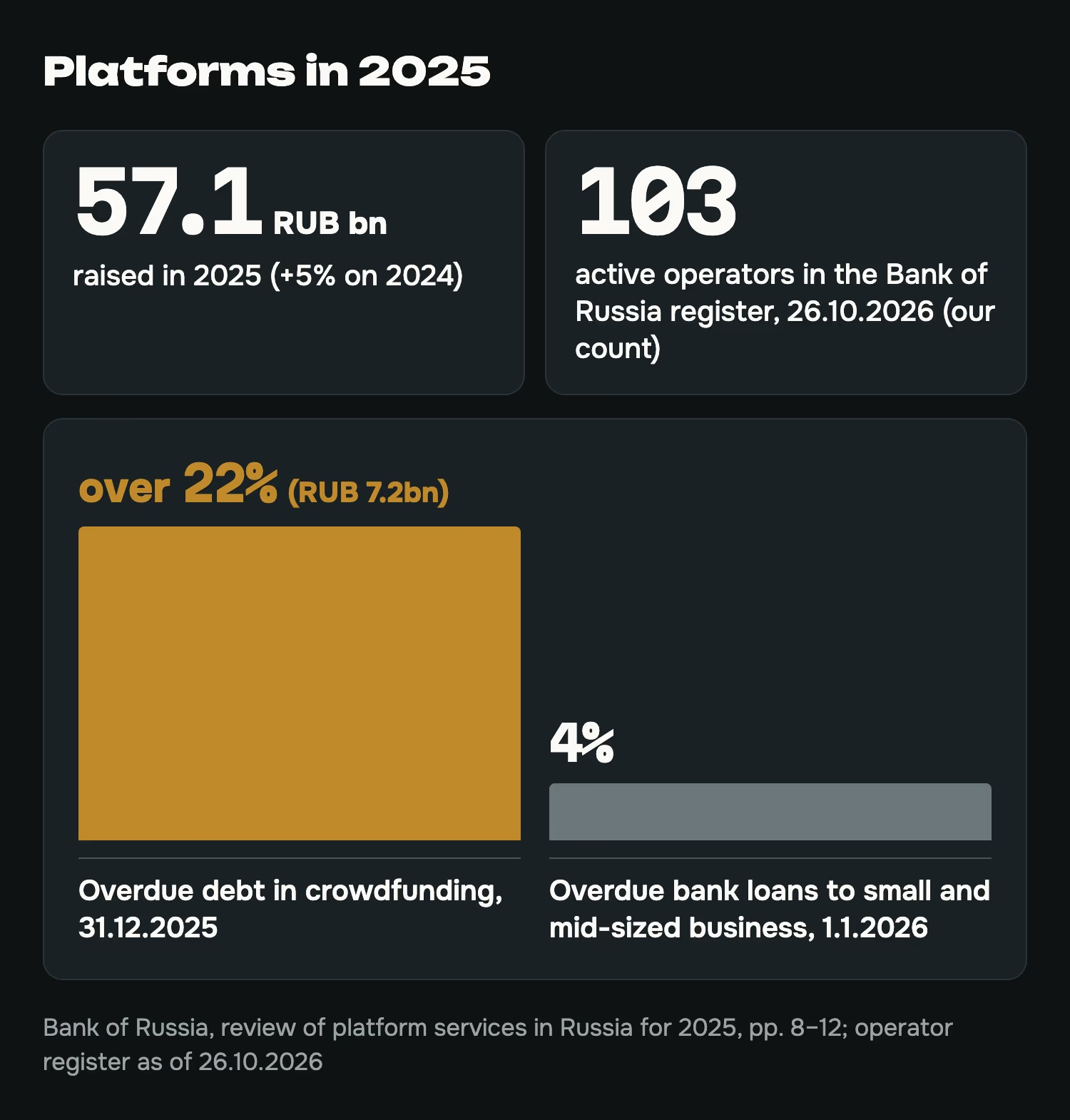
Operators sit in a register kept by the Bank of Russia: on 26.10.2026 it lists 103 active operators (our count from the register file). In 2025 platforms raised RUB 57.1 billion, 5% more than a year earlier.
The main risk is arrears. At 31.12.2025 overdue debt in crowdfunding was RUB 7.2 billion, over 22% of the portfolio; over the year it grew by RUB 3.5 billion.
For bank loans to small and mid-sized business the figure was 4% on 1 January 2026 (all figures from the Bank of Russia review).
Digital financial assets (DFA) are a separate regime. We did not find a primary source on what the regulator allows non-qualified investors to buy in real estate DFAs, so we leave them out of the comparison.
A share in the company that owns the property
Here the property belongs to a company, and you own a stake in that company.
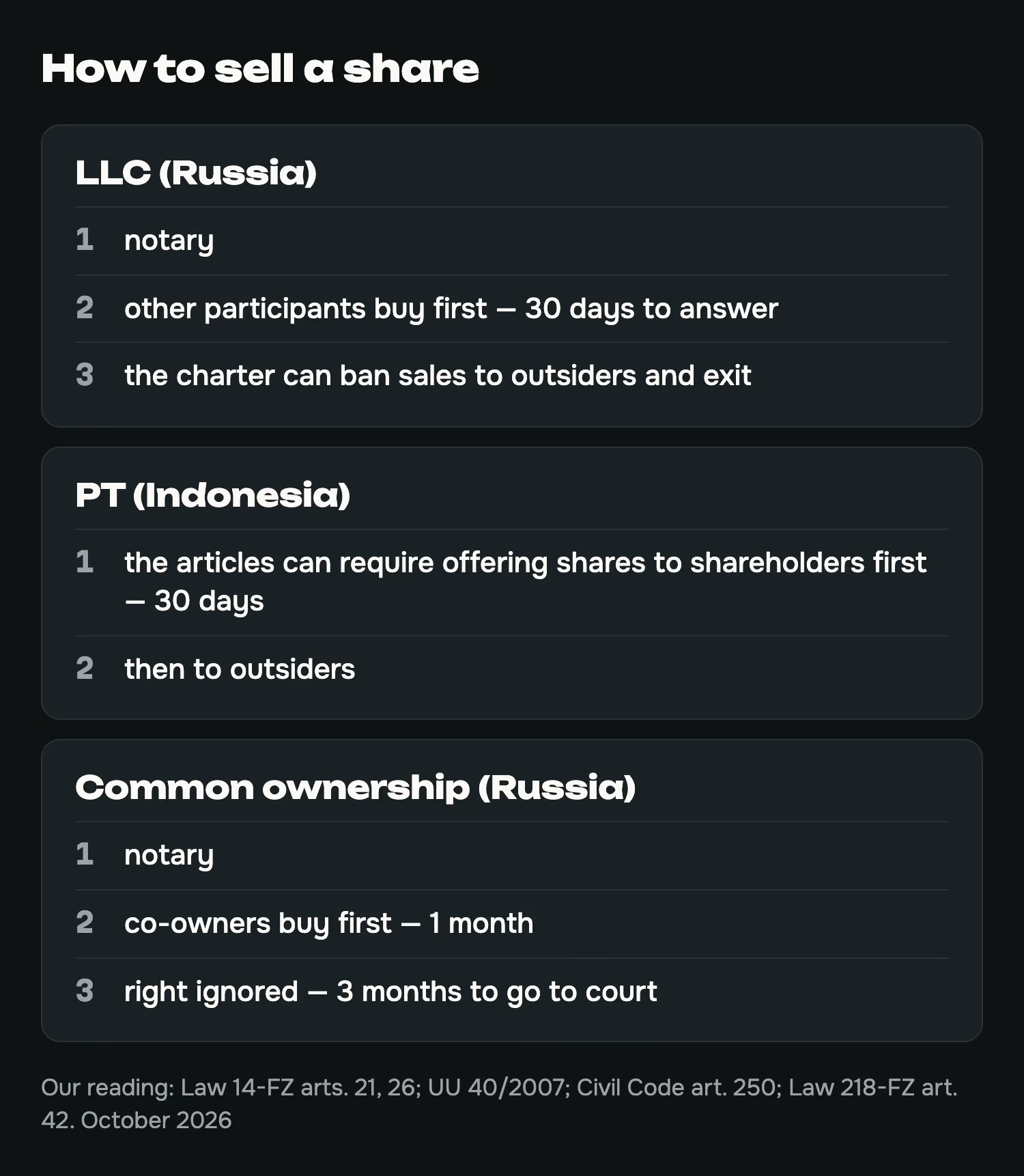
In Russia this is usually an LLC. A share is sold through a notary (Law 14-FZ on LLCs, art. 21), and other participants may buy it first, with 30 days to answer.
The charter can ban sales to outsiders, and you can leave the company only if the charter allows it. An LLC is a non-public form, and the law does not provide for a public offering of its shares (our reading).
The company “may” pay dividends: the general meeting decides, and payment follows within 60 days. Tax is 13% up to RUB 2.4 million a year and 15% above.
In Indonesia the vehicle is a PT. Under the Company Law (UU 40/2007) a shareholder votes at the shareholders’ meeting, receives the remainder on liquidation, and gets dividends if the meeting decides to pay them.
The articles can require shares to be offered to other shareholders first, and if they do not buy within 30 days, the shares can be sold to outsiders. A foreigner can be a shareholder of a PT PMA: foreign investment goes through a PT based in Indonesia (UU 25/2007, art. 5).
Fractional real estate: common ownership
This is what is often called a “fractional villa”: on paper you co-own the property itself.

In Russia this is governed by the Civil Code (arts. 244–252). The property is disposed of only by agreement of all owners, while each owner may sell, give or bequeath their own share. Selling a share in real estate goes through a notary (Law 218-FZ, art. 42).
The other co-owners have a pre-emption right: 1 month to answer. If it is ignored, within 3 months a co-owner can ask a court to transfer the buyer’s rights to themselves.
A share is separated through a court, and where that is impossible without disproportionate damage, the remedy is a payout of its value. Rental income is taxed on the general scale of 13–22% (our reading).
In Bali, Hak Milik, freehold title to land, belongs under Law 5/1960 (art. 21) to Indonesian citizens only. A foreigner can get Hak Pakai, a right of use for a limited term (PP 18/2021), but that is not ownership.
We did not find a special law on fractional ownership or timeshare (searched 27.10.2026; “did not find” is not “does not exist”). So when a “share of a villa” is offered in Bali, look at what exactly the contract gives you. We covered leases in the article on leasehold in Bali and developer checks in how to check a developer in Bali.
Collective investment in a hotel: how a Nord Nest share works
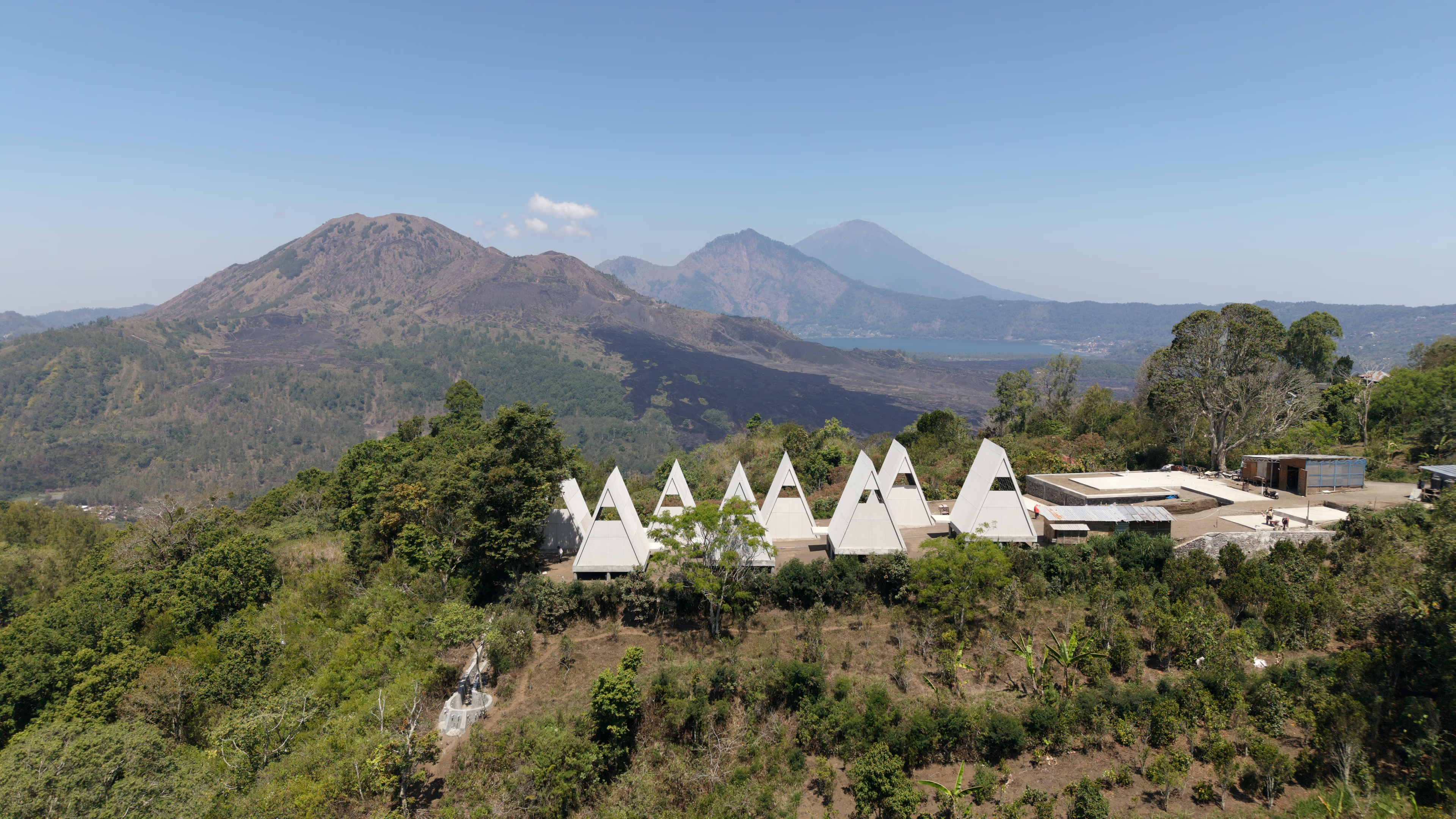
At Nord Nest you buy a share in the company that owns the whole hotel: eight villas, a restaurant, a spa and a thermal complex (a bathhouse and soaking tubs), plus a land lease of 25 years with a 1-year extension.
The share gives no title to a particular villa. 10% costs $190,000, at construction cost. GRC runs the hotel.
Profit is split 70% to share owners, 30% to GRC. GRC takes its part from the same profit as you and stands next to you in the line, not ahead of you.
The model gives 18.7% a year and a 5.3-year payback at 80% villa occupancy and a $185 average nightly rate, assumptions as of August 2026. If occupancy falls to 50%, the model gives about 12.5% a year. These are model figures, and there is no guarantee.
Now the downsides:
- handover is planned for the end of February 2027, there is no revenue yet, and every figure comes from the model;
- the land is a lease, not ownership;
- a 2-year lock-up, after which other co-owners, GRC included, have a right of first refusal with 30 days to answer;
- there is no public market for shares, so an exit takes time;
- key decisions in the company are not taken without GRC;
- 6 of the 7 shares are taken (as of October 2026).
In the share’s favour: cost overruns on the build are covered by GRC and your share is not diluted; reporting is monthly from the first month of construction; each share carries 5 days of stay a year.
The model is explained on the Finance page, the project is on Nord Nest, entry terms are on the business page.
Four formats side by side
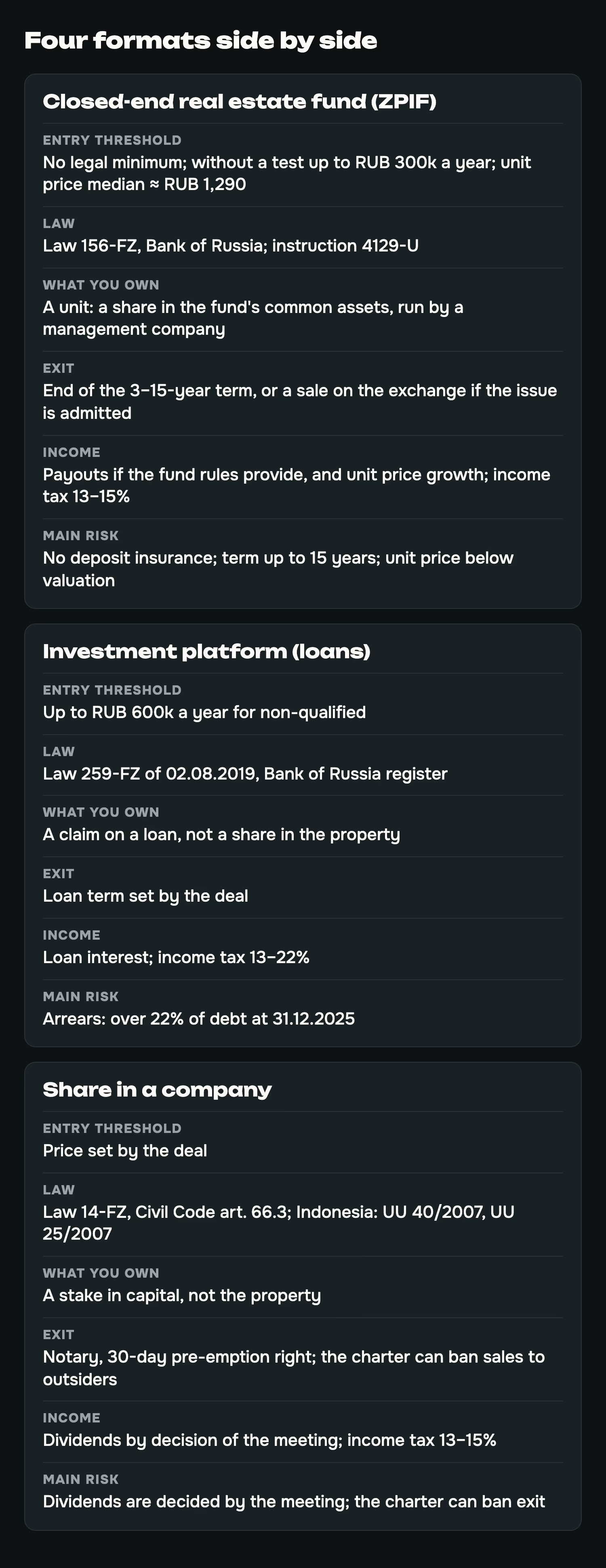
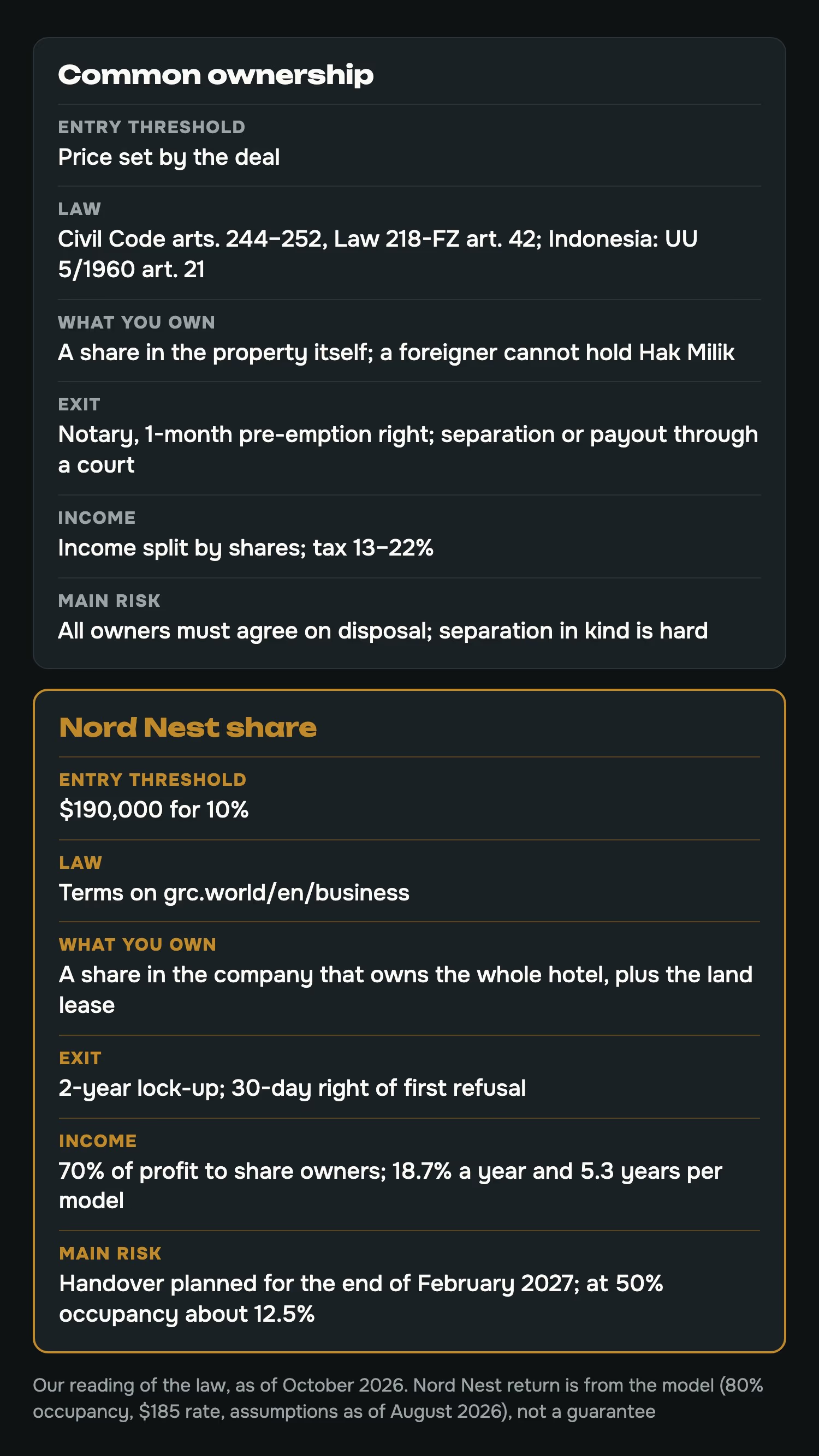
Five questions that work for any offer, ours included:
- What you own: a unit, a claim on a loan, a stake in a company or a share in the property.
- Your limit or entry threshold, and whether you hold qualified status.
- Where the income comes from and who decides whether it is paid: the contract, a meeting or a management company.
- How and when you can exit: fund term, loan term, lock-up, notary, pre-emption right.
- The main risk, and whether the documents state it.
If you are comparing shares with single hotel rooms, we have a breakdown: how to buy a hotel room as an investment.
Frequently asked questions
Can you invest in a ZPIF without qualified-investor status?
Yes. Without a passed test, no more than RUB 300,000 a year in units of closed funds; units on the exchange’s quotation list and units that meet Bank of Russia requirements need no test (our reading). Some real estate funds are open only to qualified investors, and the fund rules show which are open to you.
How is real estate crowdfunding different from owning a share?
On a platform you lend money, and you hold a claim to get it back under the loan terms, with no share in the property. With a share you co-own a company or the property itself, and your income depends on profit, not on a repayment schedule.
Can a foreigner buy a share of a villa in Bali?
Not the land: Hak Milik is for Indonesian citizens only. A foreigner can get, for example, Hak Pakai or a share in a PT PMA. We found no special law on “villa shares”, so the contract decides everything and an Indonesian lawyer should read it.
How much can you put into crowdfunding without qualified status?
No more than RUB 600,000 per calendar year across all platforms together. The limit does not apply if the operator has recognised you as a qualified investor.
What is collective investment in a hotel?
The same four formats, with a hotel as the asset. At Nord Nest it is a share in the company that owns the whole hotel, plus the land lease. Terms and downsides are above.