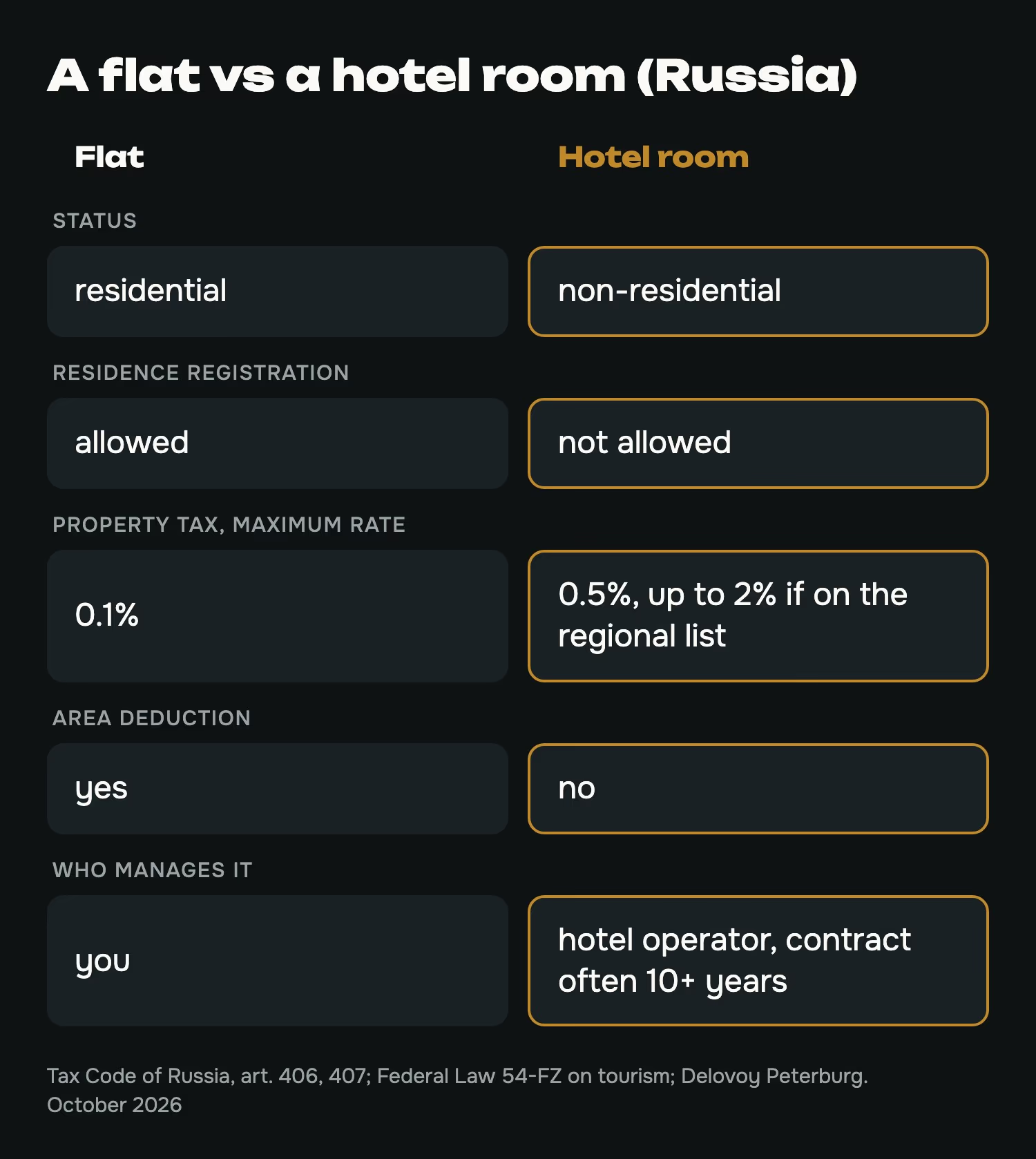
Yes, you can buy a hotel room as an investment. In law it is non-residential premises: you cannot register your home address in it, and under Russia’s hotel classification rules (Government Resolution No. 1951) a hotel must run under one operator.
You own a room, not the hotel.
Take the same nightly rate. How much of it reaches you depends on who is paid before you and what you actually hold.
Below are four models side by side. The first two come from the Russian market, a large one where hotel rooms and aparthotel rooms have been sold to private investors for years, which makes it a useful reference. The third is a condo-hotel abroad, using Bali as the example. The fourth is a share in the company that owns the hotel, which is how Nord Nest is built.
What you buy when you buy a room
In Russian law, an apartment-hotel room is non-residential premises. The word “apartments” has no legal definition, and you cannot take permanent residence registration in one.
No law has turned them into housing either: the State Duma rejected such a bill in January 2025.
Registration is a little more nuanced. In February 2026 the Constitutional Court held that refusing temporary registration in non-residential premises that resemble a flat limits people’s rights. But that concerns premises outside a hotel’s room stock, and a room in a hotel is not covered.
A law on this registration is still a draft, published by the Interior Ministry in February 2026.
Now the hotel itself. The tourism law treats a hotel as one property complex, not a set of separate flats. Rooms can belong to different people, but the hotel has to be under the single management of one legal entity or sole trader: either the owner of the building or whoever the room owners authorise.
So running your own room independently is usually off the table. The operator runs it, and your contract is with them.
One more point about words. In the classification, “apartment” is a room category: at least 40 square metres, two or more rooms, a kitchenette. It is not a legal status of the premises. In advertising and in the law the same word means different things.
Who is paid ahead of you on a room
A guest pays for a night, and the money then moves down a line. For a room in a Russian hotel it looks like this.
-
Developer
A markup already sits in the purchase price. Collected before the first guest.
-
Booking platforms
A percentage of the whole booking. Yandex Travel's base commission has been 17% since February 2026. For Booking.com the figure is in the hotel's contract.
-
Management company
20–30% of revenue by one business paper's estimate. Operations and advertising are paid out of it.
-
You
lastWhat remains. Property tax comes out of it, with no area deduction.
The order and the sizes differ from hotel to hotel; this is the general picture.
On platforms: from 1 February 2026 Yandex Travel raised its base hotel commission from 15% to 17%, and some tariffs run at 20–25%. Booking.com does not publish a percentage. It depends on the country, the property type and the contract, and it is charged on the total booking including extra fees. What applies to you is in your contract.
Treat the management company’s share with care. There is no consultancy report with its share in the open, so 20–30% of revenue is a publication’s estimate. The contracts, by the same publication, are long: ten years and more, with termination penalties from several hundred thousand to millions of roubles.
We walked through this line in detail, for a villa, in “The line ahead of the investor’s money”. Here we only need it to compare models.
Investing in hotel rooms: what is left
Numbers in this field depend heavily on who is quoting them.
- Independent consultants put the operating yield of aparthotels at 7–9% a year (Macon, RBC, September 2025). Anything above 12–15%, and certainly 18–20%, is usually what developers say.
- In 2023 the newspaper Kommersant reported, citing market participants, that ads used to promise 17–20% and in 2022–2023 they promised only 6–9%.
- NF Group says that in Moscow in the first half of 2026 average occupancy of classified aparthotels was 69.7%, while revenue per room fell 8% over the year.
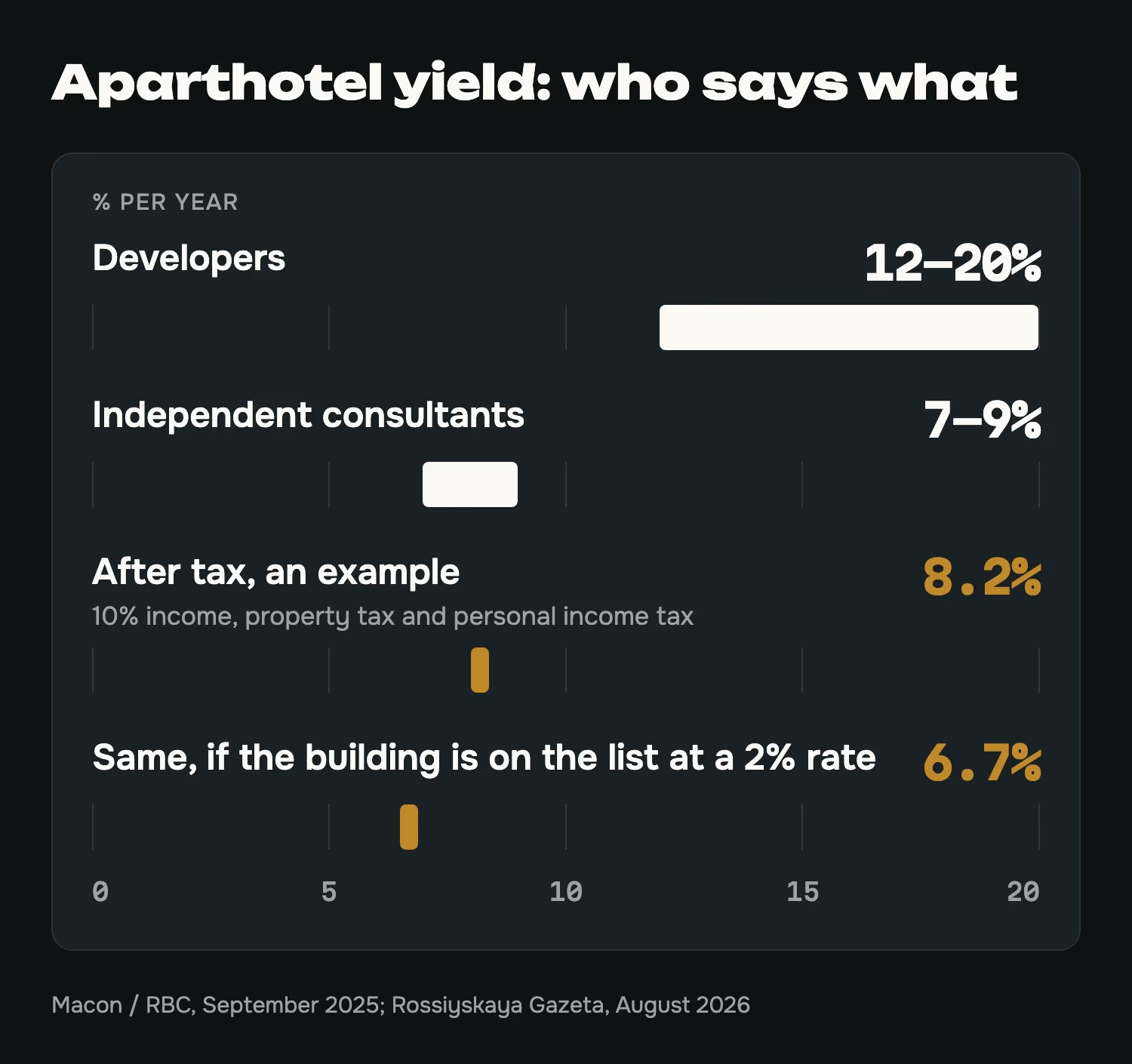
After tax it is less. An example from Rossiyskaya Gazeta (August 2026): a room bought for 8 million roubles earns 10% a year, 800 thousand. After property tax and income tax 656 thousand remains, or 8.2%. If the building falls on the regional list at a 2% rate, it is 6.7%.
Payback here is long. An operator in St Petersburg named 8–10 years, and an expert in resort property said 7–8 years was most likely unattainable.
Property tax: the rate depends on a list
Tax is easy to get wrong because housing and hotel rooms follow different rules. The ceiling rates under Article 406 of the Russian Tax Code: housing up to 0.1% of cadastral value, buildings on the regional list up to 2%, everything else up to 0.5%. The actual rate is set by the municipality (in Moscow, St Petersburg and Sevastopol, by a city law) and can be lower.
At a 2% rate the tax is 20 times higher than on housing: 8,000 RUB against 160,000 RUB a year on 8 million RUB of cadastral value, before any deduction.
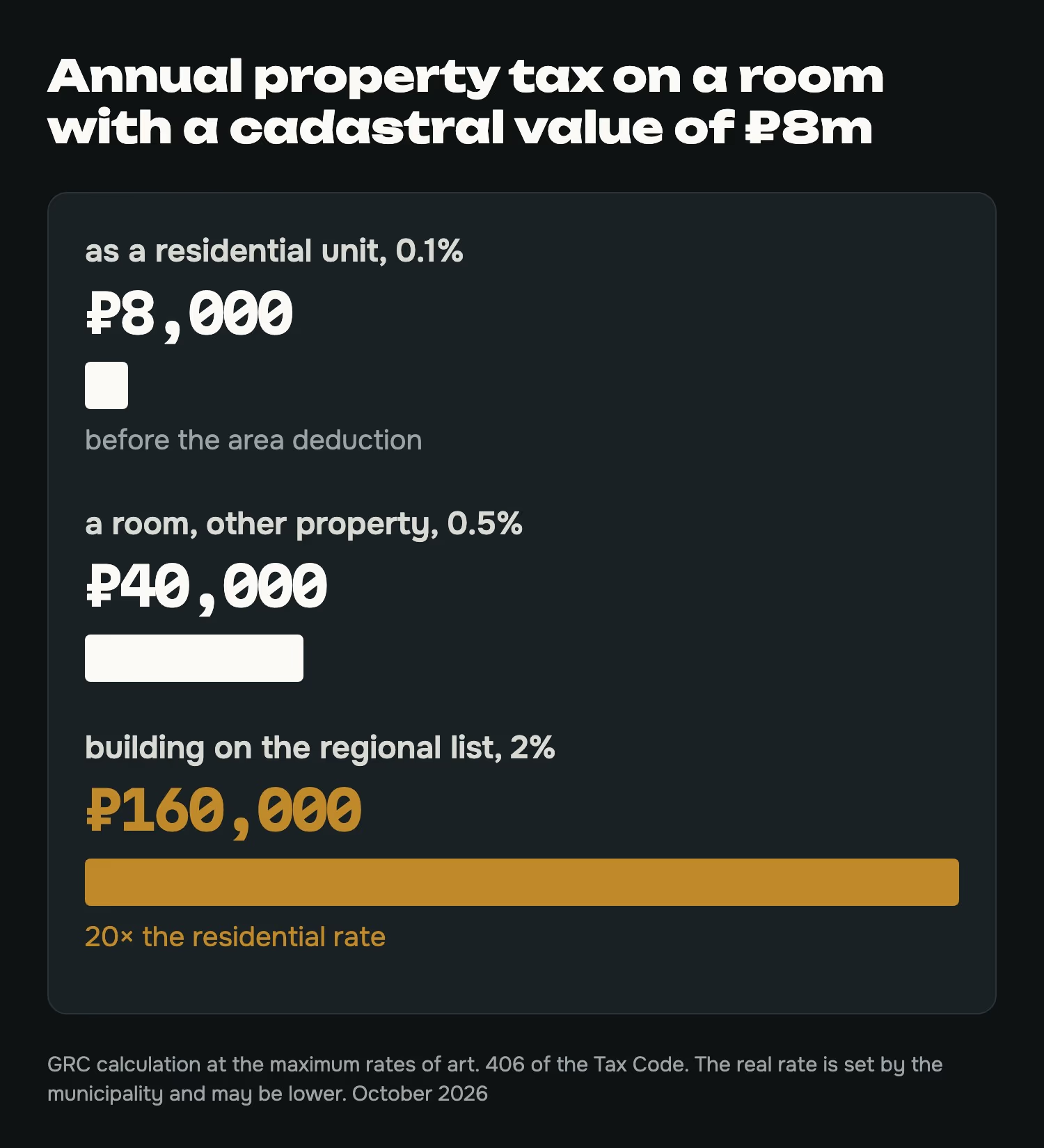
Which rate lands on you depends on how the building is entered on the list of buildings taxed by cadastral value. The list is approved every year by 1 March. Hotel rooms are not named directly in that article, so by default they count as “other” property. That is our reading of the text, so check it for your region.
The area deduction that lowers tax on a flat is given to housing only: flats, rooms, houses. Non-residential premises get no deduction.
Four models side by side
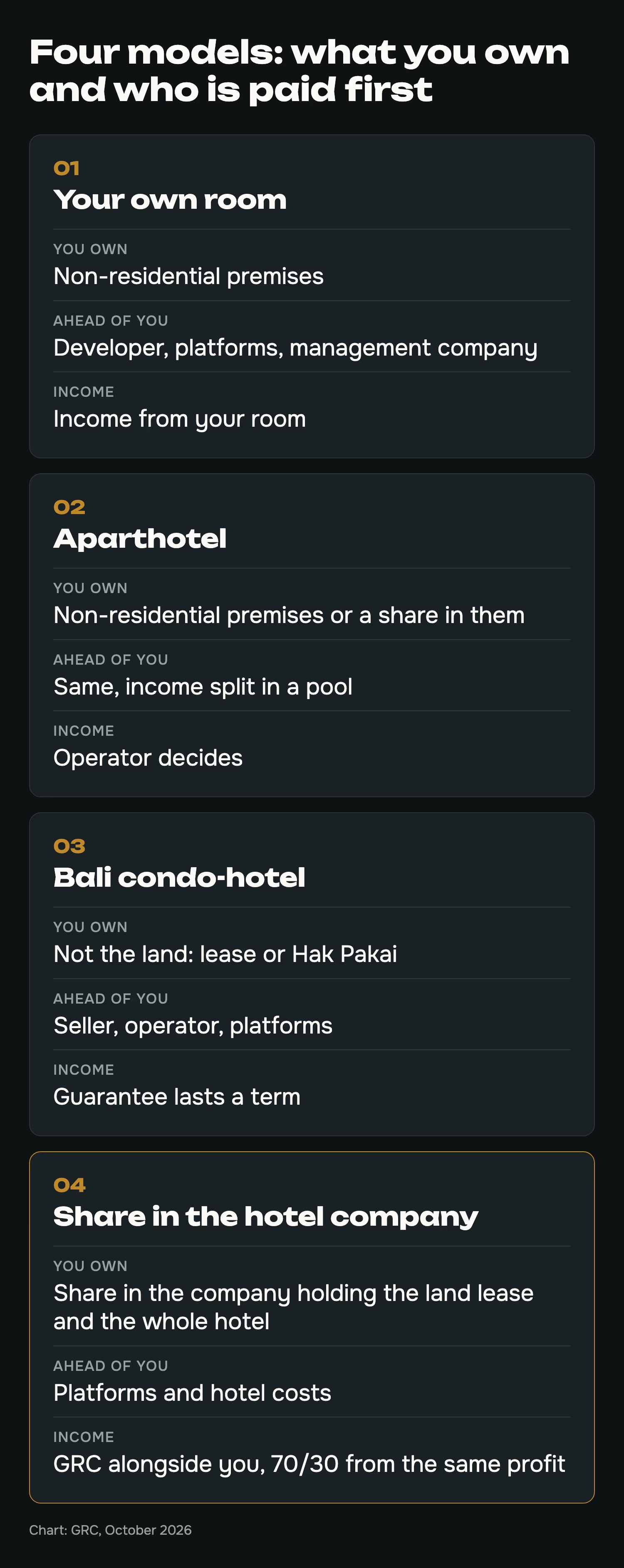
The same in words, model by model.
Own room, per-room accounting. You own non-residential premises. The developer, the platforms and the management company are paid before you. Income depends on your room’s occupancy and price, the management share and tax. To exit, you resell, and hotel rooms are slow to sell. Main risk: tax with no deduction and an operator contract that runs for years.
Aparthotel pool. You own non-residential premises, often a share in them or a right of use. Same line ahead of you. Income follows the whole pool and the split formula, not your room. Same exit. Main risk: the operator makes the calls.
Bali condo-hotel. The land is not yours: you hold a right of use or a lease, depending on the contract. The seller, the operator and the platforms are paid first. Income depends on the operator’s profit, and a fixed payout lasts only for the term in the contract. Exit depends on the type of right and how long it runs. Main risk: a land right is not ownership, and the fixed-payout term ends.
Share in the hotel company. You own a share in the company that holds the land lease and the whole hotel. Platforms and hotel costs come first, and GRC is paid from the same profit as you. Income depends on the profit of the whole hotel: villas, spa, thermal complex, restaurant. Exit: after a 2-year lock-up, with a right of first refusal for the other co-owners; there is no public market for shares. Main risk: a share is not property in your name, handover is a plan, and the figures come from a model.
Buy a hotel room for investment: your own room
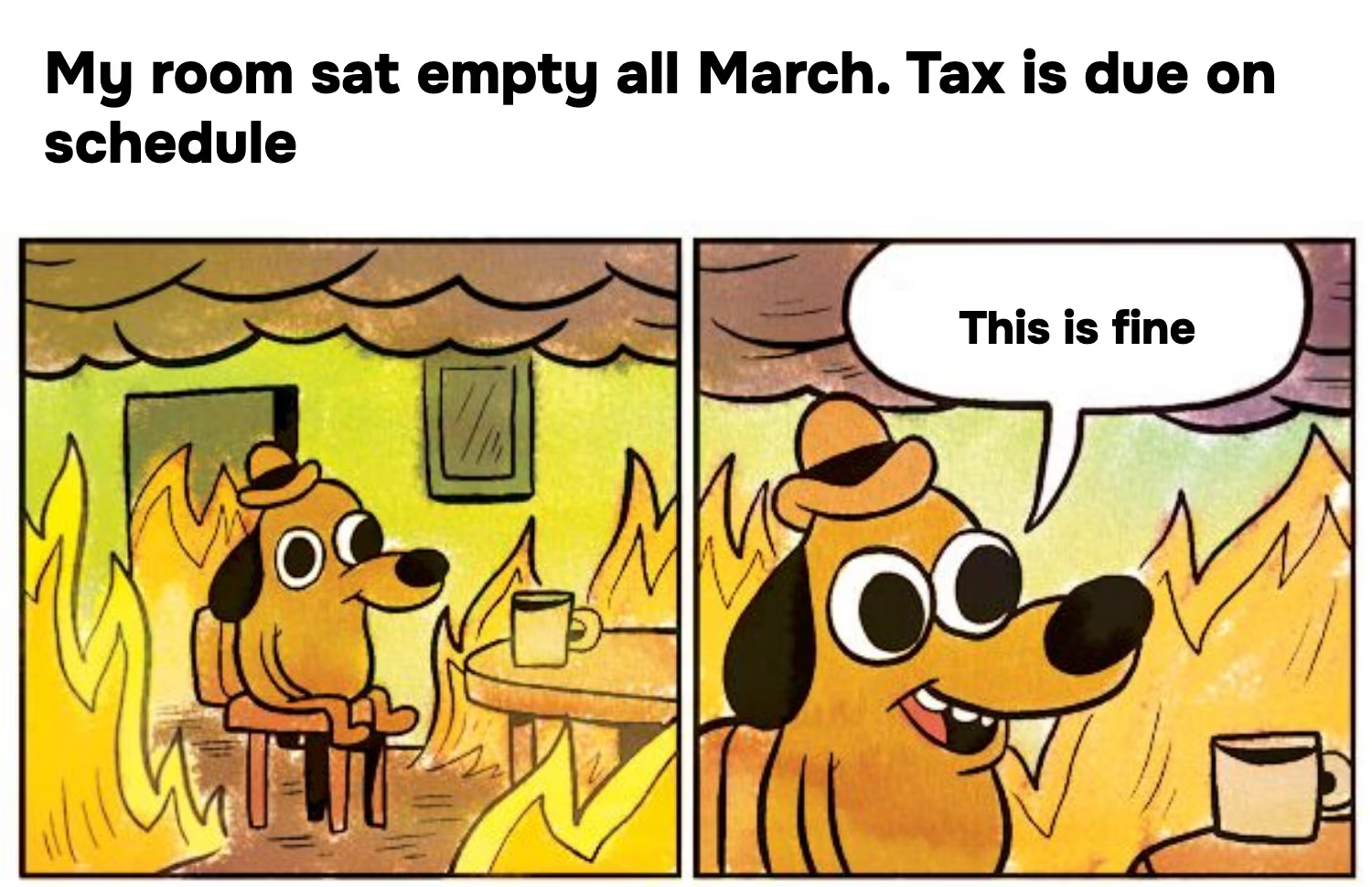
The first model is where income is calculated per room. Such schemes exist: Kommersant writes that some management companies offer individual accounting, though most hotels work differently. It is not a mass model, and in the contract you need to see what is actually sold under that name.
You own non-residential premises in a hotel that an operator runs. The developer, the platforms and the management company are paid before you.
Income depends on how full your particular room is and at what price, on the management share and on the tax rate. That is the upside: a good room earns more than average. The downside is the same thing in reverse: your room’s empty month stays yours.
There is another version of an “individual” scheme, from Delovoy Peterburg: you get 70–80% of your room’s income, but you find guests, cleaning and marketing yourself, and a vacant month earns zero. That is a different thing from full management.
You exit by selling the room on the secondary market. Experts rate liquidity there as weak, and the operator’s contract often runs ten years or more, so the buyer inherits it.
The main risks are tax and the contract. Tax is calculated with no deduction at a rate set by the list, and the contract binds you for years.
There is a pre-opening risk too: if the developer goes bankrupt, the owner of non-residential premises can claim only money and cannot demand completion of the building. That is an expert’s view in Rossiyskaya Gazeta, not a rule of law, but take it to your own lawyer before signing.
Investing in aparthotels: the pool
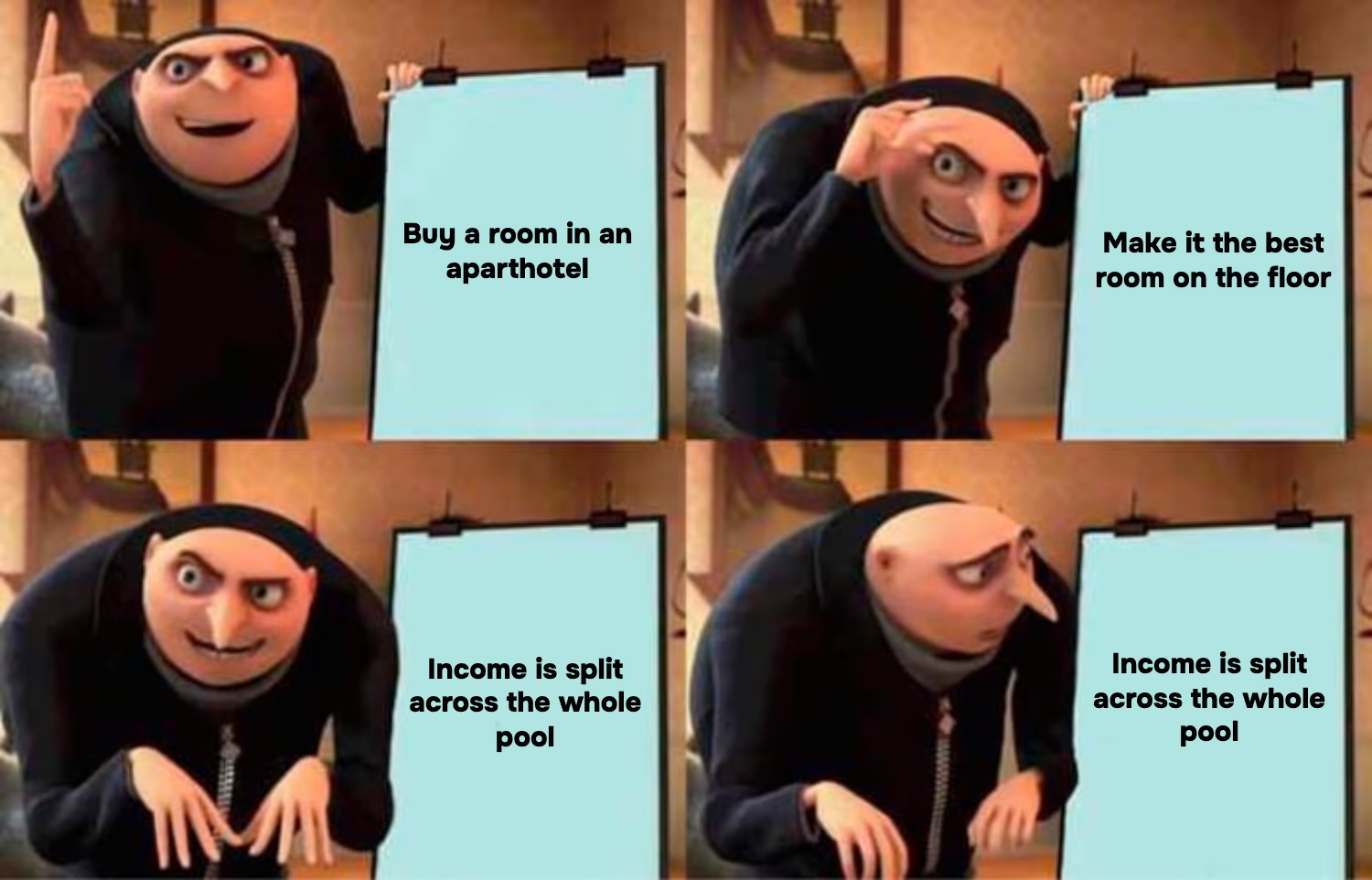
In the second model income is calculated across a common pool. This is the most common scheme: according to Kommersant most aparthotels split income across groups of similar rooms. Your room can be full every night, and you receive the same as everyone else.
How the pool is divided differs by source: equally, or in proportion to area. The answer is only in the contract.
What you own is the same non-residential premises. Developers often sell not a separate property but a share in the premises or a right of use, so the buyer in effect acquires a stake in a business that depends on the operator. That is how Rossiyskaya Gazeta puts it, citing a developer.
The same parties are paid ahead of you, and the operator takes the pool decisions. Income follows the result of the whole hotel and the split formula. Delovoy Peterburg estimates that payouts in a pool are steadier, but peak-season upside is limited. The main risk: the income is not yours to steer.
A word on “guaranteed” programmes. The payout is fixed, and in high season it can turn out lower than the room actually earned. Open sources do not say where the money for the guarantee comes from, so we will not guess. It is a sum fixed for a term in the contract, not what your room earns.
Condo-hotel in Bali: what a foreigner can buy
The third model is a condo-hotel abroad. In Bali the answer to “what am I buying” starts with the land.
Under Indonesia’s 1960 Basic Agrarian Law, Hak Milik, ownership of land, belongs only to Indonesian citizens. A deal that passes it, directly or indirectly, to a foreigner is void, the land goes to the state and the money paid is not returned.
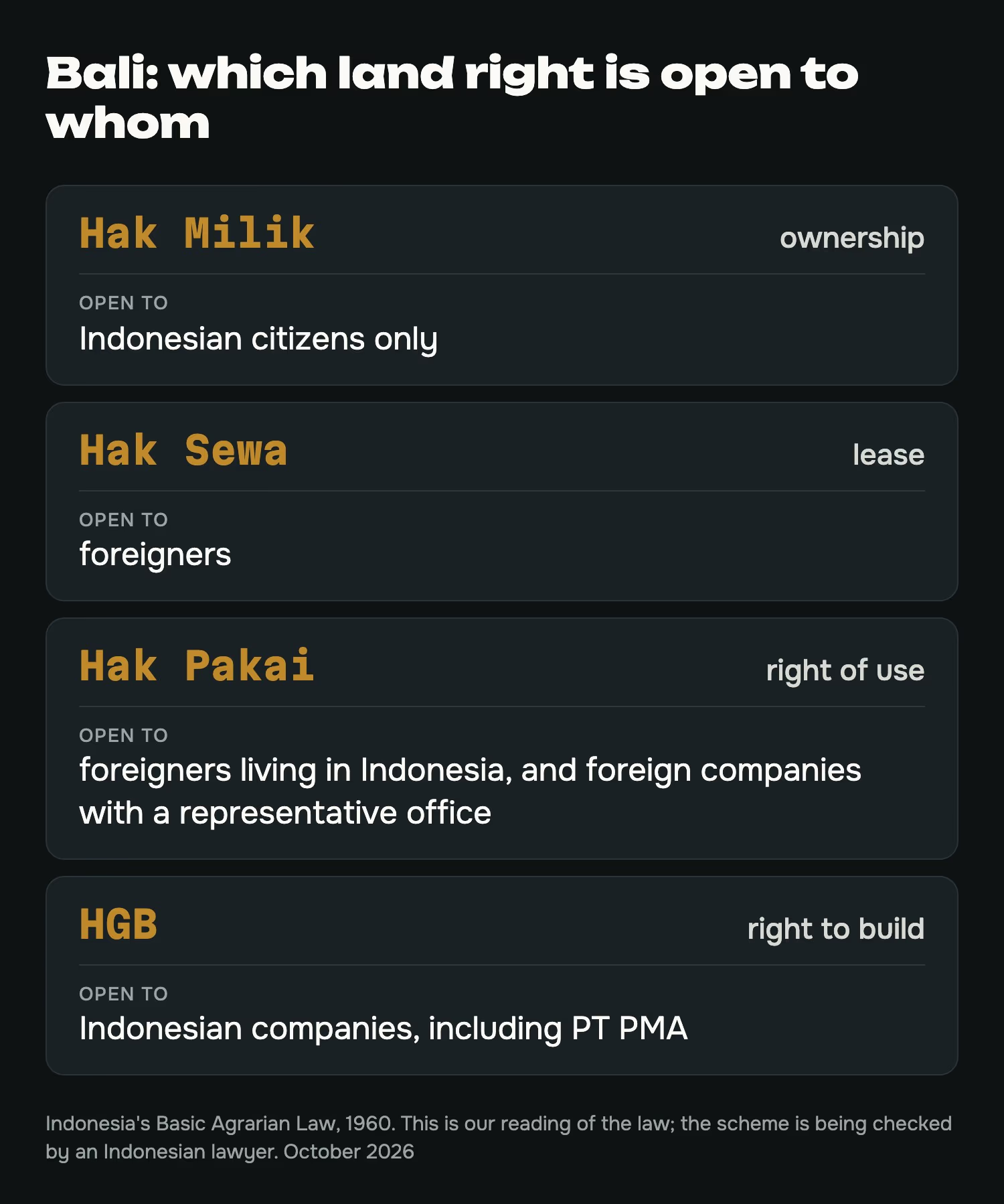
Foreigners can hold other rights: a lease (Hak Sewa) and a right of use (Hak Pakai), the latter for foreigners resident in Indonesia and foreign companies with a representative office. An Indonesian legal entity, including a foreign-investment company (PT PMA), can hold a building right (HGB). That is our reading of the law, not a quotation, and every structure should be checked by an Indonesian lawyer.
Which of these is in your contract — a lease for a term, Hak Pakai, or a share in a PT PMA — decides the rest: what you own, how you exit and what happens when the term ends. The terms and the renewal rules for a foreigner have to be read in the documents of the specific project.
On a Bali “guarantee,” consultants described a typical scheme long ago: a fixed payout for several years, then revenue goes into a pool and is split between everyone, as in an ordinary hotel. That is JLL’s 2016 report, so we take it as a description of the mechanism, not as a 2026 figure. We found no recent open data on operator fees and condo-hotel yields in Bali, and we do not make any up.
Here the seller and agent, the operator and the platforms are paid ahead of you. Income depends on the operator’s profit and the size of the project, and the fixed part on the solvency of whoever promised it and on its term.
The main risk is a land right that is not ownership, and the end of the guarantee.
A share in the hotel company: how Nord Nest works
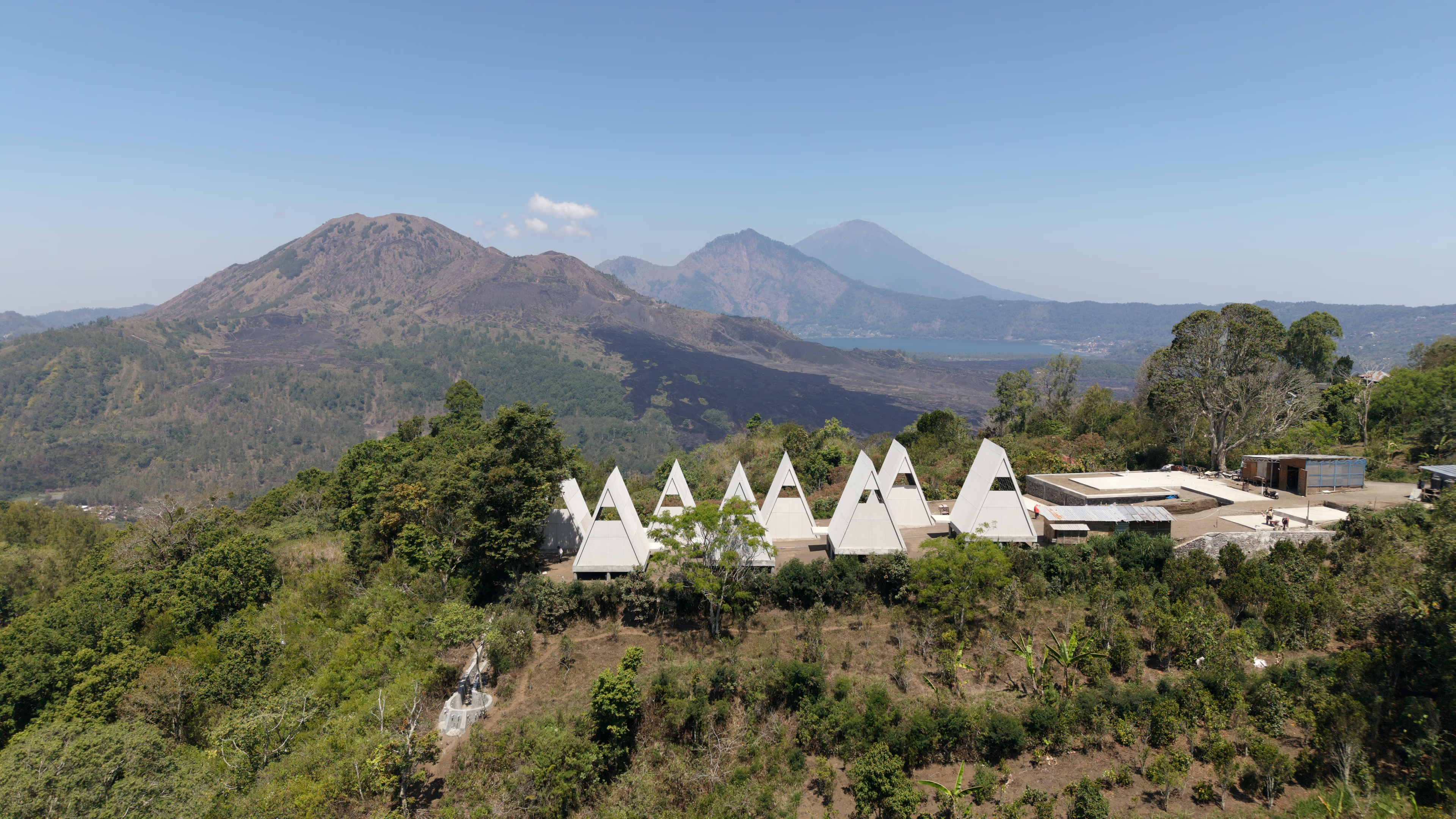
The fourth model is ours. You buy a share in the company that owns the whole hotel: eight villas, a restaurant, a spa and a thermal complex (a bathhouse and soaking tubs), plus the land lease. The land is leased. A 10% share costs $190,000, at construction cost. The share gives no title to a particular villa or room.
The line here is shorter, but it exists.
-
Booking platforms
A commission on the booking, as at any hotel. One channel among others.
-
Hotel costs
Management, repairs, staff. The company manages the hotel itself, and these costs are already deducted.
-
Profit is shared
together70% to the share owners, you among them. 30% to GRC. From the same profit as yours.
The key difference from the first three models: GRC stands in the line next to you, not ahead of you. If the hotel earns less, so do we.
Income is not tied to one villa. For a 10% share the model gives: villas $1,493 a month, spa and thermal complex $1,068, restaurant $401. That makes $2,962 a month, or $35,545 a year.
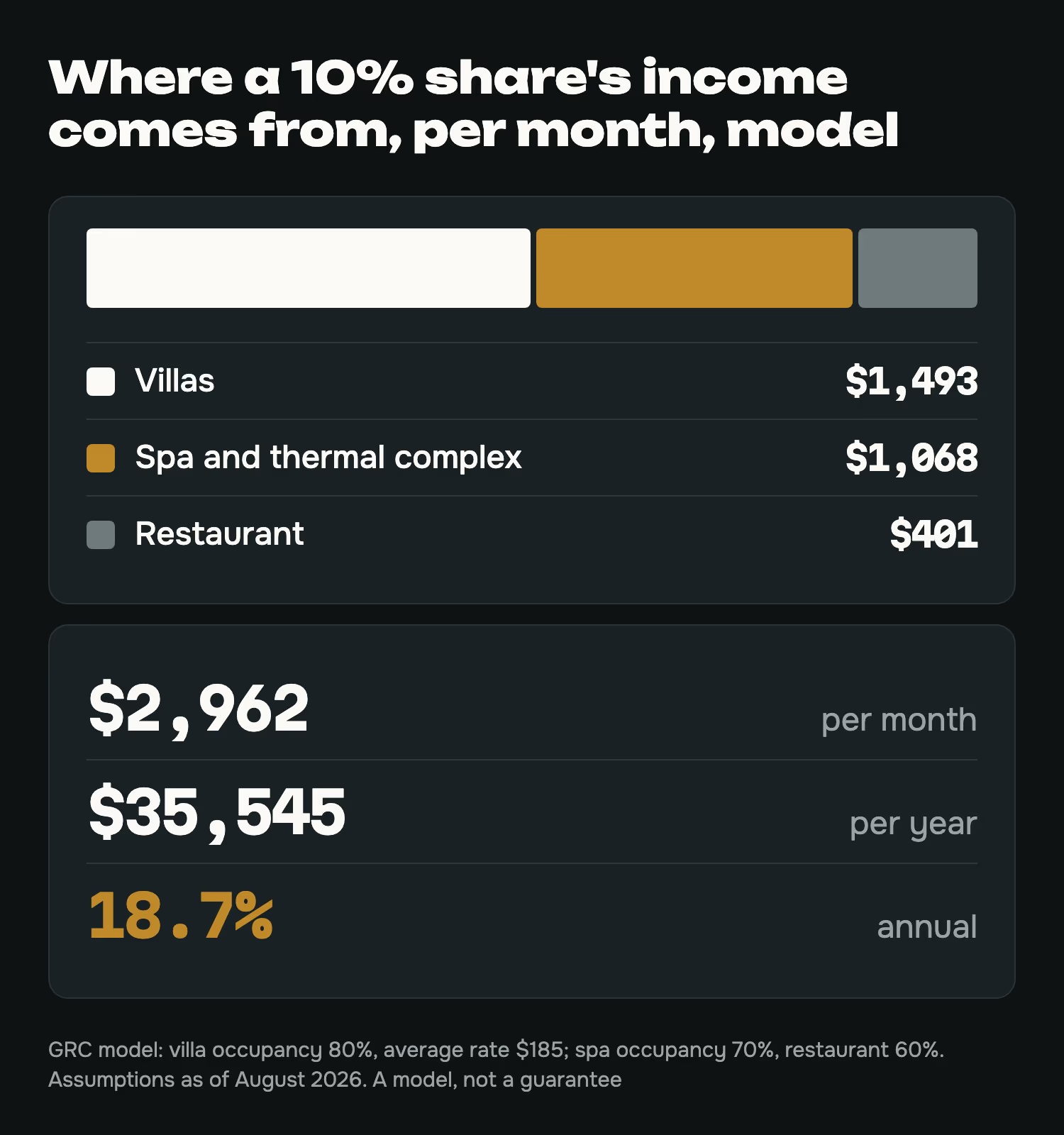
It is 18.7% a year and a 5.3-year payback, at 80% villa occupancy and a $185 average nightly rate, assumptions as of August 2026. The spa is modelled at 70% occupancy and the restaurant at 60%. If villa occupancy drops to 50%, the model gives about 12.5% a year.
Why does it come out this way, when developers above say 12–20% and consultants 7–9%? Entry is at construction cost, with no developer markup. Management runs inside the company instead of an outside management company taking a share of revenue. And almost half of modelled income comes from the spa, thermal complex and restaurant, not only the villas.
This is a model, not a promise. There is no guarantee.
Now the downsides. Handover is planned for January 2027. The figures above come from a model, and there is no revenue yet. The land is a lease. GRC keeps 30% of the profit, and key decisions in the company are not taken without GRC.
There is a 2-year lock-up. After it, other co-owners, GRC included, have a right of first refusal with 30 days to answer. There is no public market for shares, so an exit takes time. Six of the seven shares are taken (as of October 2026).
A few terms count in the share’s favour. Cost overruns on the build are covered by GRC and your share is not diluted. Reporting is monthly from the first month of construction. Each share carries 5 days of stay a year.
How the model is calculated is on the Finance page, the project is on Nord Nest, the entry terms are in the business page.
What to compare in the end
At the same nightly rate, what changes across the four models is how much of that money reaches you and on what basis you receive it. Five questions work for any offer, ours included.
- What you own: premises, a right of use or a share in a company.
- Who is paid before you, and whether it is taken from revenue or from profit.
- What your income depends on: your room, a common pool or the whole hotel.
- How you exit and how long it takes.
- What the main risk is, and whether the contract says so.
If you are weighing a villa against a room in Bali, the breakdown of villa yield in Bali may help: it uses Airbnb and AirDNA data instead of presentations.
Frequently asked questions
Can you register your address in an aparthotel room?
Not as a permanent address: by law the premises are non-residential. After the Constitutional Court ruling (February 2026), temporary registration is possible in non-residential premises that resemble a flat, but only outside a hotel’s room stock. The law on this is still a draft. A hotel room is not covered.
What tax do you pay on a hotel room in Russia?
Property tax on cadastral value. Ceiling rates under Article 406 of the Tax Code: housing 0.1%, buildings on the regional list up to 2%, others up to 0.5%. The municipality sets the actual rate (in Moscow, St Petersburg and Sevastopol, by a city law). The area deduction that lowers tax on a flat does not apply to a non-residential room.
Can a foreigner buy a hotel room in Bali?
Not the land: Hak Milik is for Indonesian citizens only. A foreigner living in Indonesia can hold a lease or Hak Pakai; an Indonesian company, PT PMA included, can hold HGB. That is our reading of the law, and a lawyer checks it; so should an Indonesian lawyer check your contract.
How much does a room in an aparthotel earn?
Consultants say 7–9% a year before tax, developers say 12–20%. After tax, Rossiyskaya Gazeta’s August 2026 example comes to about 8%, and under 7% at a 2% tax rate.
Which is better: a hotel room or a share?
There is no single answer. A room is specific premises with a tax, an operator contract and weak liquidity. A share in the hotel company is a right to the profit of the whole hotel, but without title to specific premises, with a lock-up and no public market. Compare them using the five questions above.