Investing in hotel real estate comes down to four numbers, and the order matters. First occupancy, then the average room rate (ADR); together they give RevPAR. After that, look at what is deducted before the owner is paid: booking platforms, the management company, running costs.
If a seller shows you one yield percentage and none of this chain, you have seen half the answer.
Hotel occupancy: how many nights were actually sold
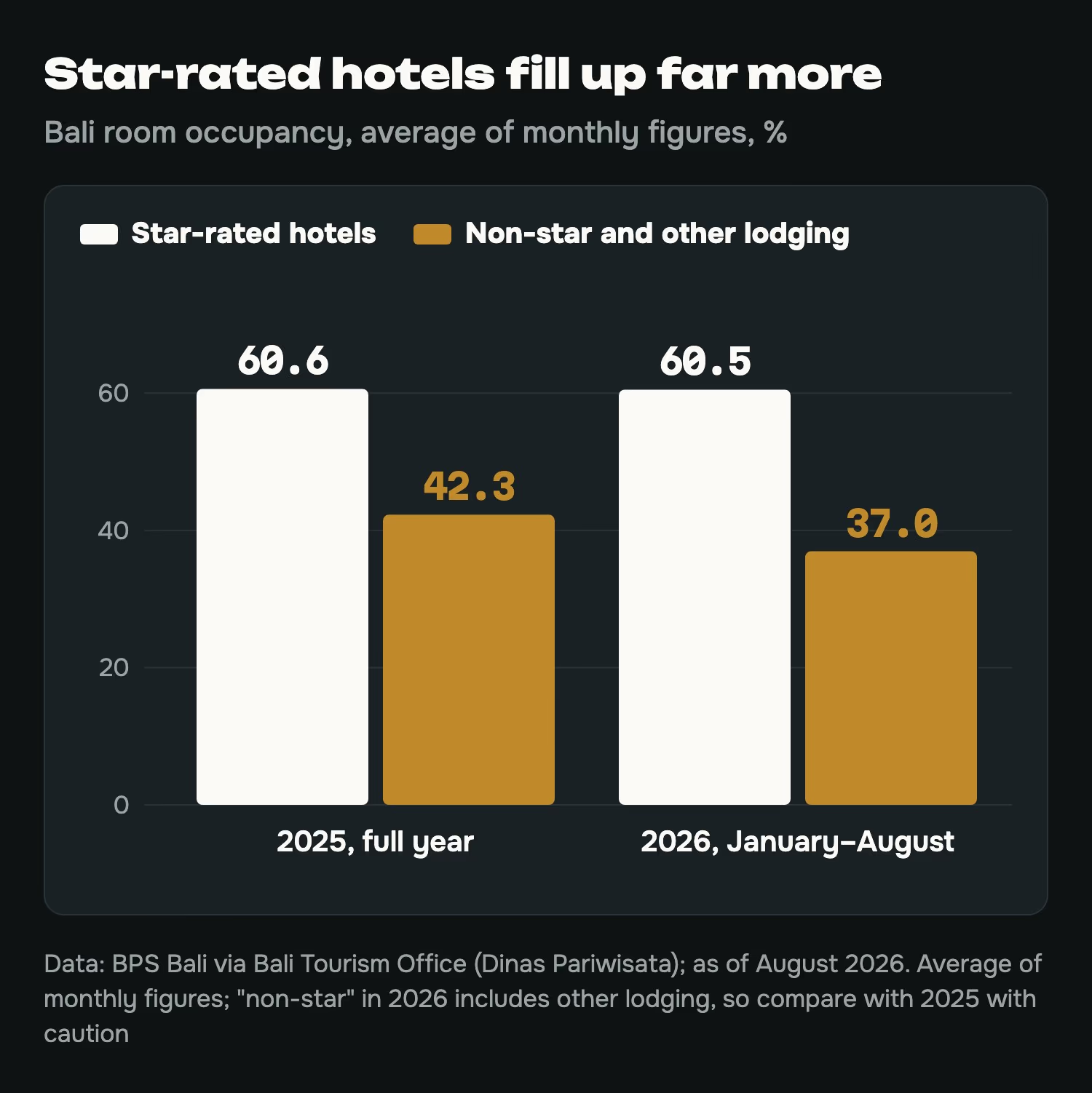
Occupancy is room-nights sold divided by all room-nights available: the number of rooms times the days in the period. STR’s own example: 100 rooms over 31 days is 3,100 room-nights for the month.
The first question is the period. Star-rated hotels in Bali averaged 60.6% in 2025 (BPS), yet the monthly figure swung from 46.6% in March to 69.5% in August, so a figure from one good season says little about the year.
The second question is who counted. “Bali occupancy” is 60.6% (BPS, star-rated hotels, 2025), 74% (Horwath HTL, a sample from the Bali Hotel Association, 2025) or 63–65% (Colliers, Q2 2026). None of them is wrong; the samples differ. So ask the seller: which sample?
ADR: the average rate, not the price on the website
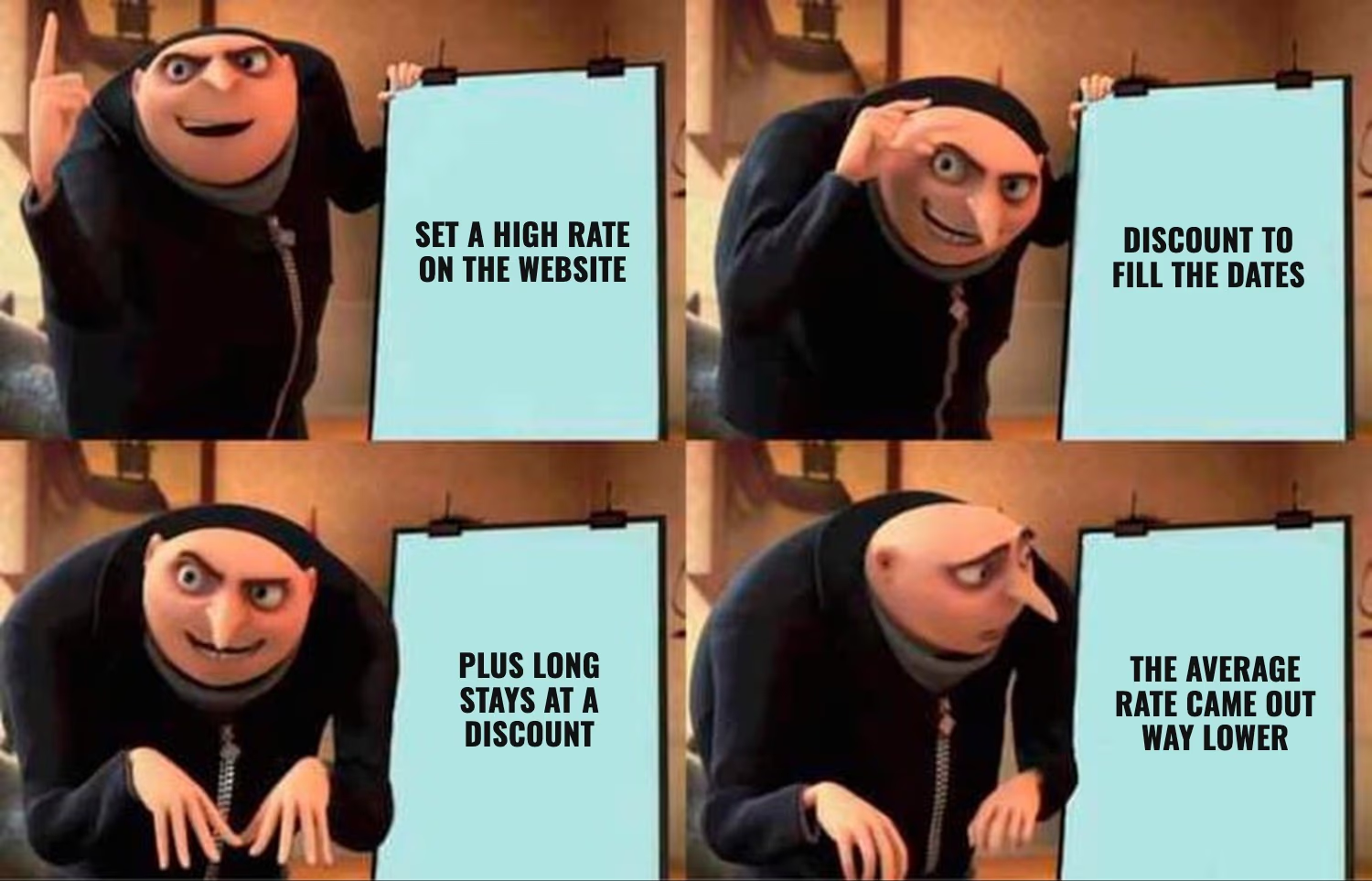
ADR is room revenue divided by rooms sold. Empty nights are not in it. The rate on the website in high season and the rate rooms actually went for over the year are often far apart.
So ask what is inside. After discounts or before? With breakfast? With taxes and fees? Booking.com, for one, takes its percentage of the whole booking, extras included, so an ADR needs a definition written in plain words.
For reference, hotels in the Horwath HTL sample had an ADR of about $150 in Bali in 2025.
RevPAR: one number instead of two
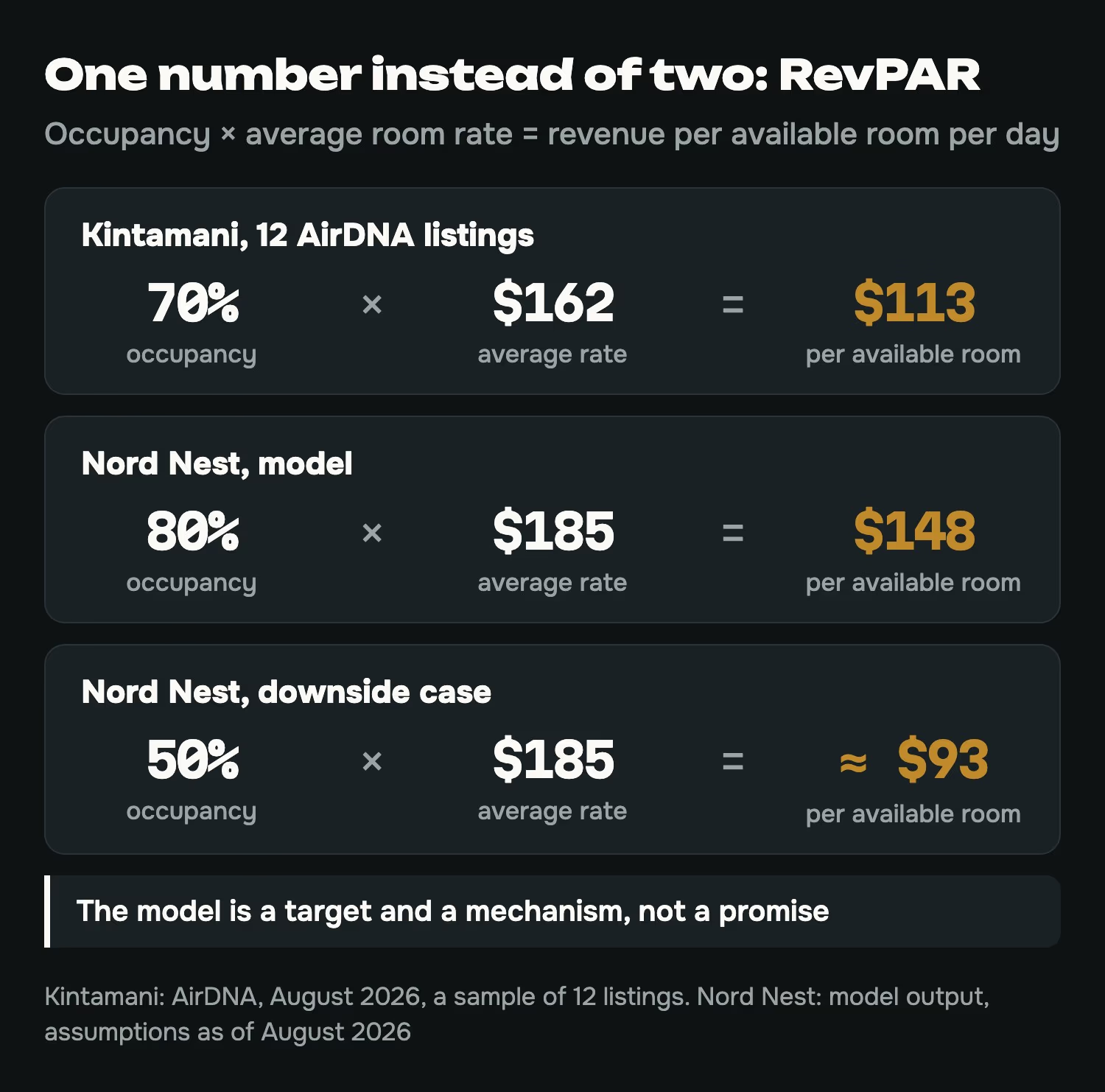
RevPAR is revenue per available room, sold or not. The formula is short: occupancy × ADR. It is how hotels get compared, because 95% occupancy means nothing without the price, and a nice price means little if the nights are empty.
A Russian example: Moscow aparthotels, first half of 2026, NF Group data as reported by Rossiyskaya Gazeta. Occupancy 69.7%, room rate 11.1 thousand rubles, so RevPAR is about 7.7 thousand rubles per available room, 8% lower than a year before.
Now Kintamani, a set of 12 properties from AirDNA, August 2026: $162 × 70% = $113 a day. This is a 12-property sample, not the district average. For the whole district AirROI showed $60 a night and 19.8% occupancy as of September 2026.
Multiply by 365 and you expect about $41,400 a year. The actual average income in the AirDNA table is $30,608.
The gap has a simple cause: three of the twelve have operated for less than a year, while for the other nine income almost exactly equals rate × occupancy × 365. So when a seller multiplies rate by occupancy by 365, ask how many months of real bookings stand behind each property.
What is left for the owner: from revenue to income
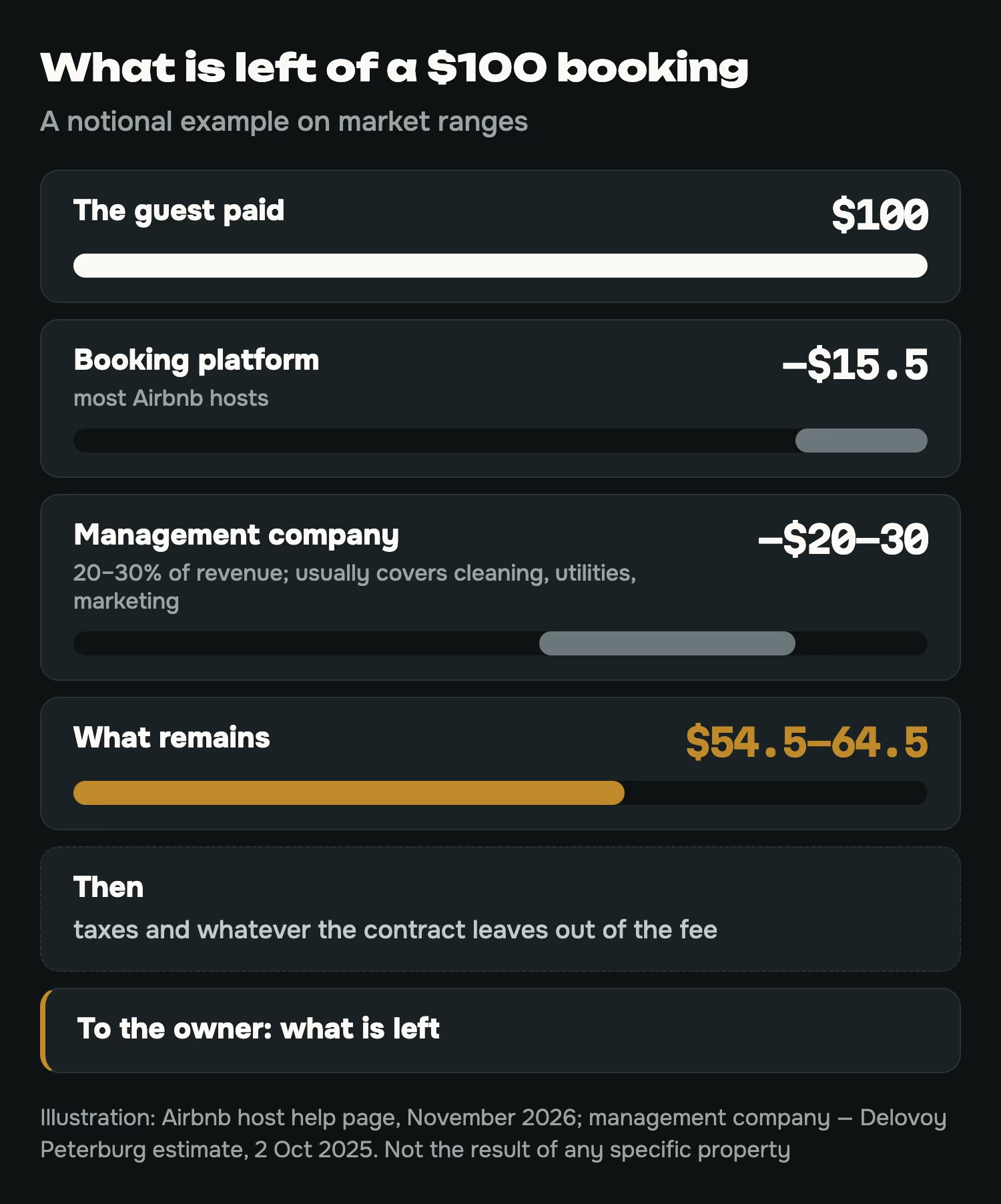
Take a notional $100 booking and follow it to the owner.
Most hosts on Airbnb pay 15.5% (Airbnb help page). Booking.com’s percentage sits in the hotel’s contract with the platform and depends on country, property type and the programs you join.
An outside management company takes 20–30% of revenue, according to an October 2025 estimate for Russian aparthotels by the business paper Delovoy Peterburg. The arithmetic: $100 − $15.50 = $84.50, and after the manager, $54.50–64.50 is left.
The same paper says the fee usually covers operations, utilities, cleaning and marketing. The owner pays tax separately, and anything else deducted before you is in the contract.
For more on who gets paid ahead of the owner, see the queue for the money.
GOP, the repair reserve and other lines of the hotel report
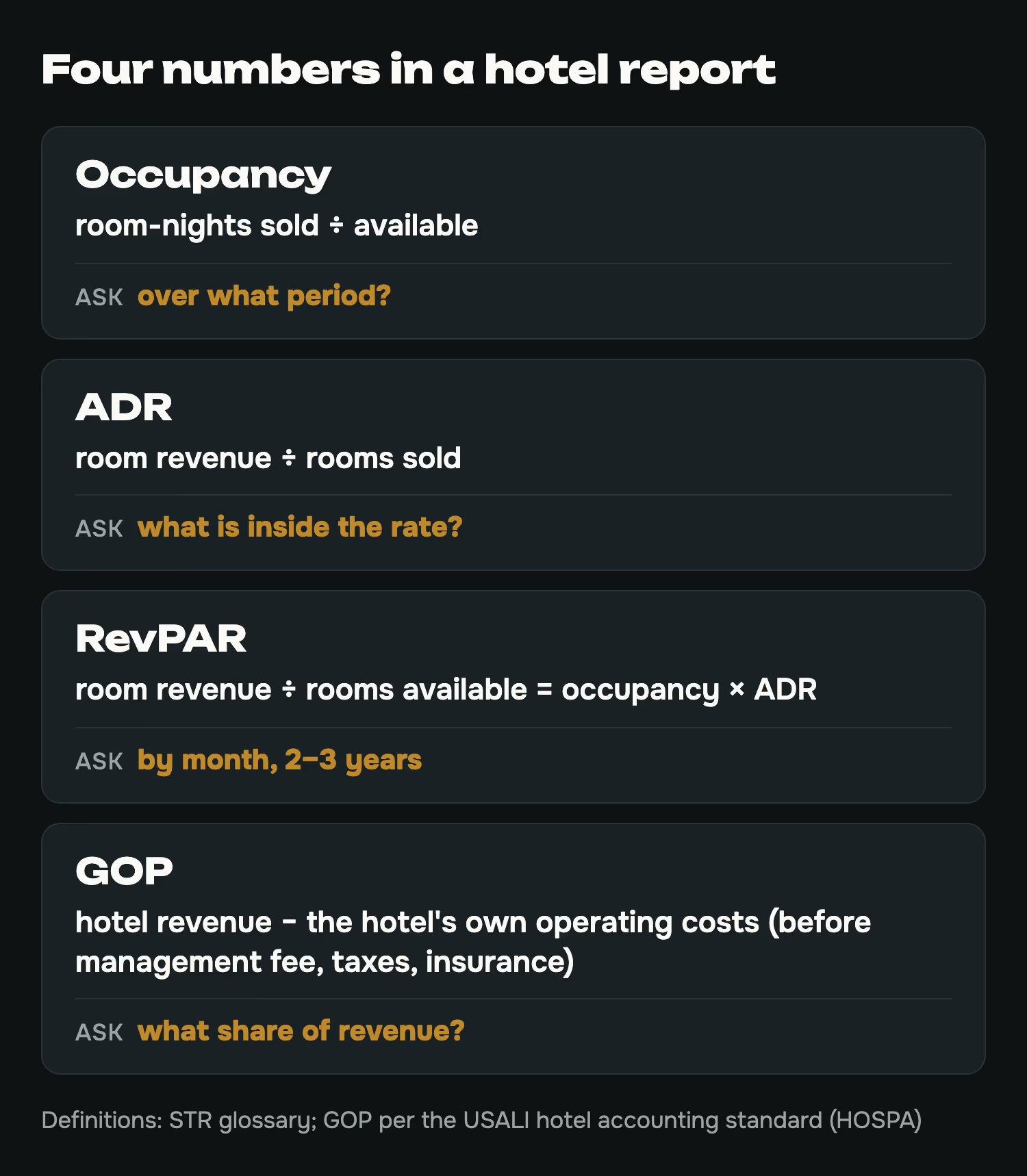
After revenue, a hotel report shows GOP, gross operating profit: what remains after the hotel itself has run. It is counted before the management fee, property tax and insurance.
A regional reference: GOP margin for Asia-Pacific hotels is about a third of revenue (HotStats, June 2025: 34%). That is a regional average, not Bali; we found no primary source for Bali.
A separate line is the reserve for replacing furniture and equipment. In the management agreement of one American hotel, disclosed in a 2022 SEC filing, it is 4% of revenue. That is a single case, but the logic is general: without a reserve the income looks higher than it is, because rooms need refreshing after a few years.
Investing in hotel real estate in Russia and Bali: what gets promised
In Russia, per Nikoliers, hotel investment in the first nine months of 2026 was 35 billion rubles, 41% less than a year earlier. For all of 2025 consultants counted from 60 billion (IBC) to 74 billion (Nikoliers); the methods differ.
In September 2025, consultant Macon put the operating yield of aparthotels at 7–9% a year, while developers talked about 12–20%. When figures differ twofold, you need the chain again: what is that 20% made of?
If you are looking at one specific room, how to buy a hotel room covers what the contract actually gives you. For a Bali villa the arithmetic is its own: villa yield in Bali.
An example: this chain at Nord Nest
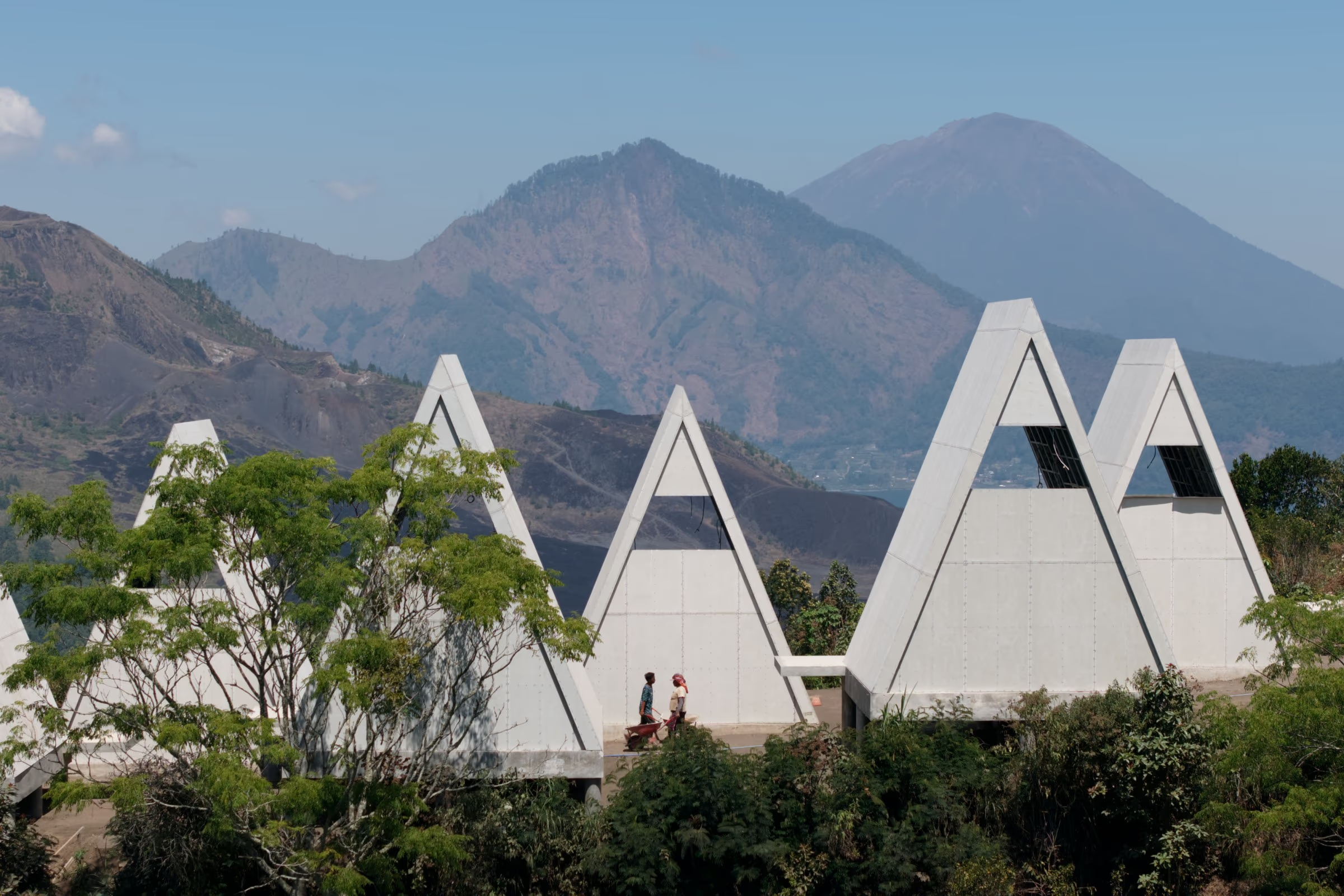
Nord Nest is our project in Kintamani: 8 villas, a restaurant, a spa and a thermal complex (a bathhouse and soaking tubs). GRC runs the hotel; handover is planned for the end of February 2027.
The model assumes an ADR of $185 and 80% villa occupancy. RevPAR comes to $148 and revenue per villa to $54,020 a year. These are assumptions as of August 2026, not facts: the model shows a target and a mechanism, not a promise.
The hotel is not built yet, so there are no actual figures for last year. That is why the full model is open, and reporting runs monthly from the first month of construction.
A share earns from the villas, the spa and thermal complex, and the restaurant. Repairs and management are already deducted in the model, and 70% of net profit goes to the share owners.
By the model, a 10% share yields 18.7% a year with a 5.3-year payback. At 50% villa occupancy it is about 12.5%. Entry is $190,000 for a 10% share; details are on the Nord Nest page, the full model is under finance, and the wider view of hotel investment is on the business page.
What to ask the seller of a room or a share
- “Is that occupancy actual or forecast, and over what period?” A season and a year give different numbers.
- “Which sample are you comparing with the market?” On Bali, everything from 60.6% to 74% gets called “the market”.
- “Is ADR with or without breakfast, before or after discounts, with taxes or without?” That tells you what is inside the price.
- “Show me RevPAR by month for two or three years.” For Bali hotels, July RevPAR is more than double February’s (Horwath HTL, 2025: IDR 2.4 million vs 1.1 million).
- “Who manages, and what do they take?” Find out whether the fee is a share of revenue or of profit, how long the contract runs and what it costs to end it.
- “In what order do platforms, manager, costs and taxes come out?” Ask for the waterfall on last year’s figures, not the plan.
- “Is there a separate repair reserve?” Without it income looks higher than it will be.
- “Which reports do I get, and how often?” A monthly report from revenue to the bottom line beats an “on average” summary.
- “What exactly am I buying: a room, a stake in a company, a right of use?” In Bali also: on what right the land is held, lease term and extension.
- “How do I exit, and is there a lock-up or a right of first refusal?” At Nord Nest there is a 2-year lock-up, and if you sell a share, the other co-owners, GRC included, have 30 days to respond.
In short
What is RevPAR?
Room revenue per available room, sold or not. It is occupancy × ADR. For a sample of 12 Kintamani listings on AirDNA, August 2026: $162 × 70% = $113.
What is ADR?
The average price of a sold room: room revenue divided by rooms sold. Empty nights are not counted.
What is hotel occupancy in Bali?
It depends on the sample: 60.6% for star-rated hotels per BPS (2025), 74% per Horwath HTL (2025), 63–65% per Colliers (Q2 2026).
How much does a management company take?
Per Delovoy Peterburg’s estimate for Russian aparthotels (October 2025), 20–30% of revenue. For Bali there is no single figure; read the contract.
Check our model against these same numbers: the Nord Nest financial model.