Before you invest in Bali real estate, check seven signs of the property and the deal: which right you get, how much of the price is markup, who owns the facilities around you, where you stand in the queue for the money, how big the complex is, whether you can see how the build is going, and whether the area is overheated. They tell you before you buy whether the investment will work. You can check each one yourself, with documents, questions to the developer and a trip to the construction site.
You will be shown the yield first. What decides whether the investment works lies elsewhere.
Below, for each sign: the essence, how to check, and what should worry you. At the end, the same signs applied to our project, Nord Nest.
How to run the checks
How to read a sign
- The essence is how the thing works.
- How to check is what to do and what to ask. Ask the questions as written: at a meeting, on a call, in a message.
- What should worry you: answers after which you should ask again, or stop.
How to check
- For every answer, ask to see where it is written down. Words at a meeting and a clause in a contract are different things.
- Mark each sign: answered directly, answered in general terms, did not answer.
- One evasive answer is a reason to ask again. Several in a row are a reason to stop.
- Have your own lawyer in the country of the property check the documents before the deal. This article suggests what to ask, but it does not replace a lawyer.
We covered how to check the company, the land and the contract separately, in “How to check a developer in Bali”.
The right comes first: it sets the yardstick for the other six.
Sign 1. The right: preserve or grow
The essence
First work out which right you are getting. It decides what you can expect from the investment.
Freehold is about preserving capital. The property stays yours even if the income was modest all those years.
A lease or a share in a business works differently. A lease has a term: near the end you can sell only the years that remain, and there are fewer each year. A share is worth what the business earns.
So the yardstick here is different: growth. Over the term of the right, the income should return what you put in and give something on top. If it does not, it is unclear what you are paying for.
How to check
- Which right is written in the document: freehold, a lease, a share in a company? Ask for the document itself, not a presentation slide.
- Whose name is the right registered in? Is it the same party you are signing the contract with?
- If it is a lease: for how many years, from which year to which? How many years will be left when the property starts earning?
- What does it say about renewal: can it be renewed, at what price, who pays?
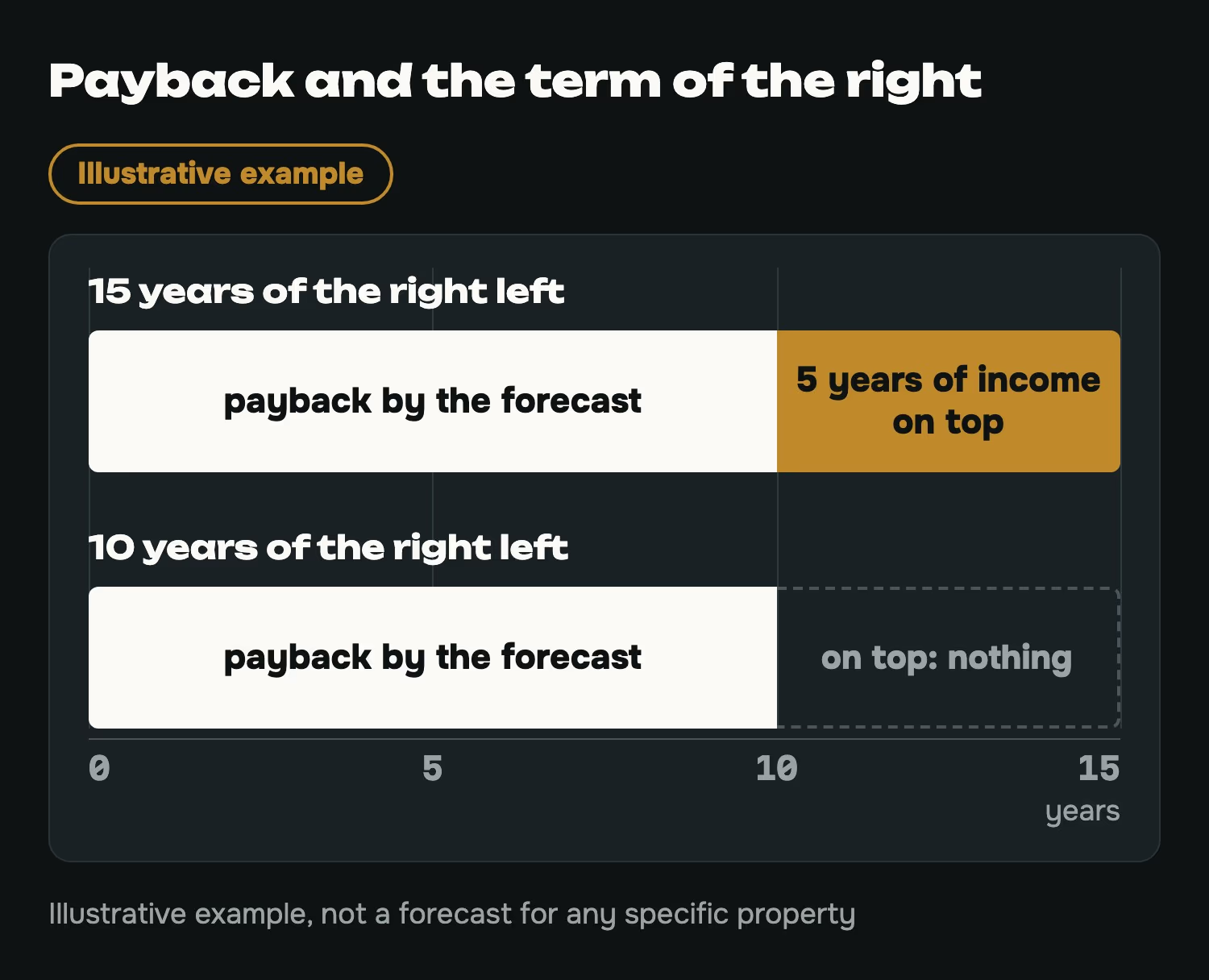
- Compare the payback with the remaining term. An illustrative example: by the forecast the investment returns in 10 years and 15 years of the right remain, so there are five years of income on top, if the forecast comes true. If 10 years remain, there is nothing on top.
- Ask for a scenario with occupancy below the forecast. Does the payback fit into the term of the right then?
- Which right a foreigner can hold and how it is confirmed, check with a lawyer in the country of the property. How leases and other rights work in Bali is in the article “Leasehold in Bali”.
What should worry you
- The term is given as “about”, and the renewal is promised verbally.
- The right is registered to one party, and you sign the contract with another.
- The forecast payback is almost equal to the term of the right, or longer.
- A lease or a share is described in the words of ownership: “your villa forever”.
Sign 2. The developer’s markup
The essence
The price of a unit is not only construction. It also holds the land or the right to it, the seller’s or agent’s commission, marketing and the developer’s profit.
That is normal: developers and agents work for money. The question is the share. The more of the price is anything other than construction, the longer the income will take to pay off the overpayment.
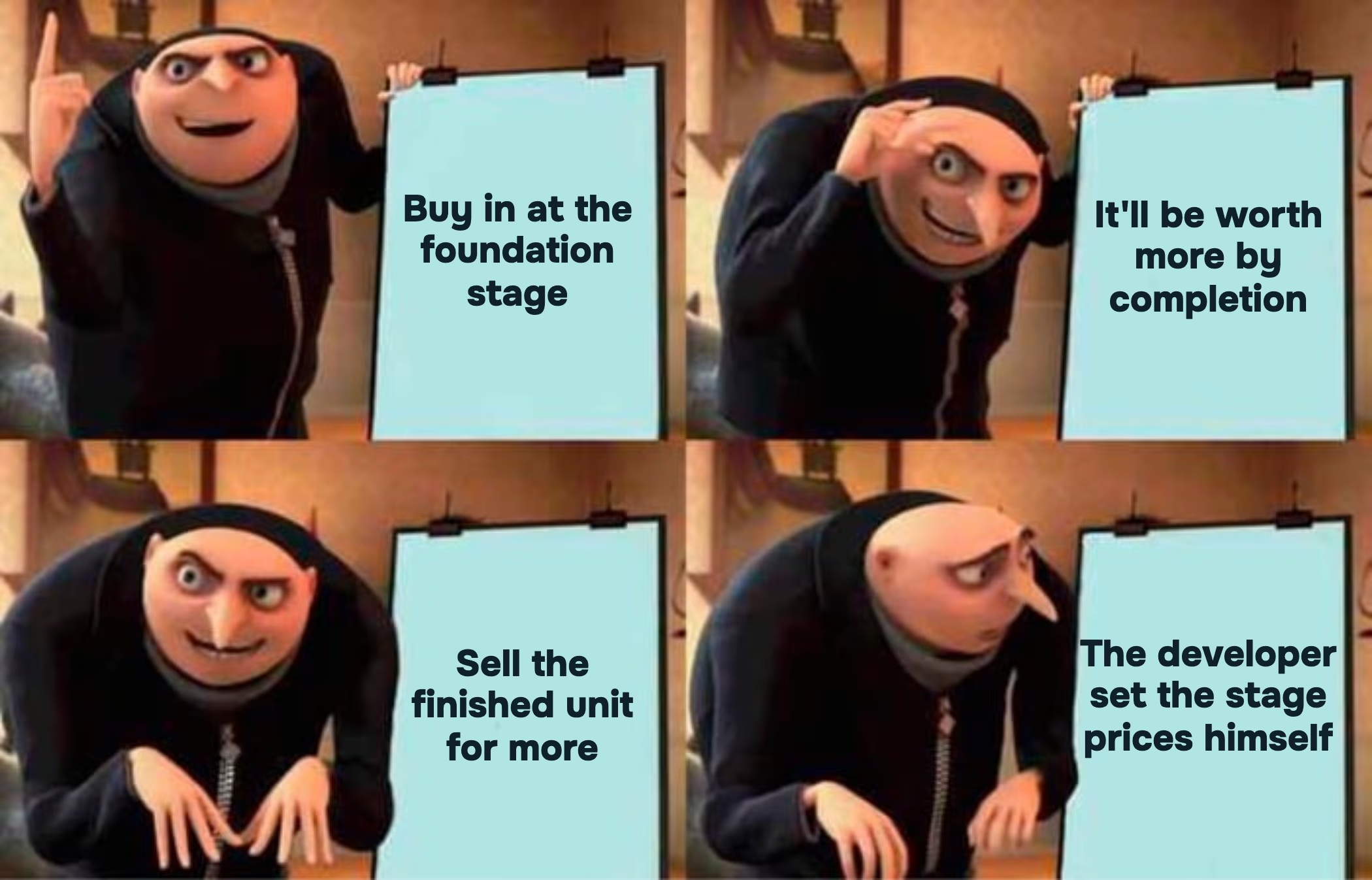
A common argument for yield is price growth “by stages”: get in now, it will cost more by handover. The stage prices are set by the developer. They show what it will cost to get in later, not what the finished property will later sell for on the market.
How to check
- Ask for the price to be broken down: construction, land or the right to it, seller’s commission, marketing, developer’s profit. Percentages will do.
- Ask how much the agent gets and who pays them.
- Compare the price per m² with finished properties nearby, of the same type and class.
- Ask a couple of local agents what similar finished properties sold for over the last year. Not what they were listed at, what they sold for.
- If the yield rests on price growth, ask: what could this property be sold for after handover, and where does that number come from?
What should worry you
- The price is not broken down: “that’s the market price”.
- The commission is not named. A commission is normal in itself. What is bad is silence about it.
- The main argument for yield is “it will cost more by handover”.
- A property on plan costs more than a finished one nearby, and no one explains what makes it better.
Sign 3. Facilities: yours or not
The essence
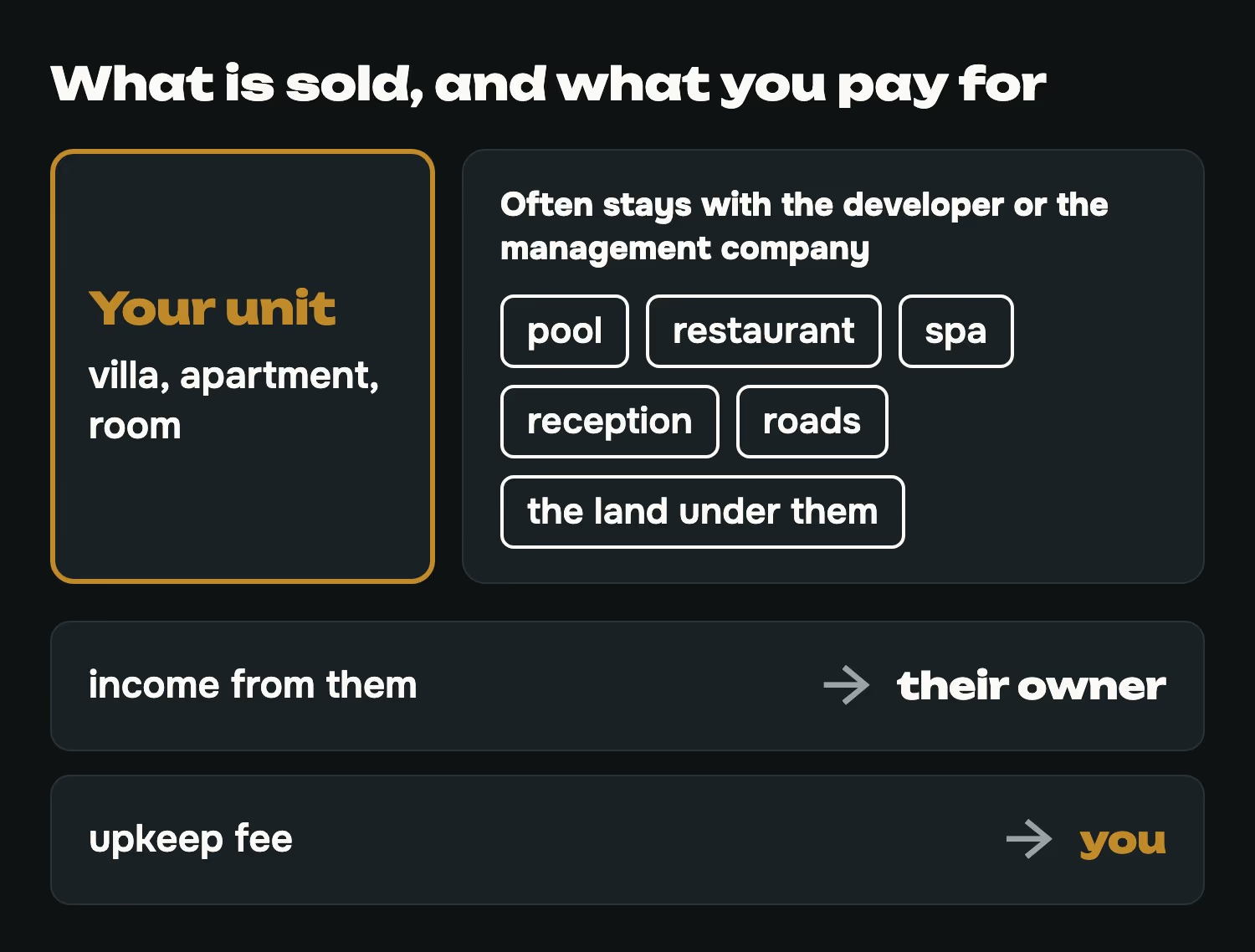
In a complex, what is usually sold is a unit: a villa, an apartment, a room. The pool, restaurant, spa, reception, roads and the land under them often stay with the developer or the management company.
The income from them goes to their owner. And the upkeep is usually paid by you, as a service fee.
So what your unit can rent or resell for depends on things you do not run: how the restaurant performs, what condition the pool and roads are in.
How to check
- Who owns the shared facilities on paper: pool, restaurant, spa, reception, roads, the plot under them?
- Who receives the income from the restaurant, spa and other services?
- How is the upkeep fee calculated: per metre, fixed, from revenue? Who approves it?
- Is there a cap on the fee? How often and by how much can it be raised?
- What happens to the shared facilities if their owner decides to sell or close them?
What should worry you
- They say “it’s all shared”, but the documents list no shared facilities.
- An upkeep fee is charged, and no expense report is given.
- The fee can be raised without the consent of the unit owners.
Sign 4. Are you last in the queue for the money?
The essence
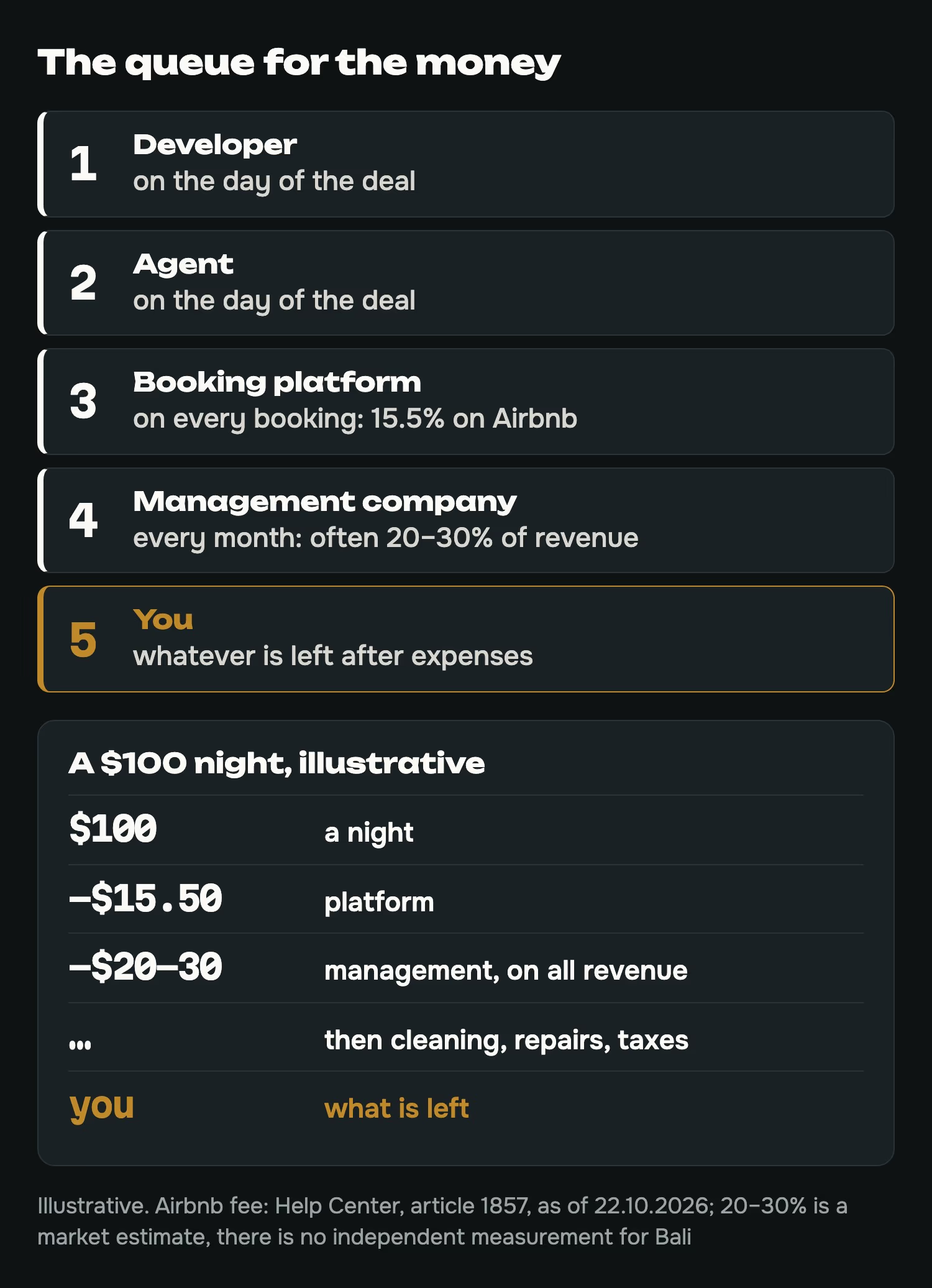
A guest pays for the night, and that money passes through several hands before it reaches your account. For a villa with a management company the queue is usually this: the developer and the agent get theirs on the day of the deal, the booking platforms take theirs from every booking, the management company takes its cut every month. The owner is fifth.
Platforms charge per booking: on Airbnb most hosts pay a single fee of 15.5%, while Booking.com does not publish its percentage. An outside management company, by market estimates, often takes 20–30% of revenue. There is no independent measurement for Bali, and a contract may say otherwise.
The key point is what the fee is taken from. “From revenue” means the commission comes off before expenses are paid and your profit is calculated. Whether you are left with a profit or not, the manager has already taken theirs.
An illustrative example for a $100 night: $15.50 to the platform and another $20–30 to the management company, if it counts from the whole revenue. That is before cleaning, repairs and taxes.
Who takes how much before the owner is covered in detail in the article “The line ahead of the investor’s money”.
How to check
- Draw the path of the money from the guest to your account: who takes how much, and when.
- Ask each one for the base: revenue, profit or a fixed sum.
- Which expenses are deducted before you: cleaning, repairs, utilities, taxes, advertising? Who approves them?
- Are all the commissions included in the yield calculation you were shown?
- Can you replace the management company? Who decides, from what date and at what cost?
What should worry you
- The management company’s commission is “to be confirmed”.
- The yield calculation leaves out the platforms or the manager.
- The manager cannot be replaced, or the contract runs for years with no exit terms.
- The report shows only the payout, with no lines for expenses.
Sign 5. Size of the complex
The essence
The bigger the complex, the more risk. The build takes longer, and to finish it more units have to be sold. If the build is paid for with the money of later buyers and sales stop, the site stops too.
After handover, dozens of identical units stand next to yours. They compete with you for the guest, and on resale for the buyer. Someone will urgently need cash and cut the price, and that pulls down the price of the whole row.
And the scale has to match the experience. Building a few villas and building a complex of hundreds of rooms are different jobs.
How to check
- How many units in total, and how many are already sold?
- What is already built, on site rather than on a render?
- Does the build depend on new sales? Where does the money to finish come from if sales stop?
- What has the developer already built of the same size and type? Can you see it?
- How many identical units will be handed over next to yours, and how are guests shared between them?
What should worry you
- The project is many times larger than anything the developer has built before.
- Deadlines are tied to sales: “we’ll finish when we sell”.
- Identical units are being resold at a discount before handover.
Sign 6. Transparency of the build
The essence
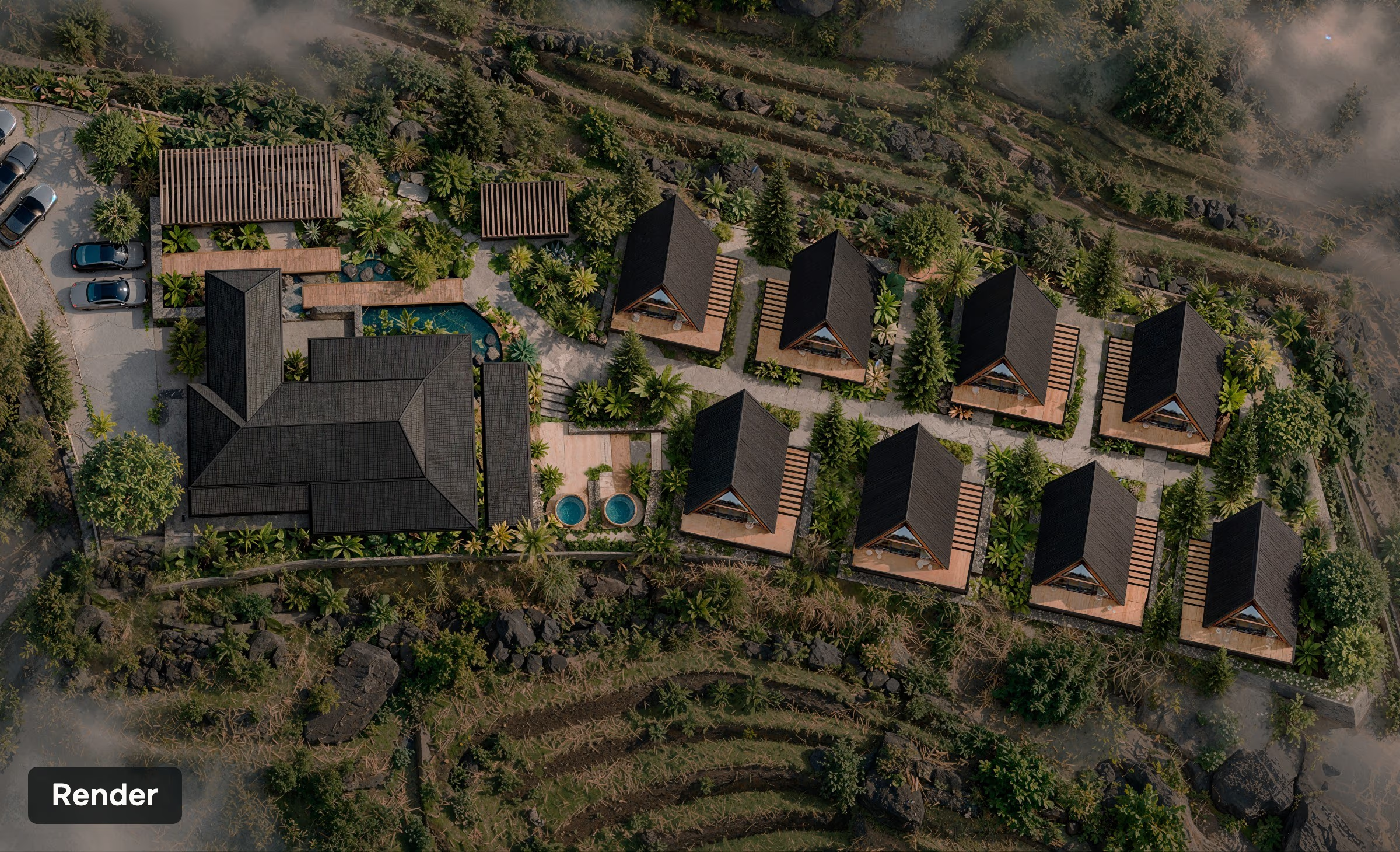
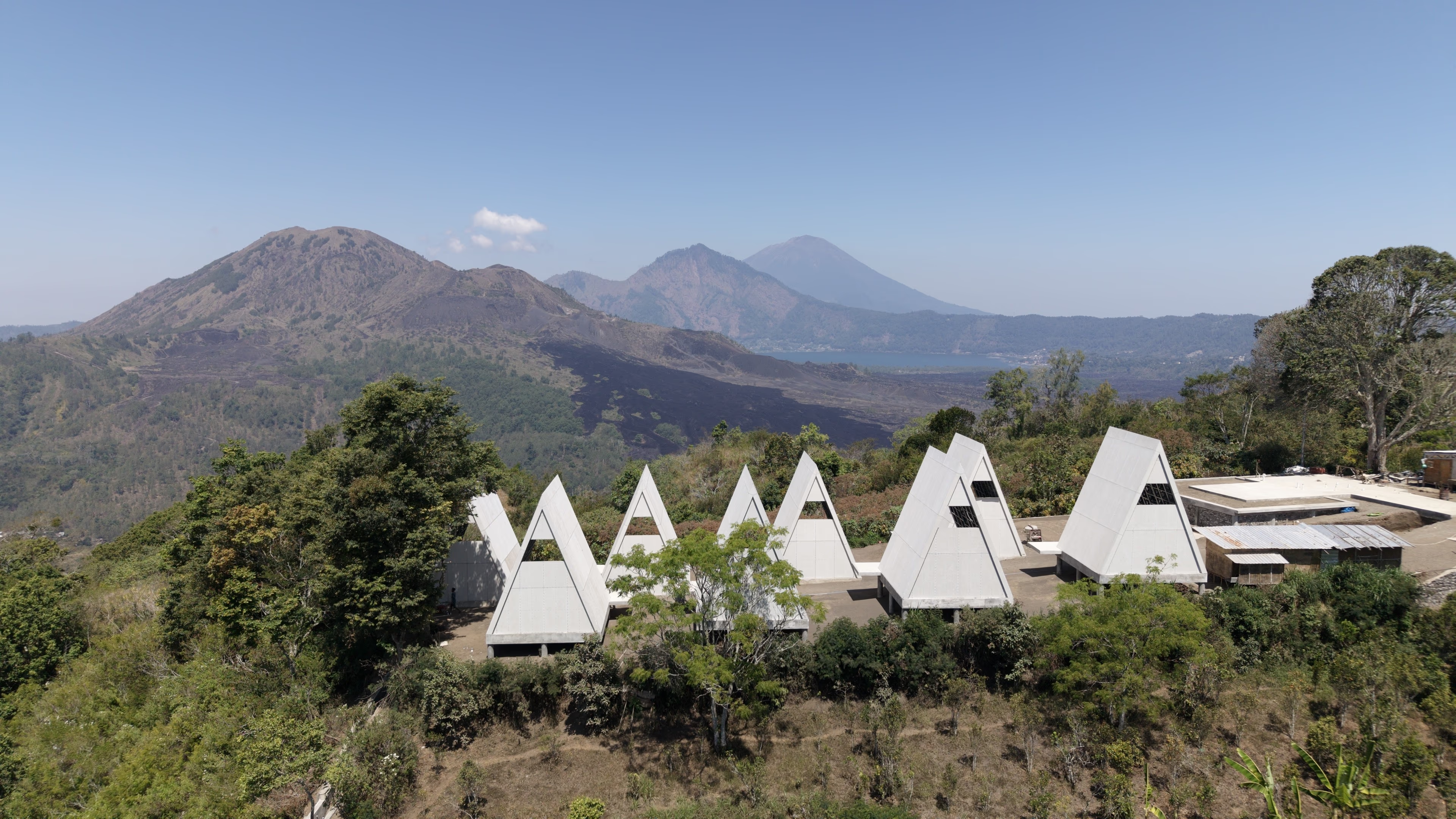
A render shows the intention. The site shows how the work is going.
If you do not live in Bali, the report is your main means of control. You need it from the first month of construction, not after opening: costs, progress of the work, photos.
A report is worth something when it can be checked: you can come and see on site the same thing that is in the report.
How to check
- Ask to visit the site on an ordinary working day, without preparation.
- Ask how often a report arrives and what is in it. Ask for a sample of one already sent.
- Is there a camera or a live stream from the site?
- Who are you in touch with after the deal: only the salesperson, or the people running the build?
- Does what you see on site match the schedule you were shown?
What should worry you
- Only renders and a presentation.
- “Reports will start after opening”.
- Visitors are let on site only on a set day, by invitation.
- Contact only through the sales manager.
Sign 7. The location is not overheated
The essence
An area everyone likes can turn out to be a poor place to invest. If a lot of identical property is being built around, then after handover dozens of neighbours will fight for the same guest.
Then the nightly rate falls, and developers cut prices to fill their units.
Price growth in such an area often rests on the phrase “everyone is moving here”. What to check is the guest’s demand: how many nights are booked and how much is paid for them. What area averages look like on live prices is in the article “Bali villa rental yield”.
How to check
- How many rental listings are in the area, and how has their number changed over the year?
- Average rate and occupancy for the area, across the whole sample, not the best property. Where do the figures come from and as of what date?
- How much is being built around? Drive through the area: excavations, cranes, “coming soon” boards.
- Does a guest have a reason to come here other than fashion?
- What happens to your income if it turns out like the area average?
What should worry you
- A comparison with the area’s best property instead of the average.
- The nightly rate in the forecast is above average, and no one explains why.
- The argument “prices are rising, everyone is moving here”, with no demand figures.
- Dozens of similar properties are being built around.
Summary: 7 questions for the developer
Save this image for your meeting with the developer.
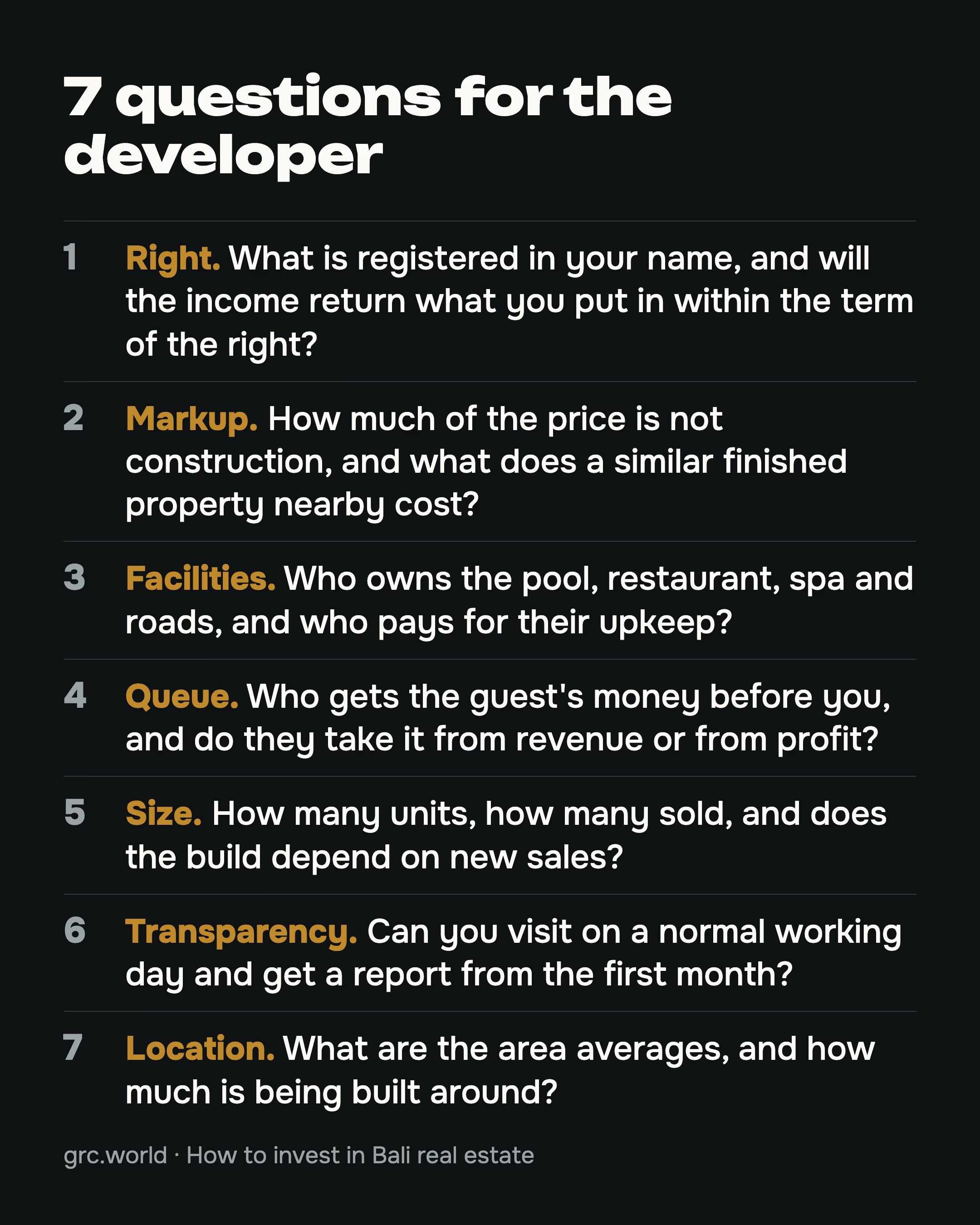
- Right. What is registered in your name, and will the income return what you put in within the term of the right?
- Markup. How much of the price is not construction, and what does a similar finished property nearby cost?
- Facilities. Who owns the pool, restaurant, spa and roads, and who pays for their upkeep?
- Queue. Who gets the guest’s money before you, and do they take it from revenue or from profit?
- Size. How many units, how many sold, and does the build depend on new sales?
- Transparency. Can you visit on a normal working day and get a report from the first month?
- Location. What are the area averages, and how much is being built around?
If they answered directly and showed where it is written down, now you can look at the yield.
How this looks at Nord Nest
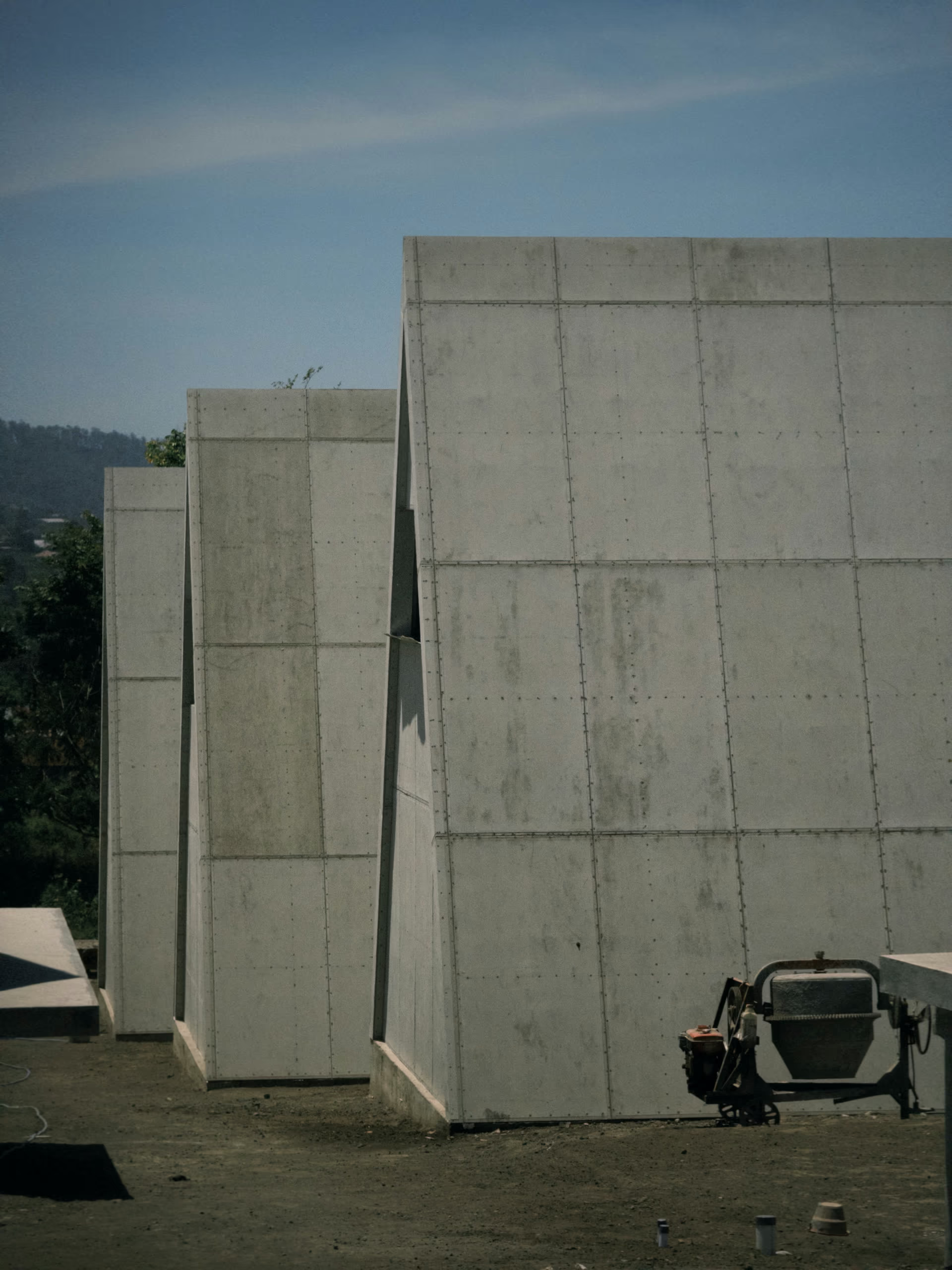
Check us against the same signs. GRC is Global Recreation Company.
We are building Nord Nest in Kintamani, Bali: 8 villas, a restaurant, a spa and a thermal complex. Nord Nest is the first project open to investors.
-
Right. You get a 10% share in the project company. A share owner has no villa of their own: the company owns the whole hotel, with the villas, spa, restaurant and the land lease. The land is leased for 25 years plus 1 year, and can be extended.
Since it is a share, the yardstick is growth: 18.7% a year by the model and a 5.3-year payback (villa occupancy 80%, rate $185, assumptions as of August 2026). At 50% villa occupancy it is about 12.5% a year.
This is a calculation, not a promise; there are no guarantees. Lock-up is 2 years.
-
Markup. The share is priced at construction cost. The entry price and terms are on the Nord Nest page.
-
Facilities. The restaurant, spa and thermal complex are part of the same hotel, and the income of the share comes from them too. By the model, per 10% share per month: villas $1,493, spa and thermal complex $1,068, restaurant $401 (spa occupancy is 70%, restaurant 60%).
-
Queue. GRC runs the hotel. 70% of profit goes to share owners, 30% is GRC’s share: our income comes out of the same profit. Repairs and management are already deducted.
-
Size. Eight villas, all in one hotel with shared income. There are 7 shares for investors, 6 closed (as of October 2026).
GRC covers any cost overrun, and the investor’s share is not diluted. Ruslan, GRC’s founder and architect: seven years in architecture and construction, more than six completed projects.
-
Transparency. Reports monthly from the first month of construction. The build is live.
As of October 2026 the eight villas are up and clad, the electrics are laid, and work has started on the frame of the restaurant and spa building. Handover is planned for the end of February 2027.
-
Location. Kintamani is mountains, not coast. By AirDNA for August 2026 (12 properties in the sample) the average rate is $162 and occupancy 70%.
Our model is above the average: 80% and $185. That is a target. The mechanism is the spa, the thermal complex and the restaurant: a guest has a reason to come to the mountains.
What next
Ask these questions of any developer. Of us too.
- The full model, with all assumptions.
- The build live: what is on site now.
- Terms and entry price.
- A visit to the site in Kintamani, on a working day, hosted by Ruslan and the team. Book on WhatsApp +62 823-5974-1026 or Telegram @grc_world.
- News of the build and the market: Telegram channel t.me/grc_wwworld.
Frequently asked questions
How do I tell whether an investment in Bali real estate will work?
Check seven signs before you buy: the right, the markup, the facilities, the queue for the money, the size of the complex, transparency of the build and the location. If they answered directly and showed where it is written down, you can look at the yield. Several evasive answers in a row are a reason to stop.
Is it worth buying property in Bali?
The property and the deal decide that, and the seven signs check exactly those. The first sets the yardstick.
Freehold is about preserving capital. A lease or a share has a term, and over it the income should return what you put in and give something on top. If it does not, it is unclear what you are paying for.
What should I ask a developer in Bali?
The seven questions from the summary above, one per sign. For every answer, ask to see where it is written down. Have your own lawyer in the country of the property check the documents before the deal.