Four things keep showing up in people’s stories and in the data: income comes in below the promise, money can’t be pulled out quickly, homes are handed over late (45% in Q1 2026), and rent doesn’t cover the interest on a mortgage (18.0% against 4.1%).
Vacancy, costs and taxes eat the difference between promised and real income. A market mortgage costs 18.0%, while gross rent in Moscow yields 4.1%. The main upside is real: resale homes in Russia rose 131.6% in ten years, and escrow now protects a buyer’s money in new builds. Below are what people write, what the numbers show and what to check before a deal. Data collected on 6 Nov 2026.
Pros and cons of property investment: in short
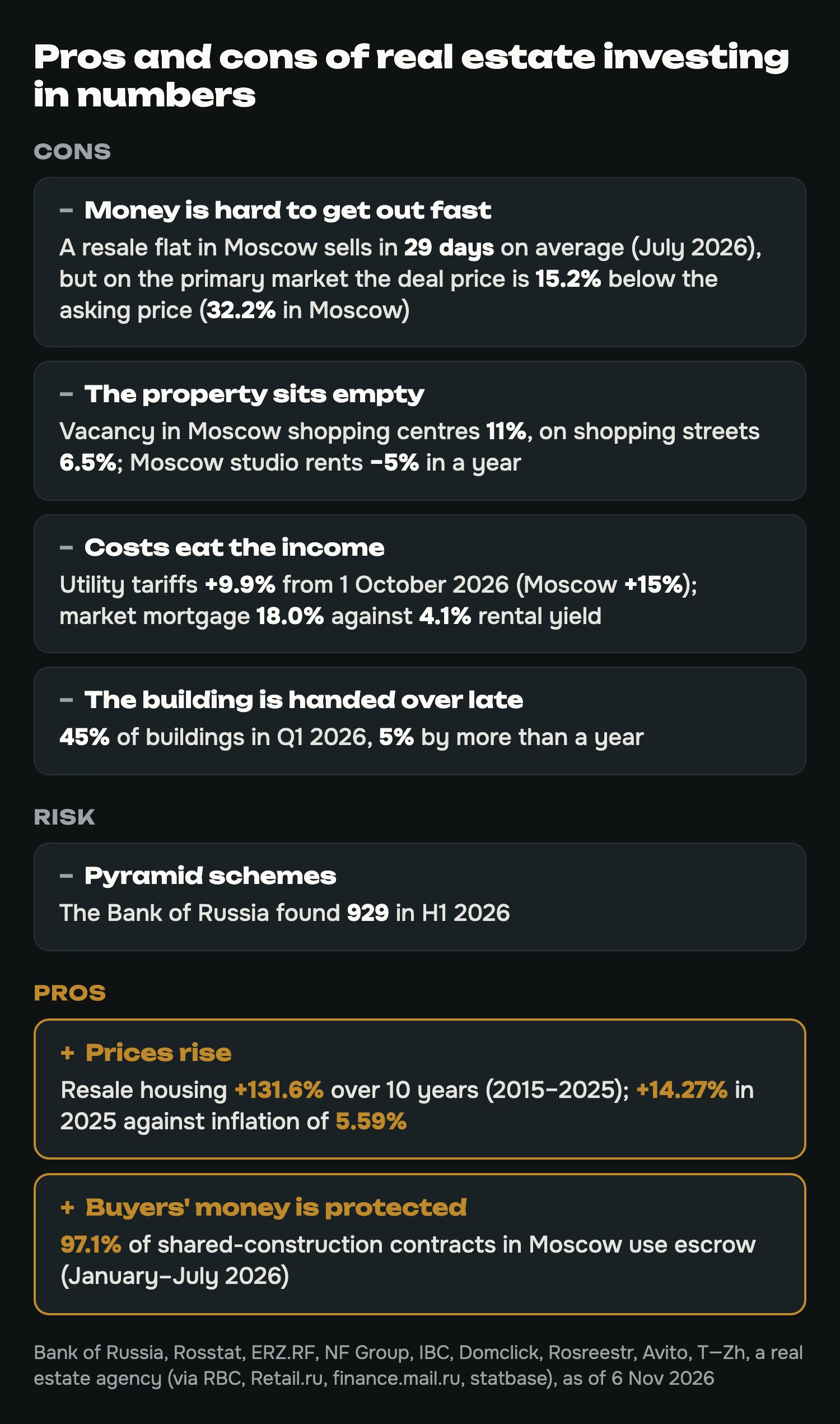
On one side is something you can touch. Resale prices rose over ten years, escrow covers the buyer’s money in a new build, and the flat is registered in your name.
On the other side are four drawbacks and one risk: liquidity, vacancy, costs, handover dates, and money placed with someone who has no property to show. You can’t take money out of a flat at the press of a button, tenants move out, and utilities and taxes keep coming. We go through each with numbers.
What reviews of property investment say
We took six published stories. The numbers are the authors’ own; we haven’t verified them. T—Zh is a Russian personal finance magazine.
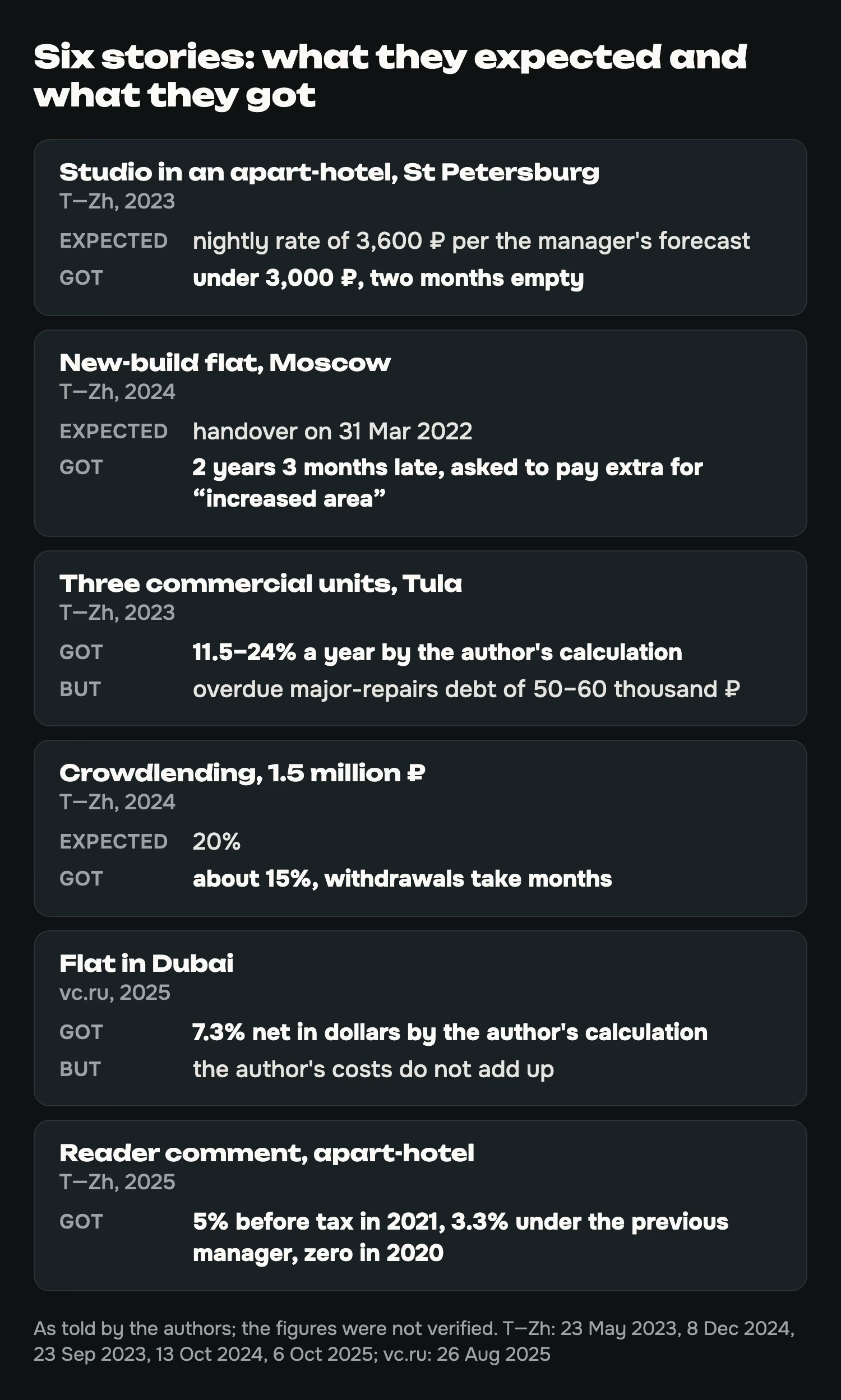
A studio in an apart-hotel, St Petersburg. A T—Zh reader bought a 24.1 sq m studio off plan for 4.3 million RUB and rented it for 30,000 RUB a month: about 7.5% a year before tax. But the flat stood empty for two months while utilities kept running.
The manager’s nightly-rent forecast turned out too high. He later learned that self-employed people can’t rent out this kind of apartment (T—Zh, 23 May 2023).
A new build in Moscow. A T—Zh reader got her flat 2 years and 3 months after the contract date. Dates were moved unilaterally, and after handover she was asked to pay extra for “increased area”.
The 800-flat building had leaks, no hot water in some blocks and lifts that didn’t work. A court, she says, awarded compensation, but the developer isn’t paying (T—Zh, 8 Dec 2024).
Three non-residential premises, Tula. Mostly a good story: rent of 15,000 to 25,000 RUB a month, a return of 11.5% to 24% by the author’s own calculation. One slip: he didn’t check the utility bills and inherited a 50–60 thousand RUB major-repair debt, which the seller paid two months later (T—Zh, 23 Sep 2023).
Crowdlending, 1.5 million RUB. The author expected a steady 20% and got about 15%. Withdrawals took months, and 2–3 loans in 100 defaulted.
The money survived, the income was “like a deposit”. These are small-business loans, not a flat, but the promise is the same (T—Zh, 13 Oct 2024).
A flat in Dubai. An author on vc.ru (a Russian business platform) reports a net 7.3% in dollars: $170,000 invested, rent $1,250 a month. He describes no problems.
But his costs are given as a range that doesn’t add up with the list in the same text, and he doesn’t count Russian taxes. Read this one with care (vc.ru, 26 Aug 2025).
A reader comment on an apart-hotel. Two years in an apart-hotel gave 5% before tax in 2021 and 3.3% under the previous management. In 2020 there was no income at all (T—Zh, 6 Oct 2025).
The same three things repeat: the author didn’t count vacancy and costs, didn’t check what exactly they were buying (documents, status of the premises, debts), and trusted a forecast from someone who earns on the deal.
Con 1: money can’t be pulled out quickly
Sometimes it is quick. A resale flat in Moscow took 29 days to sell in July 2026, against 54 in January (a real estate agency via RBC, 5 Aug 2026). But that is one city, one source and a market short of supply. In another city or another year the number will differ.
Speed depends on price. On the primary market the deal price sits 15.2% below the asking price across Russia and 32.2% in Moscow (Domclick, Sber’s property platform, and Sber’s Centre for Financial Analytics, via RBC, 13 Oct 2026). Selling fast means giving ground.
For apartments we found no published days-to-sell figure, and their liquidity is weak. A closed-end real estate fund runs 3–15 years: fund shares trade on an exchange only if the issue is admitted there.
Con 2: the property stands empty
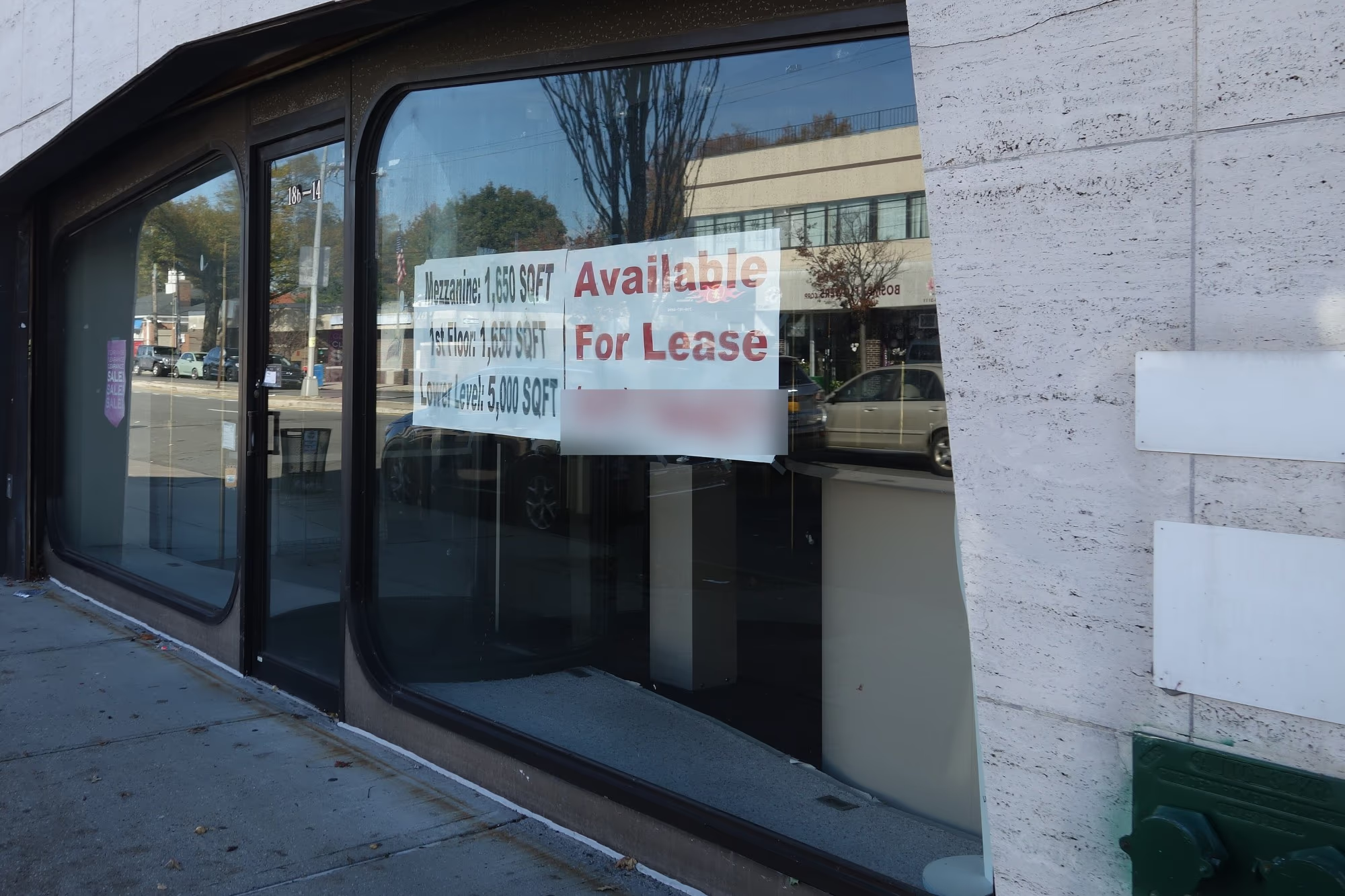
Vacancy shows up in the stories above too. The reader in St Petersburg paid utilities on an empty studio for two months.
In Moscow commercial property, vacancy was 6.5% on retail streets in H1 2026 (NF Group via Retail.ru, 8 Jul 2026) and 11% in shopping centres by September (IBC via Retail.ru, 4 Sep 2026). Moscow apartment-hotel occupancy is 69.7%, so on average nearly one room in three sits empty (NF Group via Rossiyskaya Gazeta, 11 Aug 2026).
Housing isn’t smooth either. Rent for 20–40 sq m studios in Moscow in August 2026 was 60.2 thousand RUB against 63.5 thousand a year earlier: down 5%. In 13 of 20 cities rents are below last year’s (Domclick via RBC, 11 Aug 2026).
Con 3: costs eat the income
Costs arrive even when there is no tenant. From 1 October 2026 utility tariffs rose by 9.9% on average across Russia and by 15% in Moscow (T—Zh, 30 Oct 2026). Add property tax and tax on rent: a self-employed landlord pays 4%, everyone else pays personal income tax on a scale starting at 13%.
Apartments carry a higher property tax, and a management company takes 20–30% of revenue (a magazine estimate, not a report).
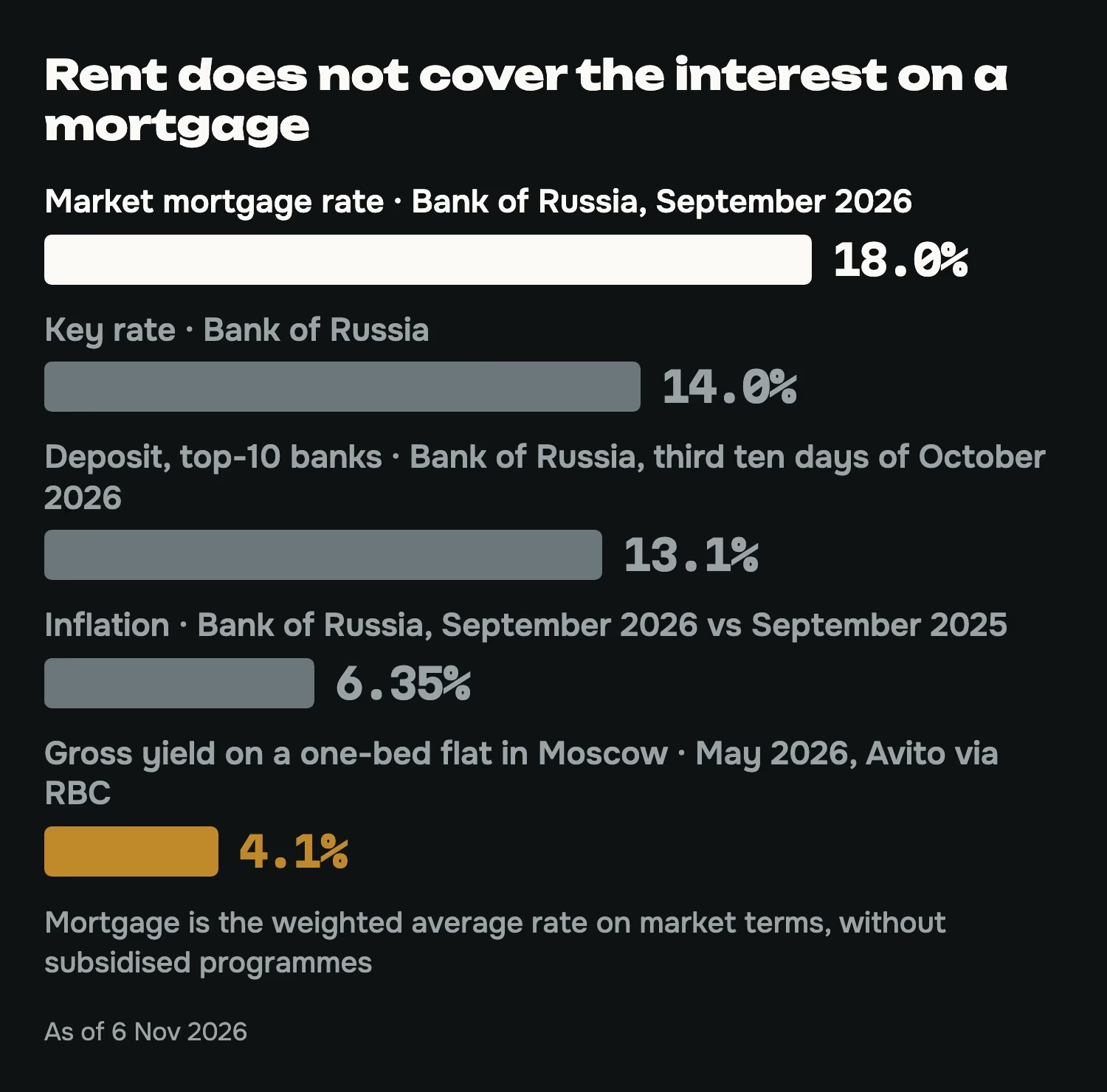
The mortgage needs its own count. The market rate in August and September 2026 is 18.0% (Bank of Russia). Gross yield on a one-bedroom in Moscow is 4.1% (Avito via RBC, May 2026). The loan rate is about 4.4 times the rental yield. That is the market rate; a subsidised mortgage has different arithmetic.
What vacancy and repairs cost, primary sources don’t say, so we have no number. Buyers’ spreadsheets usually leave them out; real life doesn’t.
Risks of property investment: the developer didn’t finish or ran late
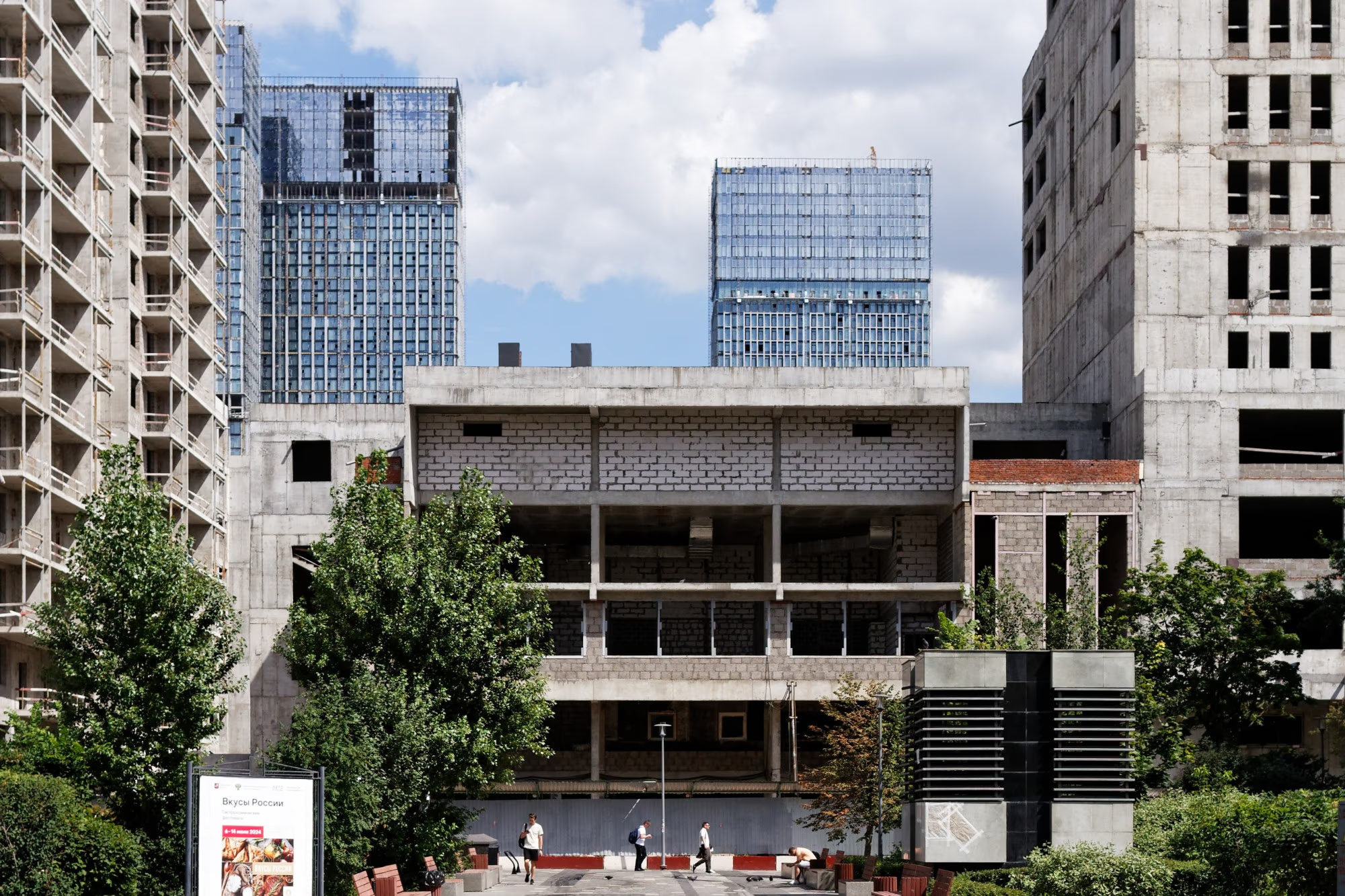
A buyer’s money is safer now. In Moscow 97.1% of shared-construction contracts in January–July 2026 were signed with escrow, and 29 projects are still being built without it (Rosreestr Moscow via RBC, 26 Aug 2026). The register of problem projects held 99 projects and 10.1 thousand people in June 2025 (Interfax via NormaCS, 17 Jun 2025). We found no fresher figure for 2026.
Since 2019 the Fund for Territorial Development, the state body that restores buyers’ rights, has restored the rights of more than 261 thousand people (the fund via Stroitelnaya Gazeta, 16 Mar 2026).

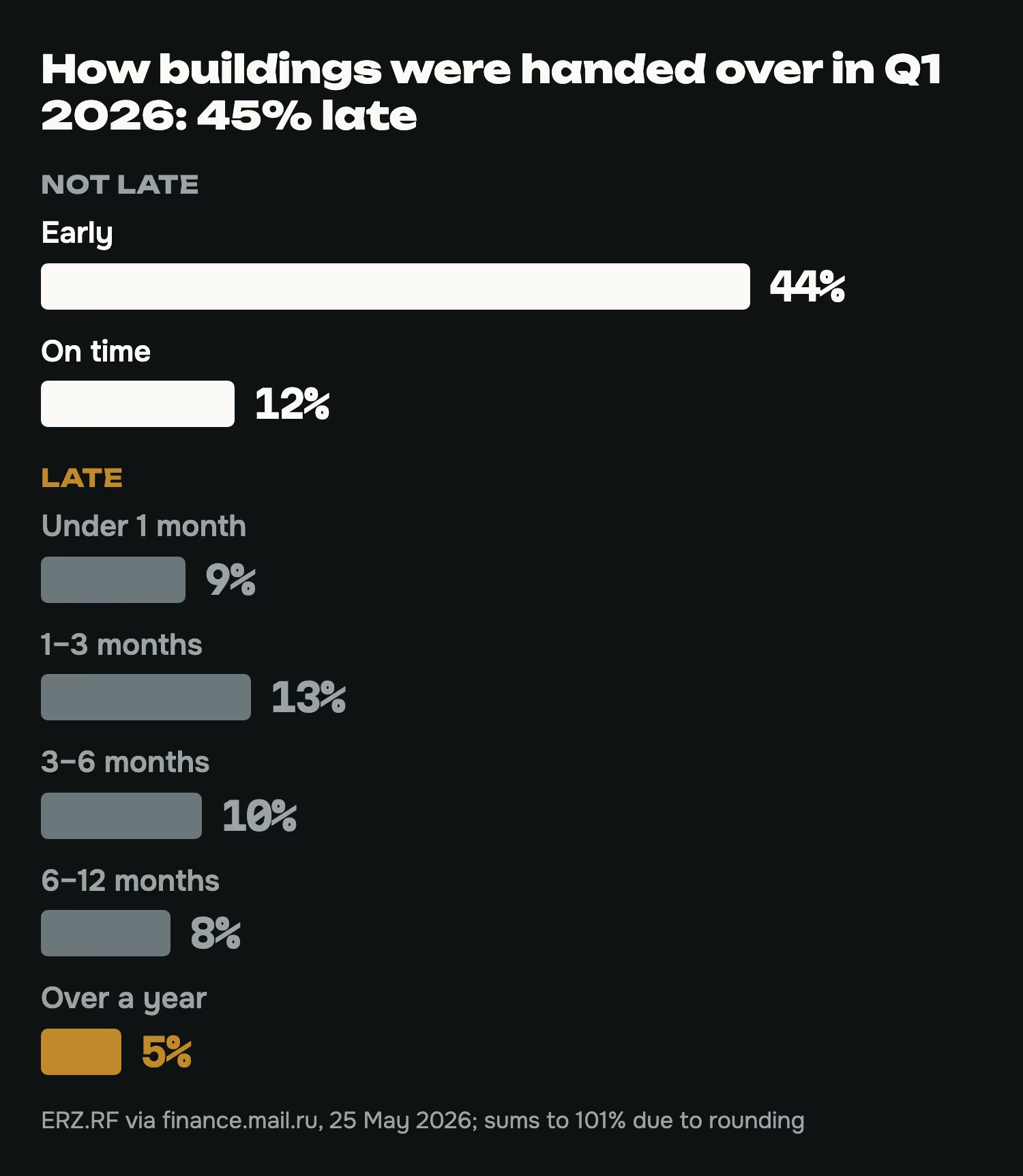
But escrow protects the money, not the deadline. In Q1 2026 45% of homes were delivered late, 5% by more than a year. The average slip was 2.9 months, and 12% were on time and 44% early (ERZ.RF via finance.mail.ru, 25 May 2026).
The Moscow buyer got her building two years and three months late. The money wasn’t lost, but she is the one waiting and fighting the developer.
Risk: “property investment” with no property
Sometimes a promise is sold instead of a property. In H1 2026 the Bank of Russia found 929 financial pyramids and 379 entities raising investment illegally. Separately it found 999 illegal lenders, some of whom lend against flats as collateral (Bank of Russia, 27 Aug 2026). The regulator has no separate line for “pyramids in real estate”.
Crowdlending platforms carry another risk: overdue loans on them were above 22% on 31 Dec 2025 (Bank of Russia). The crowdlending author expected 20% and got about 15%.
The upside: why people still buy property
The average price of resale housing in Russia rose from 56.28 to 130.36 thousand RUB per sq m between 2015 and 2025: +131.6% (Rosstat via statbase). That is growth in roubles, not adjusted for inflation.
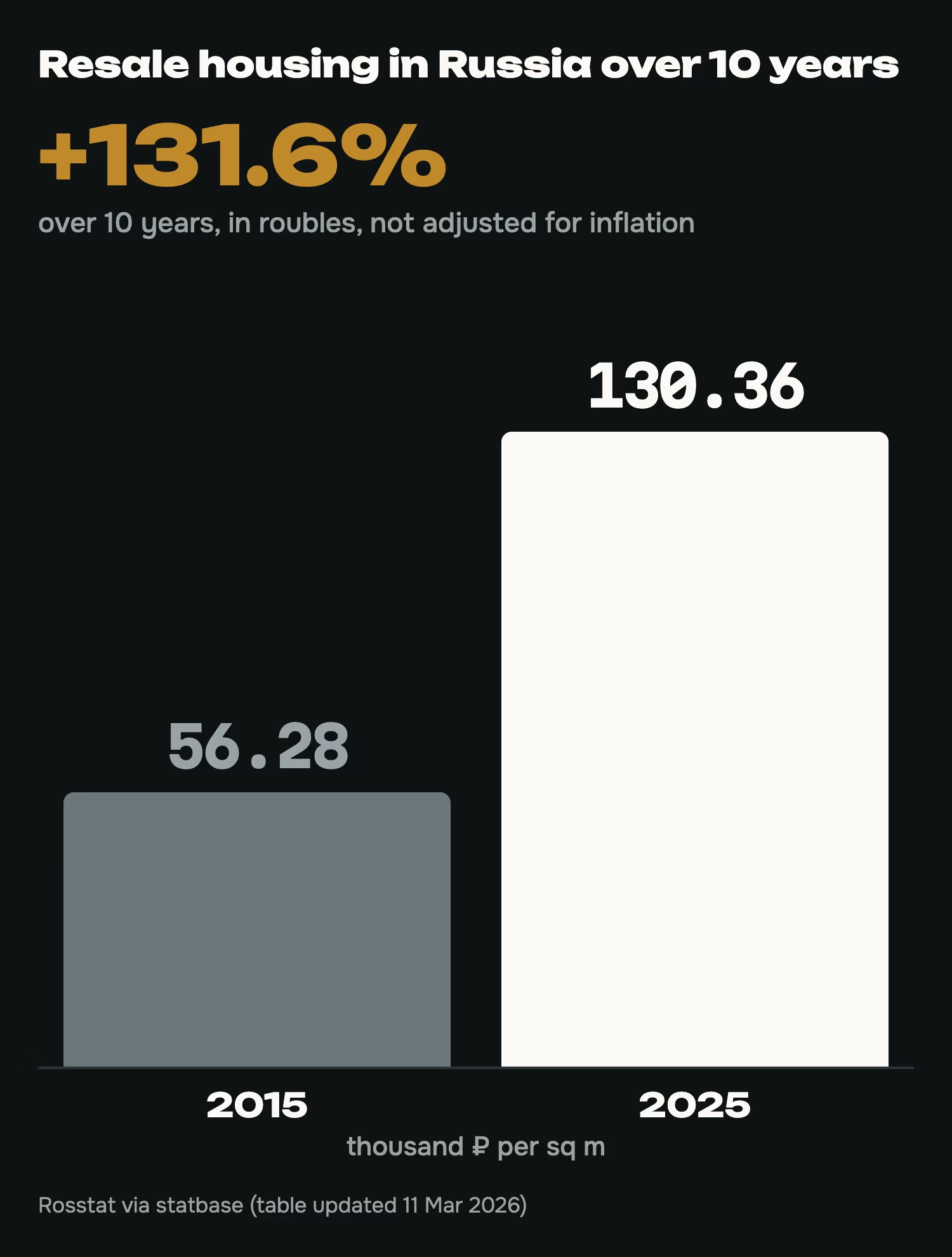
In 2025 alone resale prices rose 14.27% against inflation of 5.59% (Rosstat).
The second upside is escrow: the buyer’s money sits in an account until handover. The third is that the property is yours, if it’s a flat. The Tula reader with three non-residential premises got 11.5% to 24% by his own calculation, because he found tenants right away.
What to check before a deal
Most items come from the stories and numbers above.
- Rate and rent. Compare the loan interest with rent, not just the payment. Count rent after tax.
- Costs. Utilities, property tax, tax on rent, management. Apartments carry more.
- Vacancy. Assume at least two months without a tenant and see how the return changes.
- Developer. Past delivery dates, escrow, court cases. More in our piece on how to check a developer in Bali.
- Bills and status of the premises. Major-repair debts, residential or not, whether it can be rented out.
- The queue for the money. Who gets paid before the owner.
- Comparing routes. What is left on one sum is in the piece on 7 ways; the share calculation is on /en/finance/.
- The forecast. If it comes from someone who earns on the deal, ask for the assumptions and check them against the market.
How these risks look for a share in a hotel

Nord Nest is our hotel in Kintamani, Bali: 8 villas, a restaurant, a spa and a thermal complex (sauna and hot tubs). A share in it raises the same questions, and we answer them directly.
Liquidity. For the first two years the share can’t be sold (lock-up). After that a sale goes through a right of first refusal: the other co-owners, including GRC, have 30 days to answer.
Timing. Handover is planned for the end of February 2027.
Vacancy and income. 18.7% a year is the model figure at 80% villa occupancy and a $185 average rate (assumptions as of August 2026). The Kintamani market per AirDNA for August 2026: $162 and 70%. At 50% occupancy the model gives about 12.5%.
Costs. Repairs and management are already deducted in the model. GRC covers construction overruns, and the share isn’t diluted. There are no guarantees.
The full model is on /en/finance/, the terms of the share are in the project section.
Questions and answers
Is it worth investing in property in 2026?
It depends on the route. A Moscow flat gives about 4.1% gross rent with a key rate of 14% and a deposit at 13.085% (Bank of Russia, late October 2026). Property wins on price growth and on being something you can touch, but loses on liquidity and vacancy.
What are the main risks of property investment?
A late handover (45% of homes in Q1 2026), vacancy, costs and taxes, a mortgage dearer than rent (18.0% vs 4.1%) and a slow sale.
Can you trust reviews of property investment?
A review is one story and the author’s own numbers. It is useful while costs and vacancy are visible in it. Trust less an author who reports no problems and whose costs don’t add up.
How do you avoid a financial pyramid?
Check the company in the Bank of Russia registers. In H1 2026 the regulator found 929 pyramids and 379 entities raising investment illegally. A promise of high returns with no explanation of where they come from is a reason to stop.
Is 20% a year from property realistic?
For a Moscow flat, 3.8–4.1% is the realistic range. If you are promised 20%, check what it is calculated from: it often includes a paper rise in price.