Property tax in Bali comes due at four points. When you buy, the main tax is BPHTB: ceiling 5%, paid by the buyer. Every year you pay land and building tax, PBB-P2: ceiling 0.5% of the tax valuation. When you rent by the night, a villa falls under the hotel tax PBJT, ceiling 10%: the guest pays, the owner calculates and remits. When you sell, the seller pays 2.5% (per the tax office’s guidance).
These are ceilings from law UU 1/2022; the region sets the actual rate. In Kintamani and Sanur the land tax is 0.1–0.2% instead of the 0.5% ceiling, and for Canggu we could not find the regulation. Data as of 29 October 2026.
Property tax in Bali: the four points
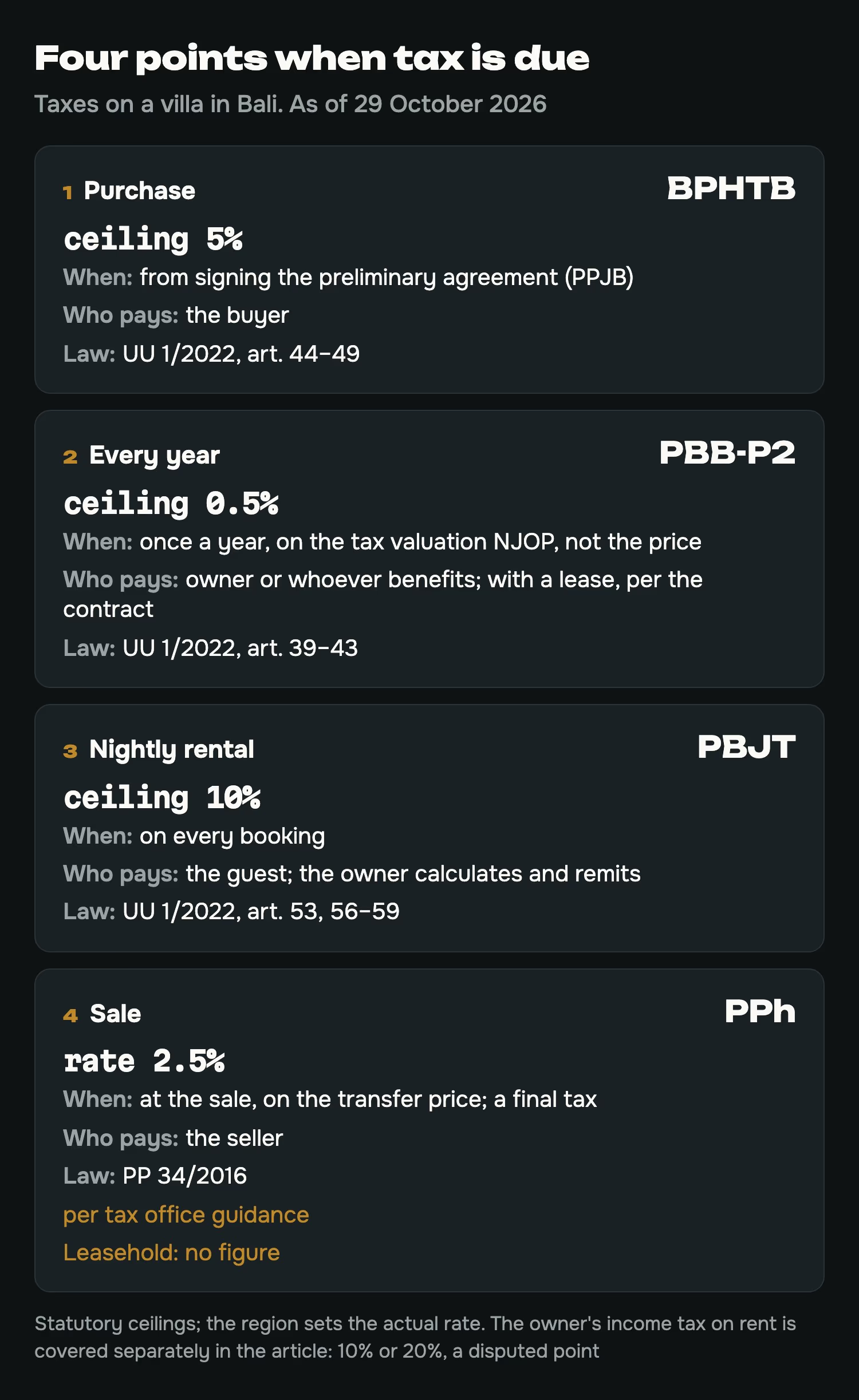
The rate ceilings come from UU 1/2022, the seller’s tax from PP 34/2016 and the tax on renting land and buildings from PP 34/2017. Regional rates come from each region’s regulation (Perda) of 2023, in force since 1 January 2024.
Tax when buying property in Bali
The main purchase tax is BPHTB, the tax on acquiring a right to land and a building. The buyer pays it. The ceiling in the law is 5% (UU 1/2022, art. 47).
It is calculated on the deal price but not below the tax valuation. A tax-free minimum is deducted: at least Rp 80 million, about $4,410, on the first acquisition in a region.
You start paying early: on the day the preliminary agreement (PPJB) is signed, not on the day of the notary deal. In Bangli and Denpasar the regulation sets exactly 5%; in Gianyar it is also 5%, going by an unofficial copy of the regulation.
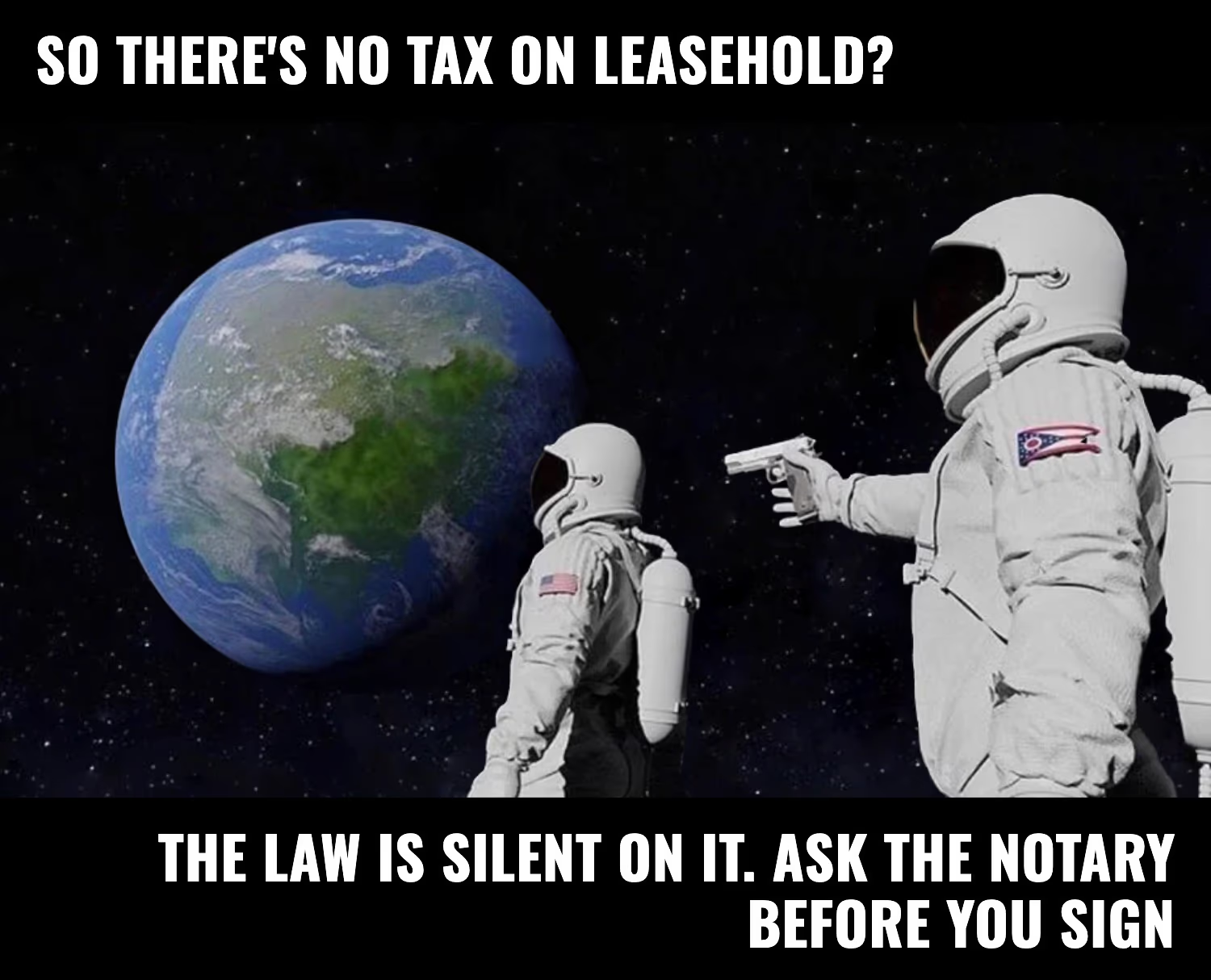
Now leasehold, because most foreigners buy leasehold. The law lists six rights that BPHTB applies to: ownership, right to build, right to use and three more. Lease (Hak Sewa) is not on the list.
That does not mean there is no tax. The law simply says nothing, and how your region’s notary and tax office treat it comes down to practice. Ask the notary before you sign. What leasehold is, we explained in a separate article.
Two more taxes at purchase.
VAT on a purchase from a developer is 12% on paper, but for ordinary goods the base is multiplied by 11/12, so it works out at 11% effective. Whether your villa deal is subject to VAT at all, check with the notary.
For 2026 there is a relief called PPN DTP, where the state covers the VAT, but only for new, finished housing, the first transfer from a developer, a price up to Rp 5 billion, and only on the part of the price up to Rp 2 billion. Whether it applies to a villa built for rental, we could not establish. That is a question for a lawyer.
Seller’s tax (PP 34/2016) is 2.5% of the transfer price per the tax office’s guidance, and the seller pays it. For a resale of the leasehold itself there is no number: we found no source.
The other purchase costs, from the notary to the agent’s commission, are in our article on villa prices.
Land and building tax: what you pay every year
Once a year you pay PBB-P2. The ceiling in the law is 0.5%, but it is calculated on the tax valuation, NJOP, not on the price of the villa, and the two can differ a lot. A tax-free minimum is deducted from the valuation.
The taxpayer is whoever owns the land or building or benefits from it. With a lease, the contract usually decides, so find that clause before you sign.
What the regulations we read say:
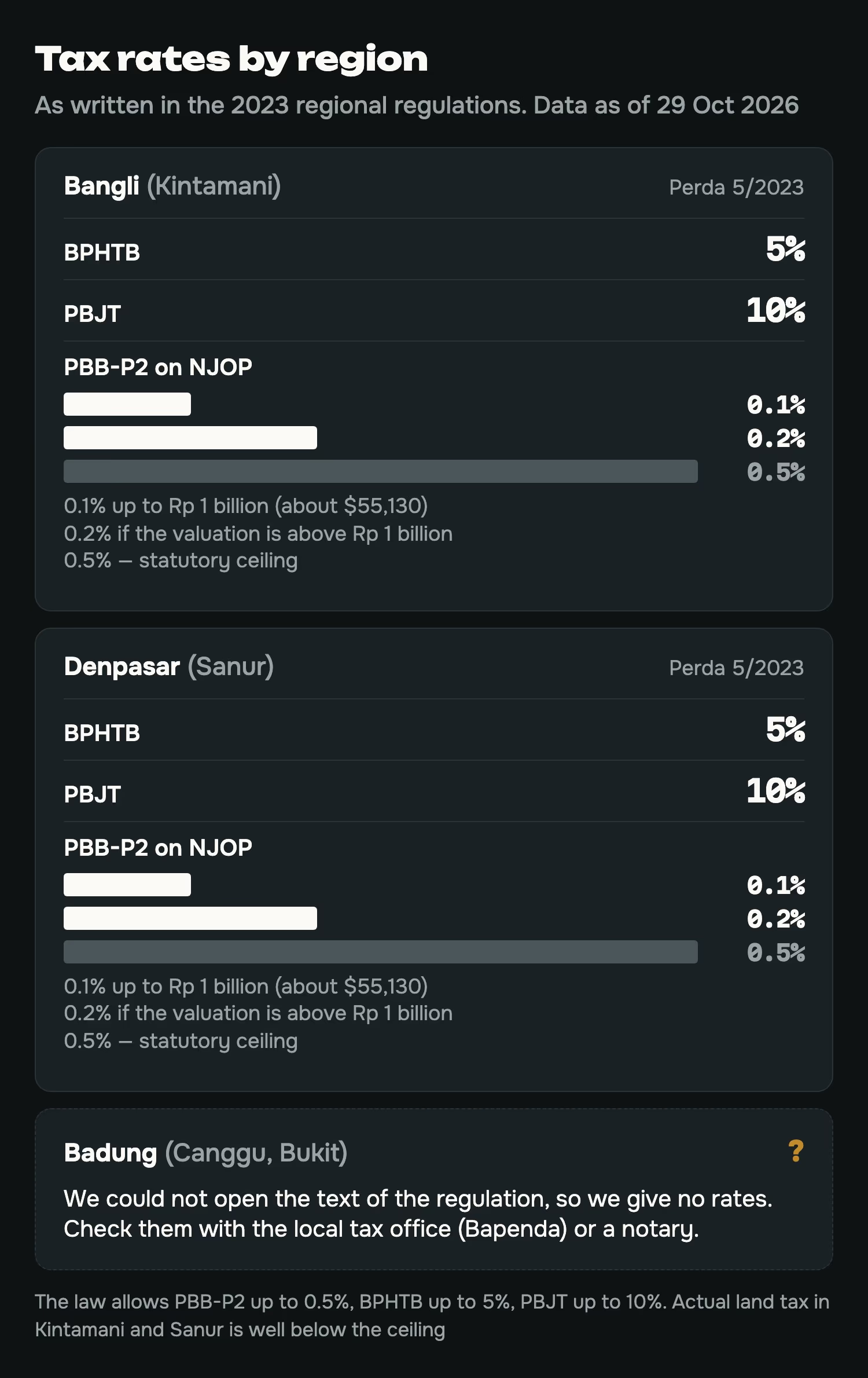
- Bangli (Kintamani), Perda 5/2023: PBB-P2 0.1% if the NJOP valuation is up to Rp 1 billion (about $55,130), and 0.2% if it is higher. BPHTB 5%, hotel tax 10%.
- Denpasar (Sanur), Perda 5/2023: the same 0.1% and 0.2% for PBB-P2, BPHTB 5%, hotel tax 10%.
- Badung (Canggu, Bukit): we could not get hold of the Perda text, so we give no rates. Check with the local tax office (Bapenda) or a notary.
So the real land tax in Kintamani and Sanur sits well below the ceiling in the law. For Gianyar (Ubud) we did not confirm the PBB-P2 rate.
Tax on renting out a villa in Bali
Rental income meets two separate taxes.
The first is PBJT, the hotel tax. Nightly rental is “accommodation services” under the law, and “villa” is named in the list (art. 53). The ceiling is 10%.
The guest pays it as part of the booking, and whoever lets the villa calculates it and remits it to the region. If you let the villa through a booking site, the taxpayer is still the owner, not the platform.
The rule has a boundary: a lease longer than a month is not under PBJT. A private house let out “like a hotel” is.
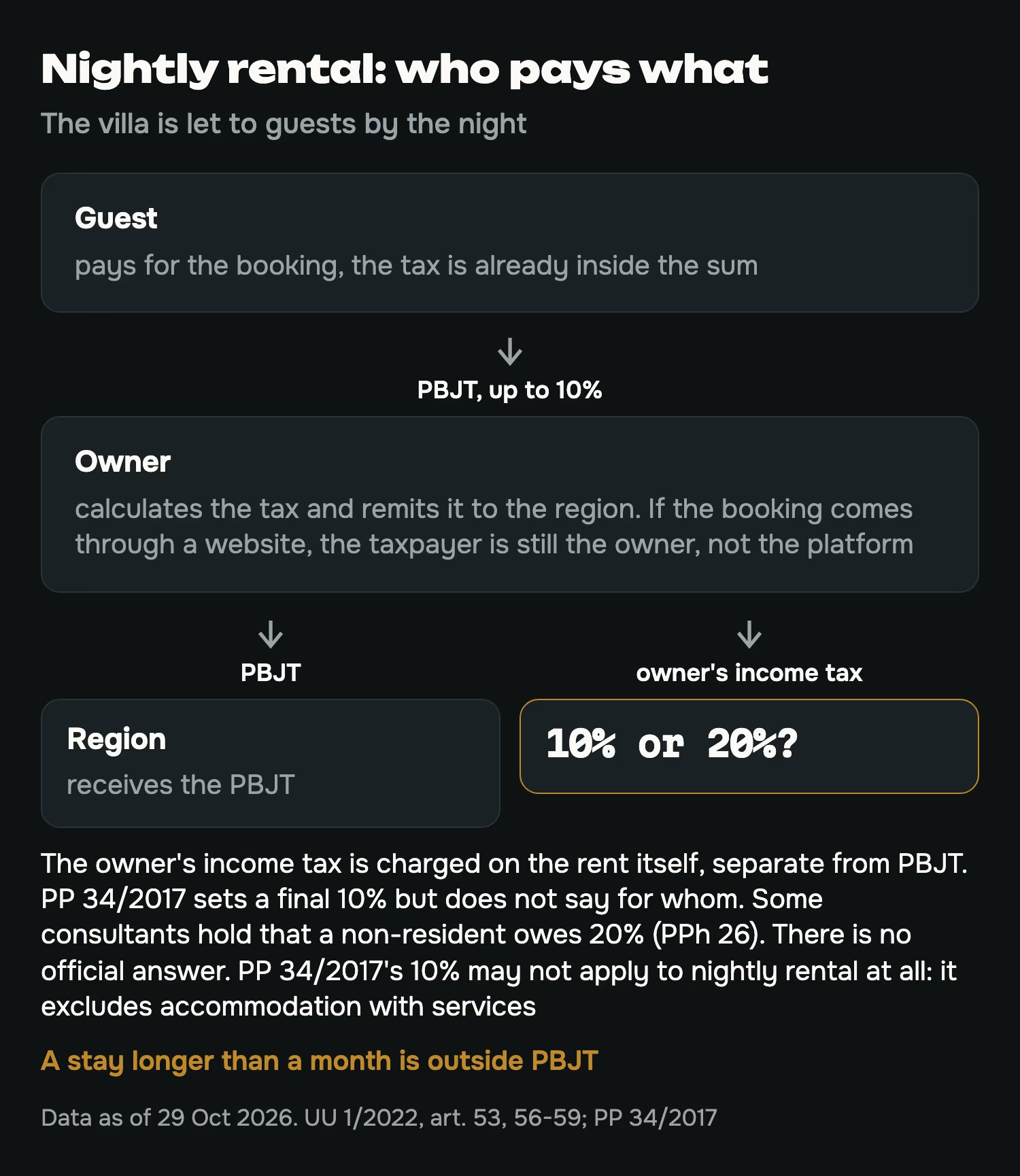
The second is income tax on what the owner earns. Here there is no official answer for a foreigner.
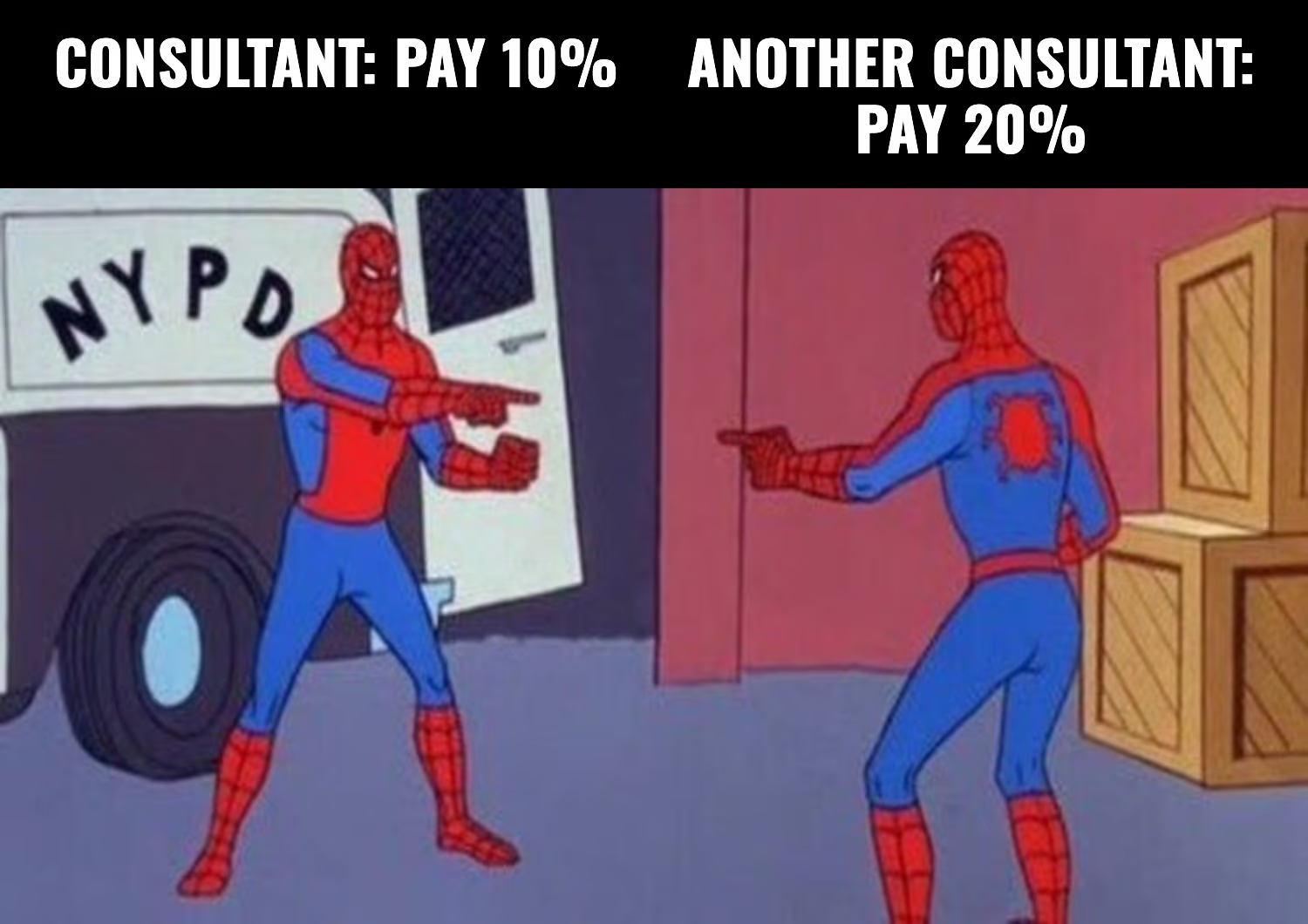
Regulation PP 34/2017 sets a final 10% on rent from land and buildings, but does not say who it applies to. Some consultants hold that a non-resident without a permanent establishment owes 20% under art. 26 of the income tax law (PPh 26). We found no position from the tax service and no court ruling.
One more caveat: PP 34/2017 does not cover accommodation with related services, so its 10% may not apply to nightly rental at all.
Which rate applies, 10% or 20%, is an open question right now. Ask a tax consultant and get the answer in writing.
The Russia–Indonesia tax treaty does not lower the rate on rent: under art. 6 Indonesia can tax that income with no ceiling. The reduced 15% in the treaty applies only to dividends (art. 10).
If the villa sits in a PT PMA company, it is different: the company pays corporate tax of 22%, and dividends paid to a non-resident owner are taxed at 20% at source, or no more than 15% for Russian residents under the treaty. Who else gets paid from a booking before the owner is covered in our article on the queue for money.
Tax when selling property in Bali
The seller pays a final 2.5% of the transfer price (PP 34/2016, per guidance from Indonesia’s tax office). The tax is taken on the sale price, not on profit: sell at a loss and you still pay.
For simple housing the rate is 1%, for a transfer to the state 0%.
With a leasehold, be careful. For assigning a lease, meaning selling the remaining term, we found no number. The law speaks of rights to land and buildings and is silent on the rest of a lease. That is one more question for the notary before you sign.
At home: tax in Russia
A Russian owner also owes tax at home. If you spend at least 183 days in Russia within 12 consecutive months, you are a Russian tax resident (Tax Code art. 207) and pay tax on all income, foreign income included. Rent and sale of property abroad are named in art. 208.
Rental income falls under the personal income tax scale in force since 2025 (art. 224): 13% up to 2.4 million rubles a year, 15% from 2.4 to 5 million, 18% from 5 to 20 million, 20% from 20 to 50 million, 22% above 50 million.
Income from selling property and dividends have their own, shorter scale: 13% up to 2.4 million rubles and 15% above (art. 224 para. 1.1, art. 210 para. 6).
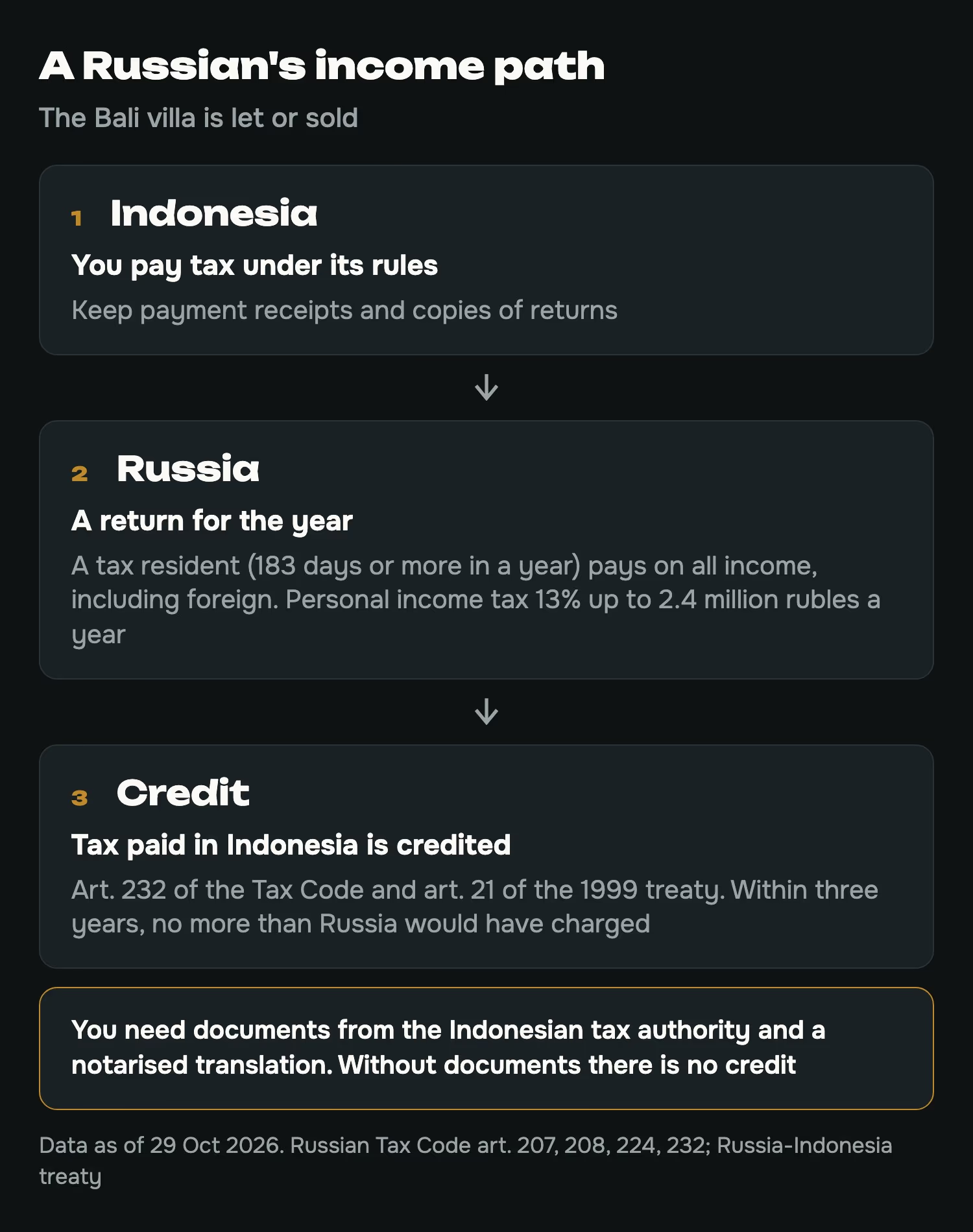
Tax paid in Indonesia can be credited in Russia: art. 232 of the Tax Code and art. 21 of the 1999 treaty. The rules are strict:
- the credit is claimed in the annual return, within three years;
- you need documents from the Indonesian tax authority and a notarised translation;
- the credit cannot exceed what Russia would charge on the same income.
Collect the documents on tax paid in Indonesia from the first year: without them you will not get the credit.
Whether art. 217.1 (relief after a minimum holding period) applies to a lease right and to property abroad, we did not establish. You need a Russian tax lawyer for that.
If you hold a share in the hotel
A share in a hotel works differently from a villa. In the GRC model, the property’s taxes sit in the costs before profit is distributed and are calculated under the property’s jurisdiction (the costs are laid out on the financial model page). After that, 70% of profit goes to share owners.
What a share owner pays at home on the income received depends on their country and on how the payout is structured. Check that with a tax adviser in your country.
In short: questions and answers
What taxes does a foreigner pay when buying a villa in Bali? BPHTB, ceiling 5% (the buyer pays). If you buy from a developer and the deal is subject to VAT, VAT is 11% effective: check with the notary. The seller’s tax of 2.5% (per the tax office’s guidance) is paid by the seller.
Is there tax when buying a leasehold? The law does not list lease among the rights BPHTB applies to, but it does not say there is no tax. Ask the notary before you sign.
What is the tax on renting out a villa in Bali? On nightly rental, guests pay PBJT, ceiling 10%, and the owner remits it. The owner’s income is taxed separately, and for a non-resident it is disputed: 10% or 20%.
Who pays the hotel tax if the booking comes through a site? The person letting the villa, not the platform. The guest pays it inside the booking, the owner remits it to the region.
Do I pay tax in Russia if I already paid in Indonesia? A Russian resident must declare the rental income. Indonesian tax is credited under art. 232 of the Tax Code, but only with documents.