A house on a slope almost always costs more than one on flat ground. A Portland State University study found that preparing a steep site cost 24–47% more than a flat one (US, 2020; an order of magnitude, not a price for Bali). The cost comes from the height of the retaining walls and the volume of soil carted away. So place the houses with the terrain, grade only what a building needs, and plan for water from day one.
At Nord Nest, above the Batur caldera, the villas sit on the slope and the ground under the main building was almost levelled. First we cover what costs more, how dangerous slopes are in Bali, how terraces have been built here for centuries, and what to ask a developer when the site is on a slope. Nord Nest comes after that.
Hillside construction costs: level the site or build with the terrain
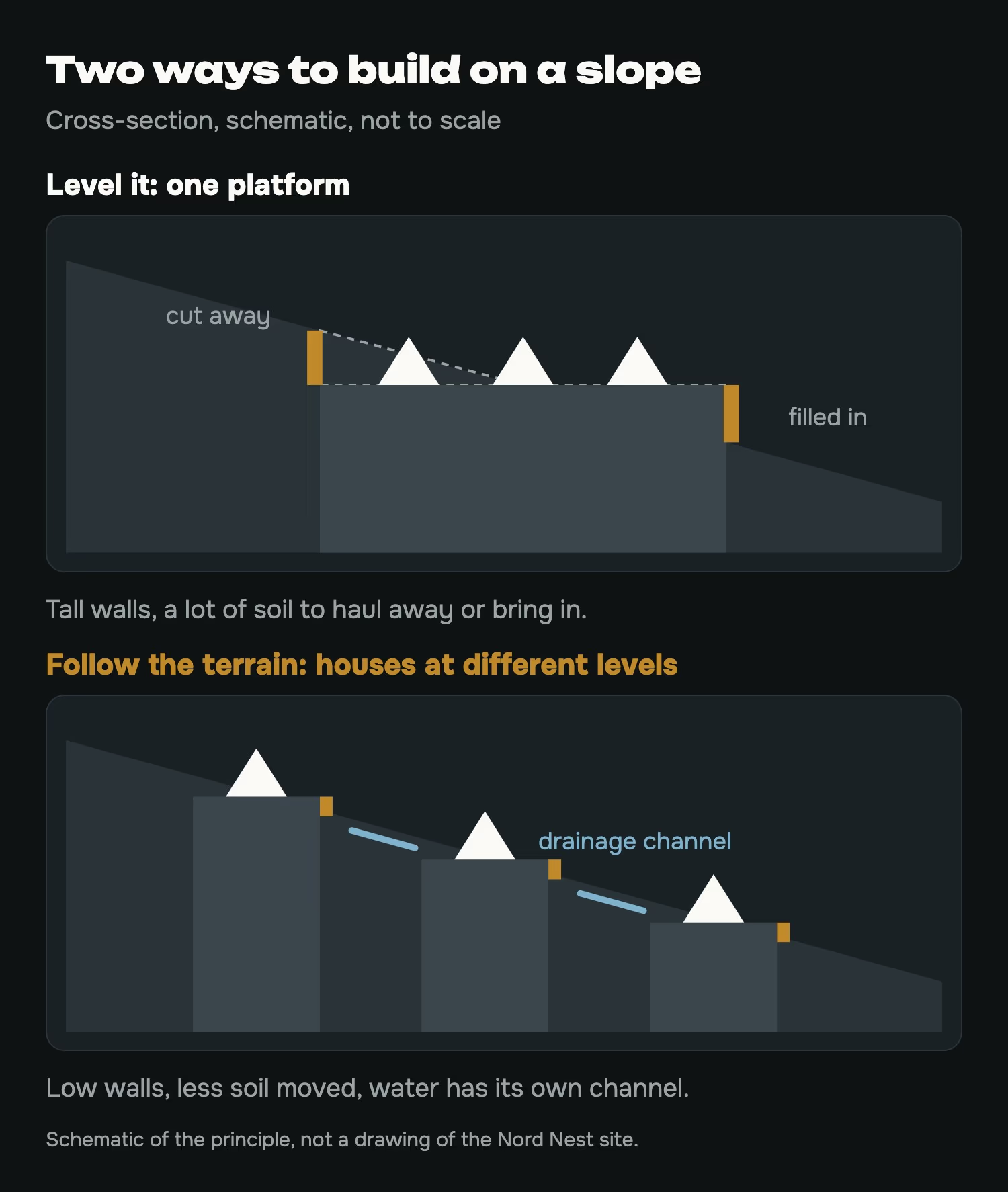
The two methods can’t be compared in money directly: the data only shows how much more it costs to prepare a steep site. In summer 2020 Portland State University’s Center for Real Estate studied developments in the Willamette Valley, Oregon, for the city of McMinnville. “Steep” meant a gradient of 10% or more, “flat” up to 4%. The weighted premium on site preparation for steep over flat was +47% in one sample (16 developments, 328 lots) and +24% in the other (12 cases). We found no comparable data for Bali.
The same report shows what gets expensive. A boulder retaining wall works up to about 1.2 m (4 ft); above that you need reinforced concrete.
An engineer on the project from Marion County estimated the extra cost per square foot of wall at about $25 for boulders and $50–75 for concrete. The steeper the slope, the taller the walls and the more soil you haul out.
| Level the site | Build with the terrain | |
|---|---|---|
| Earthworks | whole platform | under houses |
| Retaining walls | 1–2 tall | a row of low |
| Drainage | needed | needed |
| View | partly blocked | own for each |
| Schedule | lots of soil | more surveying |
| Cost | wall height | wall count |
Cells without numbers come from engineering logic; nobody measured them. Boulders work for walls up to 1.2 m; above that the price jumps, and in Oregon concrete costs 2–3 times more. Drainage is needed either way: a slope has no natural storage, so water must be held back and led away.
Building on a slope: why water is the real enemy
The most frequent destructive landslides in the US are caused by prolonged or heavy rain (USGS, 2 Jul 2018). On steep slopes, small fast slides can turn into debris flows.
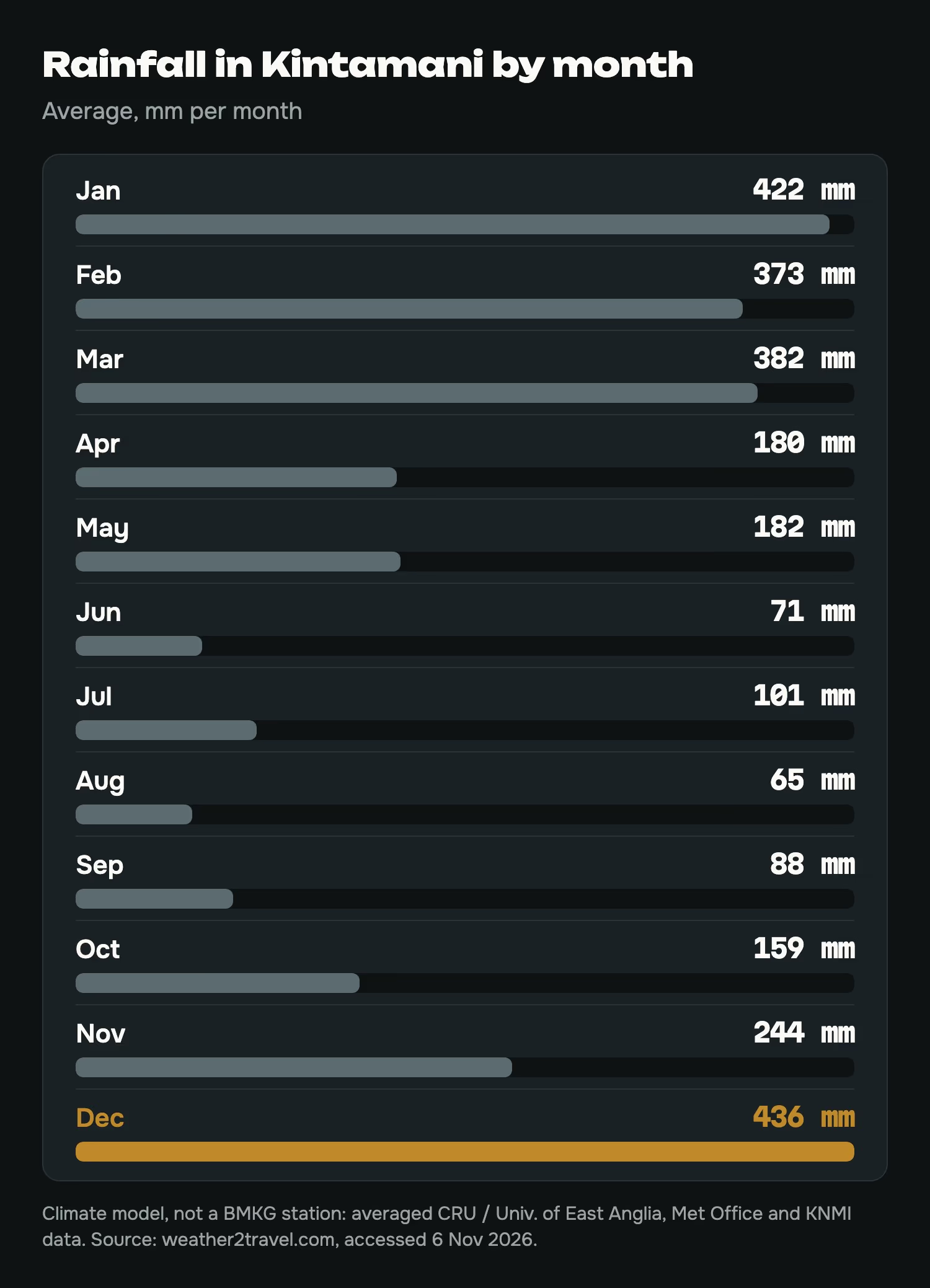
Kintamani gets a lot of rain. A climate model (weather2travel, averaged CRU, Met Office and KNMI data) gives about 2,700 mm a year, with 436 mm in December and 422 mm in January.

That is a model, not a BMKG station reading: we found no measured data for Kintamani.
A slope stays stable while the water has somewhere to go. Drainage is the first line of the budget.
Landslides in Bali: what happened in Kintamani in 2017
On 10 Feb 2017, after heavy rain, landslides hit Awan, Songan and Sukawana in Kintamani and killed at least 12 people (Antara Bali, 10 Feb 2017; one report says 13).
There are rules for this. The Bangli regency spatial plan (Perda No. 1/2023) allows housing in high landslide-hazard zones on conditions: a slope stability calculation, drainage, infiltration wells and deep-rooted vegetation. Where slides are common, retaining walls are required.
A technical hazard assessment comes first. A cliff edge (slope of 45% and a drop of 15 m or more) can be built on only with the sign-off of certified specialists.
Terraces in Bali: how people have built on slopes for centuries
People have built along slopes in Bali for a long time. The island’s rice terraces and the subak system, community management of water, were inscribed on the UNESCO list in 2012.
The listing includes the Jatiluwih terraces and Lake Batur, in the same caldera as our project. Water runs downhill through channels, and a subak assembly decides the release schedule.
We won’t compare villas with rice terraces, since the tasks differ. The shared lesson is to decide where the water goes before calling the bulldozer.
How Nord Nest is built: villas staggered along the slope
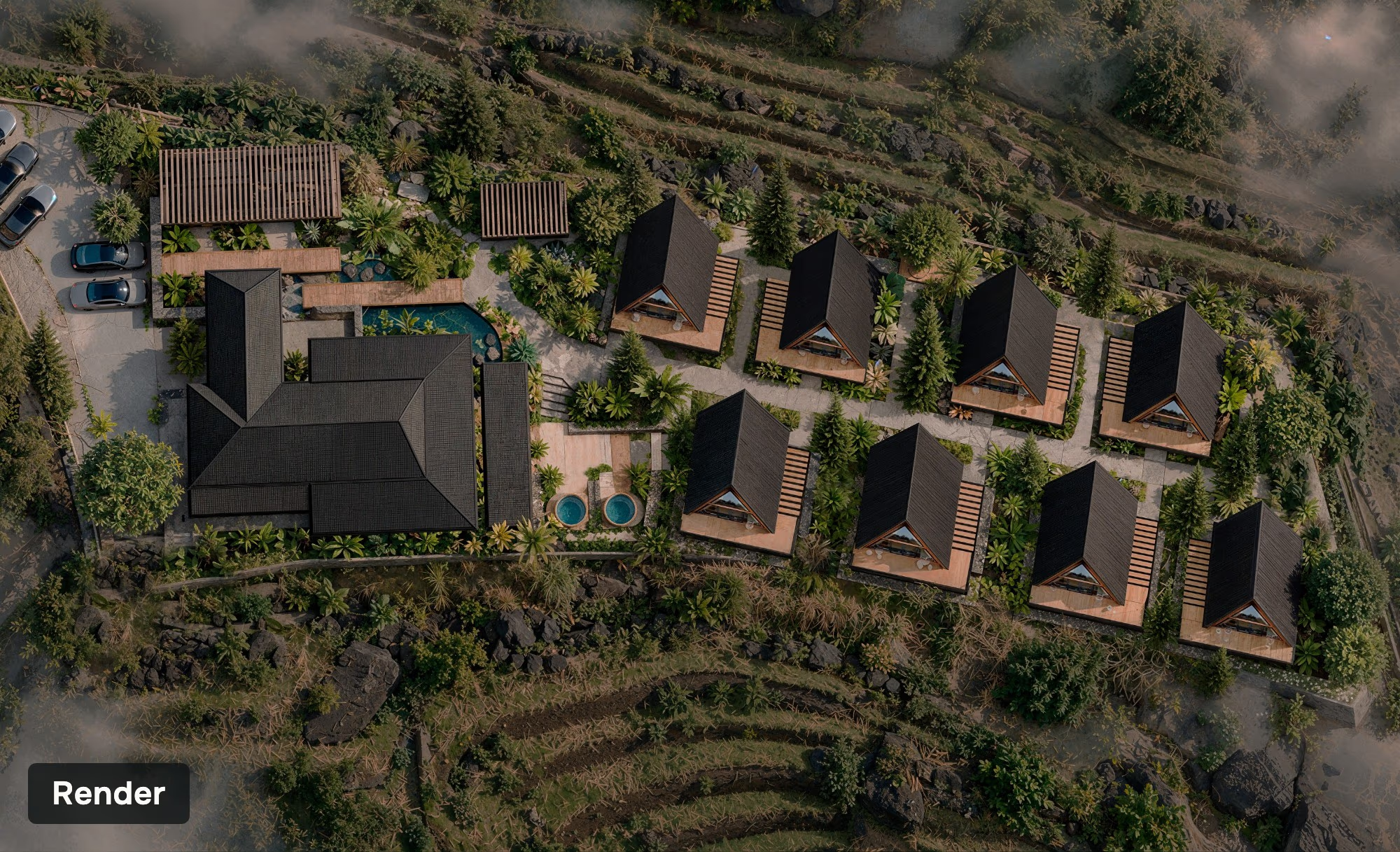
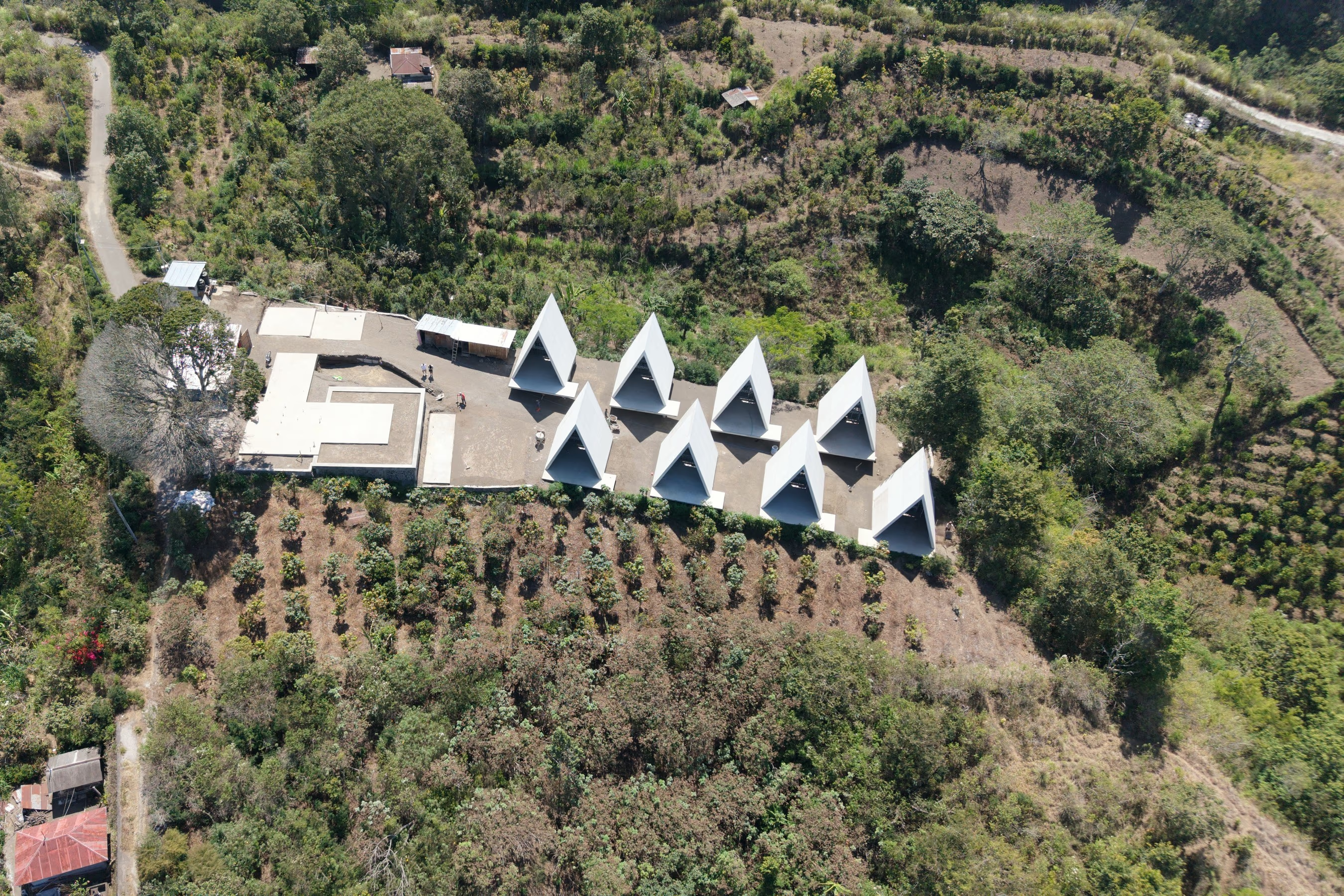
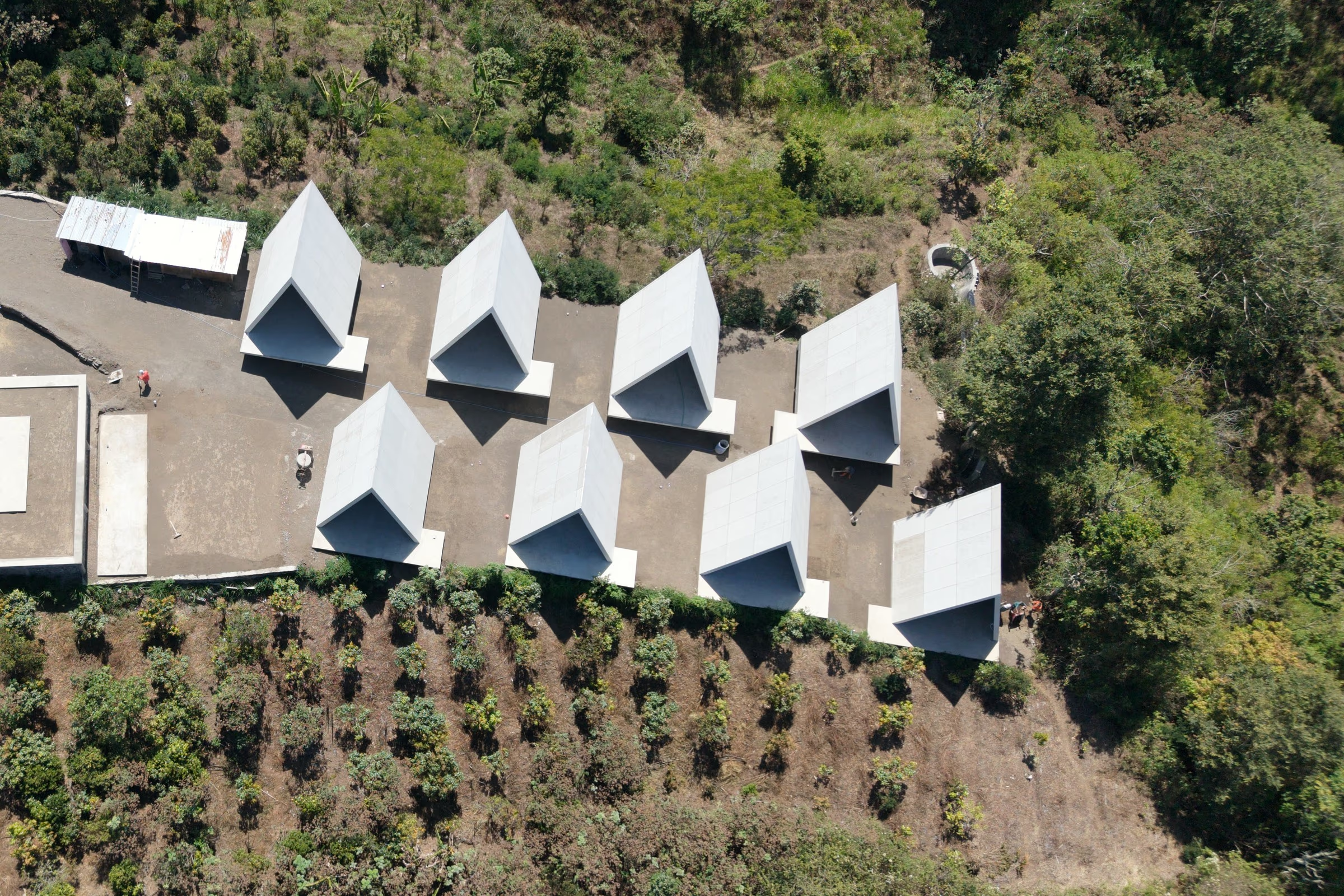
Eight villas stand in two staggered rows along a shared path, each at its own level. Each has an open view of Batur, Abang and Agung: the rows don’t block each other. Why the view matters so much is covered in Best area to invest in Bali.
Under the main building the plot was almost levelled, and in places we added fill.
The second row of villas stands higher than the first, on foundations with grade beams (site report, 2 Mar 2026). The foundations were reinforced for seismic load and wind.
A drainage channel runs between the houses.
What to ask a developer if the site is on a slope
A short list. A good developer answers each point with a document or a number.
- What is the gradient in percent, and who measured it? You want a topographic survey, not “a gentle slope”.
- Is there a geotechnical report on the soil and slope stability?
- Where are the retaining walls, how tall, what are they made of, and who calculated them?
- Where does rainwater go: channels, infiltration wells, outfall? Ask to see it on the plan.
- How much soil is cut and filled, and where does the surplus go?
- What happened to the site in the last rainy season: wash-outs, settlement?
- How are the foundations set relative to the slope: slab or piers?
Checking the company, the land and the permits is covered in How to check a developer in Bali and How to open a hotel in Bali. The project’s economics are in the financial model. Next: Thermal complex at a hotel: hot water in the Kintamani highlands.
Frequently asked questions
How much does building on a slope cost?
In the PSU study (Oregon, 2020), preparing a steep site cost 24–47% more than a flat one. That is the US and residential streets; there are no prices for Bali. Use it as an order of magnitude and as a list of cost items: walls, soil, drainage.
Is it better to level the site or terrace it?
Cutting the whole slope is expensive because of tall walls and hauling soil, and the houses lose their view. Building with the terrain needs drainage and stability calculations. You usually have to grade under a building either way.
Can you build a house on a slope in Kintamani?
Yes. The Bangli regency spatial plan requires a slope stability calculation and drainage in high landslide-hazard zones, and specialist sign-off at cliff edges.
How do you protect a hillside house from rain and landslides?
Lead the water away: channels, infiltration wells, deep-rooted vegetation, retaining walls where the slope moves. These are design decisions made before construction starts.