A developer’s price is the cost of construction plus the developer’s profit, commissions and marketing. The buyer sees only the total. Entering at cost means the developer’s margin is not built into the price: you pay for the construction, and the costs are backed by documents.
Below: what the price is made of, how big the margin usually is, and what its absence does to the yield maths.
What a developer’s price is made of
The most detailed public breakdown comes from US home builders. The National Association of Home Builders (NAHB) surveyed its members and published the price structure of a typical new home for 2024. The average price was $665,298.
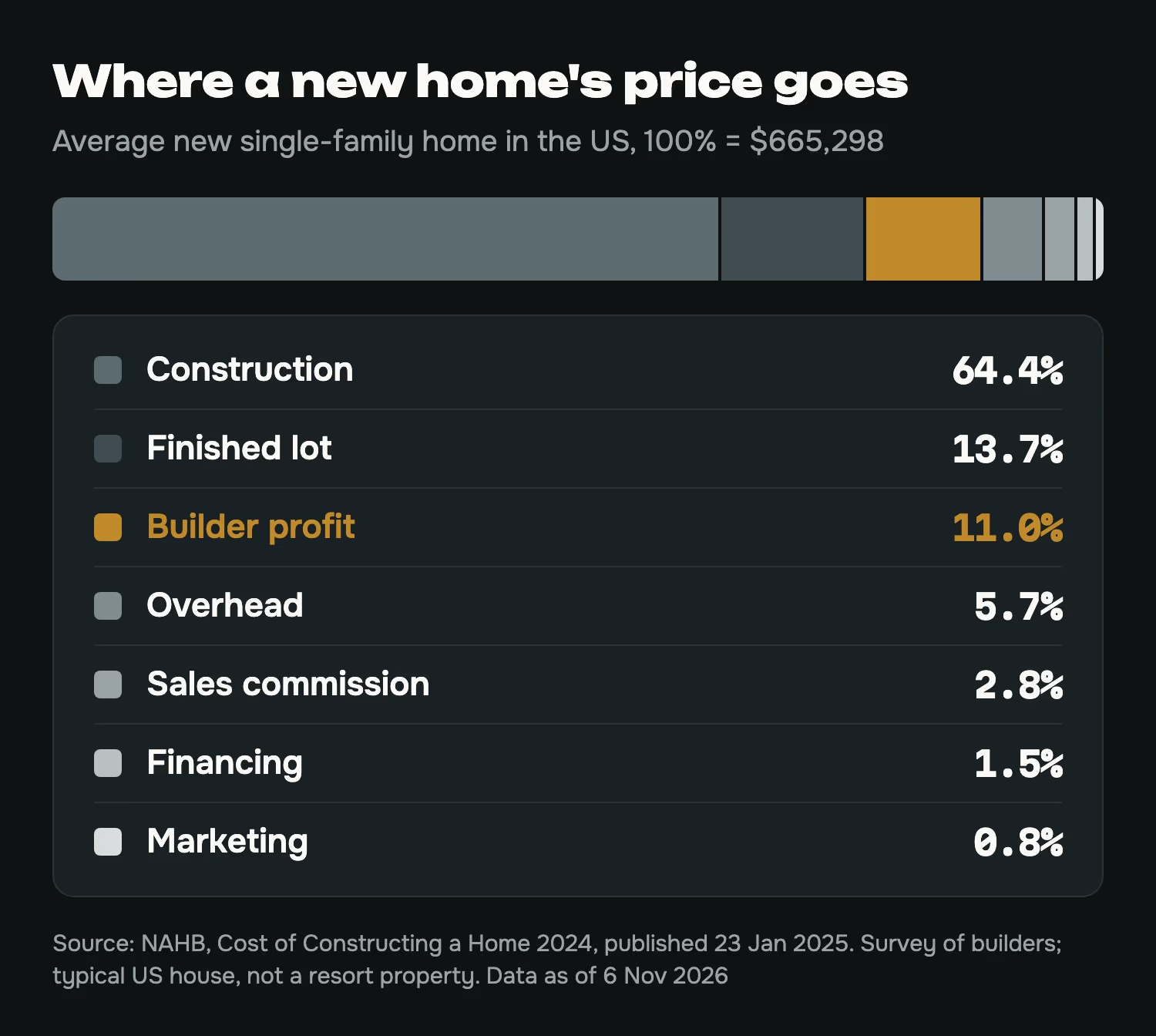
Construction itself is 64.4%. Builder profit is 11.0% of the price. Another 11% or so goes to overhead, sales commission, financing and marketing. This is a typical NAHB home: not a resort hotel and not Bali, but the structure is clear.
How big a developer’s margin is
There is no single number, because the base differs by source. Each fact below comes with its base and date.
| Where and what is measured | Profit | Source |
|---|---|---|
| US: builder profit as a share of the price of a new home | 11.0% | NAHB |
| UK: developers’ required profit on the value of the finished scheme; for housing, 20–25% on cost | 15–20% | RICS |
| Russia: developers’ EBITDA margin for 2025, not a markup on cost | ≈ 20% | Expert RA |
| Bali: no open comparison of budget and sale price on real projects | — | — |
Sources: NAHB, 23 Jan 2025; RICS Land Journal, 12 Mar 2020, survey from 2019; Expert RA, 13 Aug 2026.
Do not add these up and call the result “the average margin in the world”. One is measured on price, another on cost, a third on earnings before interest, tax and depreciation. The safe reading is that developer profit is 11 to 20% of the price, depending on the market and the base, and it is collected on the day of sale. Who stands behind the developer in the line for the money is in the queue for the investor’s money.
How much it costs to build a villa in Bali
There is no universal price per square metre. Agencies and contractors quote different ranges: $500 to $1,500 per m² (Cekindo, August 2024; Own Property Abroad, May 2026). One contractor removed its ranges from its page in 2026 because they could not be backed by measured quantities and tenders.
The spread is easy to explain: some count a bare shell, others add the pool, furniture and taxes. So the honest answer to “how much does it cost to build” is a budget for a specific project and a list of what it includes. The investor sees Nord Nest’s cost before entering.
What entering at cost means
In Nord Nest the investor buys a share of the hotel at construction cost. The developer’s margin is not built into the entry price. How you can check it:
- costs are confirmed by invoices and receipts, and the cost is disclosed before you enter;
- a report arrives every month from the first month of construction: costs, cost structure, progress;
- GRC covers any overrun, and the investor’s share is not diluted.
How to check a developer itself is in how to vet a developer in Bali. The terms in order are on the finance page.
What a markup would do to 18.7%
This is an example on the GRC model, not a forecast. Take the model’s income per share, $35,545 a year at 80% villa occupancy and a $185 average rate (assumptions as of August 2026), and assume it does not depend on the entry price: the hotel earns it. Only what the investor paid changes. The markups come from the UK survey as an order of magnitude, not as an estimate for Bali.
| Markup added to $190,000 | Share price | Yield per year | Payback |
|---|---|---|---|
| 0% (GRC terms) | $190,000 | 18.7% | 5.3 years |
| +10% | $209,000 | 17.0% | 5.9 years |
| +20% | $228,000 | 15.6% | 6.4 years |
| +25% | $237,500 | 15.0% | 6.7 years |
Every +10% on the price costs about 1.4–1.7 percentage points of yearly yield and roughly half a year of payback. The model is a calculation with assumptions, and real results can differ: at 50% villa occupancy it gives about 12.5% a year. Nobody has openly measured developers’ margins in Bali, so the table is arithmetic only.
How GRC makes money
GRC holds 30% of the project company. The other 70% of operating profit is split between seven holders of 10% shares. Its income comes from the same hotel profit as the other holders’.
The deal has limits. There is a 2-year lock-up from signing. The land is not owned but held under a lease: 25 years plus a 1-year extension. Income is not guaranteed, and entry is $190,000 for a 10% share; the terms are on the investor page.
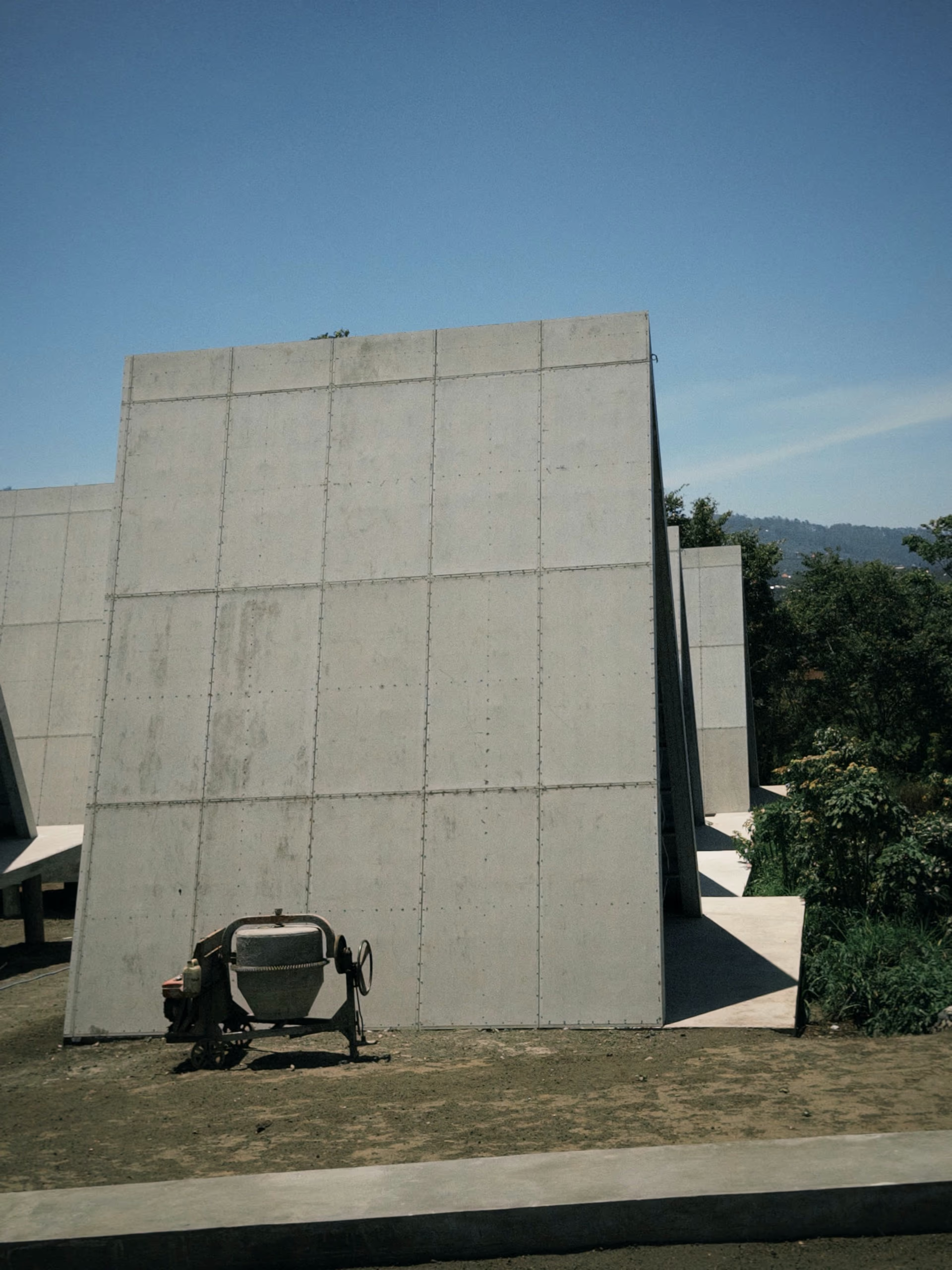
This is the third part of a series on how the model took shape. Part one, Boutique hotel vs villa: how to invest in a Bali hotel, explains the format. Part two, Best area to invest in Bali: remoteness isn’t protection, explains the place. This one is about the entry price. The project itself is Nord Nest.
Frequently asked questions
What is developer margin?
It is the profit a developer builds into a property’s price on top of its costs. The buyer is usually shown the final price without a breakdown.
How big is developer margin?
It depends on the market and on what it is measured against. In the US, builder profit is 11% of a new home’s price (NAHB, 2025). In the UK, developers require 15–20% of the value of the finished scheme (RICS, 2020). For Bali there are no open measurements.
What does “at cost” mean in Nord Nest?
A share in the hotel at construction cost, with the developer’s margin not built into the entry price. Costs are confirmed by invoices and receipts, and a report arrives monthly.
Who pays if the budget grows?
GRC covers the overrun. The investor’s share is not diluted.
How much does it cost to build a villa in Bali?
There is no universal figure: sources quote $500 to $1,500 per m², depending on finish, pool and taxes. It has to be priced per project.